All species › Caryophyllales › Sundew family › Drosera neocaledonica
Drosera neocaledonica
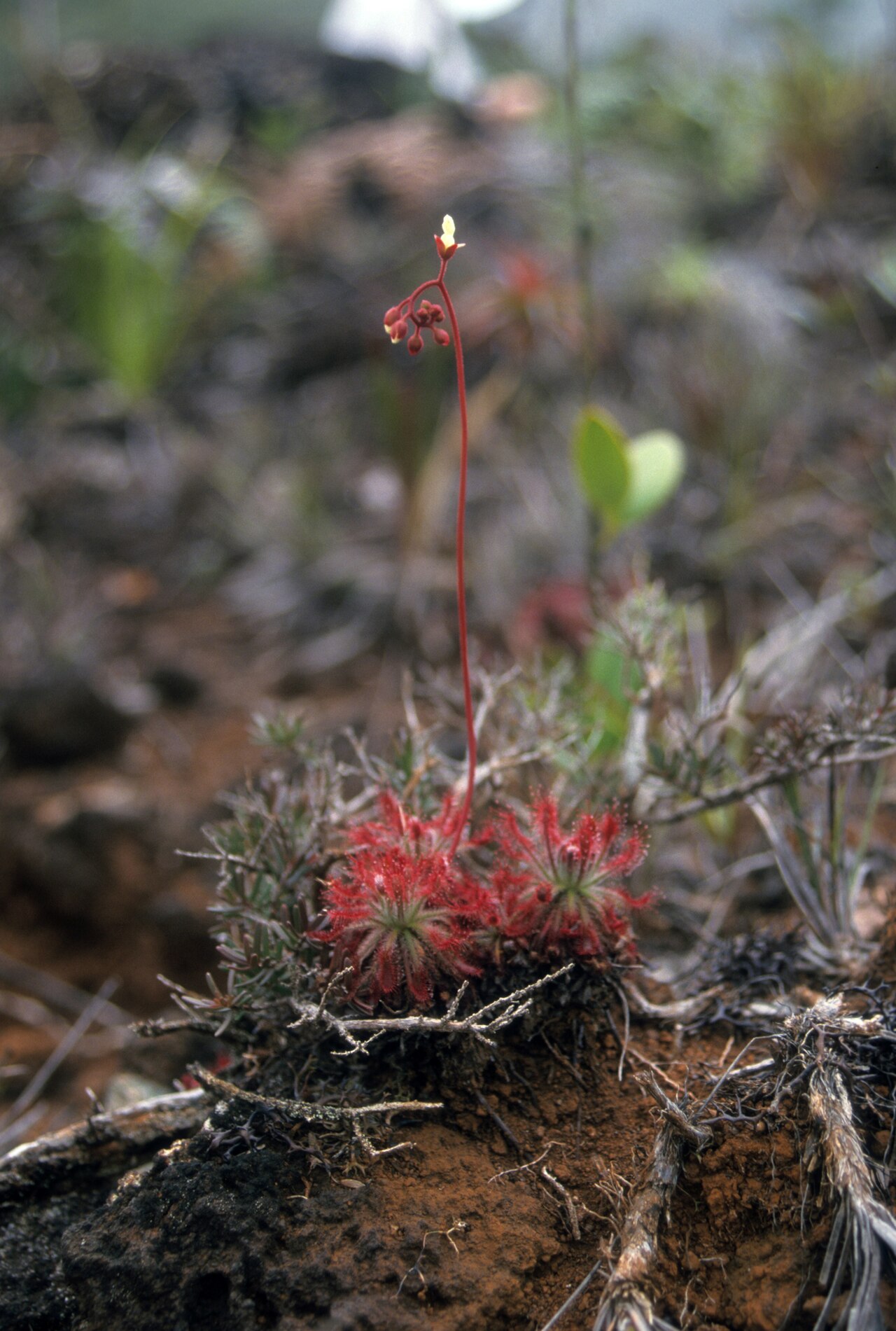
The only sundew of New Caledonia, and a plant that belongs to the landscape there as much as the red, iron-rich earth of the southern massif. Drosera neocaledonica was described in 1906 by the French botanist Raymond-Hamet and grows almost exclusively on ultramafic rock, in open scrub and small marshes in the south of Grande Terre. Strikingly, in cultivation the plant thrives without that heavy, metal-rich soil too: its tie to ultramafic ground seems a matter of competition rather than necessity.
Identification
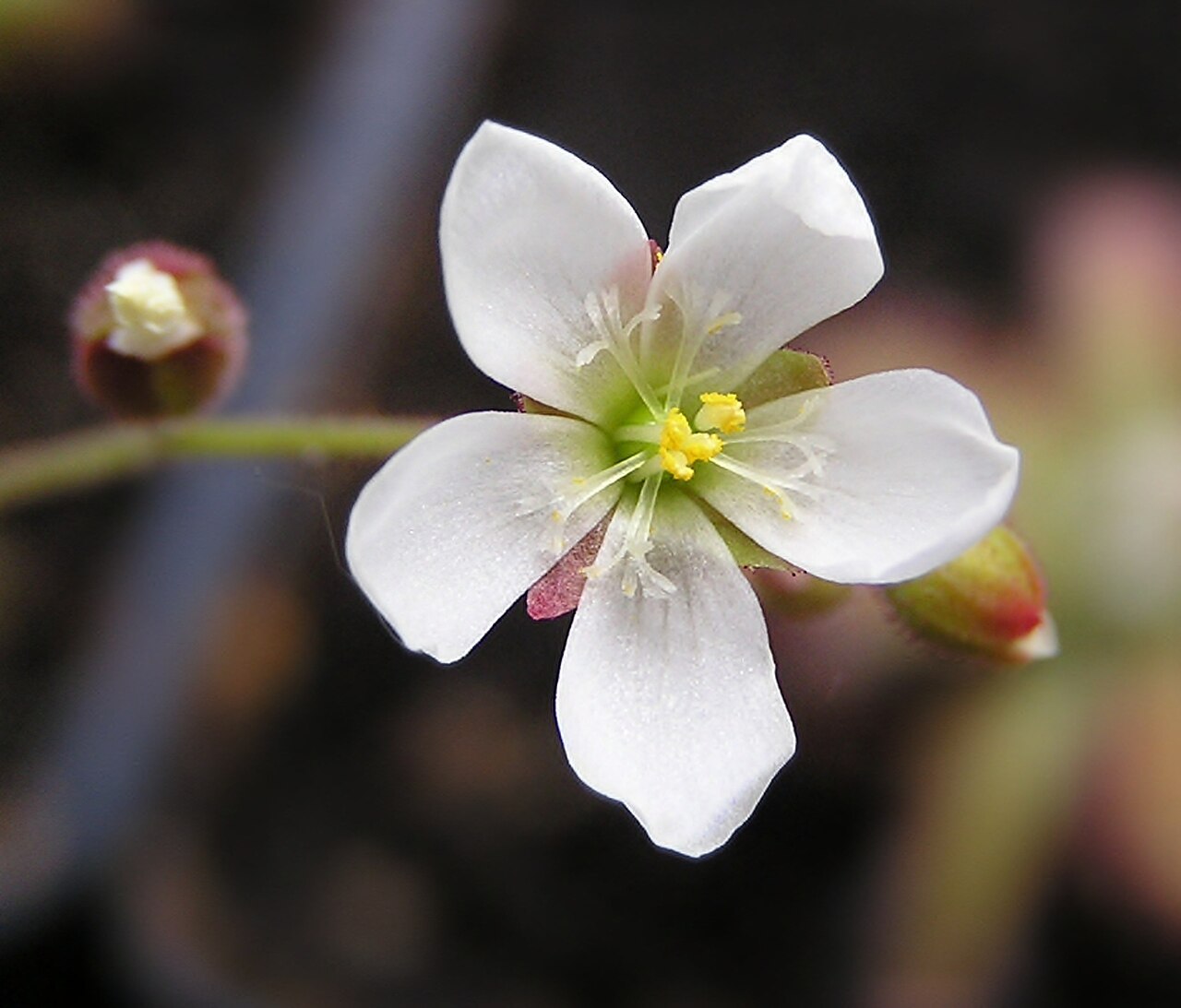
A perennial rosette sitting on a short stem, with semi-erect leaves. The blade is narrowly spatulate to oblong and covered in tentacles; the petiole carries conspicuous white bristly hairs, a good character. The flowers are large for a sundew of this size, about 2 cm across, with cuneate to obovate petals about 10 by 4 to 5 mm. The seeds are ellipsoid and finely patterned. Flower colour is not given in the source consulted and has therefore not been filled in.
Similar species
There is no other sundew in New Caledonia to confuse it with. Within the genus it is related to Drosera spatulata, and according to the authors of D. ultramafica also to that species and to D. oblanceolata from southern China. From the spatulata group D. neocaledonica differs in its stem-forming rosette, bristly-haired petioles and large flowers.
The trap and how it works
An active flypaper trap. The tentacles on the blade carry droplets of sticky mucilage; an insect that lands in them sticks and is held further by the inward-bending tentacles. The glands then secrete enzymes and absorb the released nutrients. On the extremely nutrient-poor ultramafic soils — poor in phosphorus and potassium, rich in nickel and magnesium — this is an essential supplement to what the roots can take up.
Habitat and ecology
Mainly ultramafic soils (R4) in open vegetation: the low, hard scrub known in New Caledonia as maquis minier (B5), and wet, open small marshes and seepages on the same rock (W4). It grows less often in forest. The altitudinal range runs from about 50 to 1280 m. In nature the tie to ultramafic rock is almost complete.
Distribution and elevation
Endemic to New Caledonia, and there confined to the southern ultramafic massif of Grande Terre, from Port-Boisé in the south north to about Dogny. The altitudinal range is 50 to 1280 m.
- Recorded (one-degree cells)
Forms and variation
No varieties are recognised. Some older names, including Drosera caledonica and the never validly published D. rubiginosa, are treated as synonyms. Plants in full sun are redder and more compact than those in partial shade.
Where and when to see it
The southern massif is easily reached from Nouméa, and the red plains and scrublands south and east of the city partly lie in nature parks with walking trails. Search wet, open spots in the maquis and along streams on red ground. Keep to the paths: the maquis recovers extremely slowly from damage.
Conservation status
The species is listed as Least Concern (LC) on the global IUCN Red List and is not in CITES. Its range is small, but within the southern massif it is not rare in suitable places. The ultramafic areas of New Caledonia are, however, under heavy pressure from nickel mining and from fires, which have damaged large parts of the maquis; conservation of the species goes hand in hand with conservation of that landscape.
Scientific name
Drosera neocaledonica | Hamet, 1906
Drosera neocaledonica was described in 1906 by the French botanist Raymond-Hamet, in Bulletin de la Société Botanique de France, volume 53, pp. 151–152. The species is endemic to New Caledonia and occurs on Grande Terre. The precise type locality, collector and collection date could not be established with certainty. The name is a toponym, composed of Greek/Latin "neo-" ("new") and "caledonica" ("of Caledonia"), thus meaning "of New Caledonia" — referring to the archipelago to which the species is endemic.
World Checklist of Vascular Plants (WCVP), via Plants of the World Online (POWO), Royal Botanic Gardens, Kew.