All species › Caryophyllales › Sundew family › Drosera paleacea
Drosera paleacea
One of the first pygmy sundews to be described: Augustin Pyramus de Candolle named Drosera paleacea in 1824. In Western Australia it is called Dwarf Sundew. The name means 'chaffy' and refers to the papery stipules at the heart of the rosette, the hallmark of the whole group. The species was long broadly conceived; in the current, narrower delimitation it is a rare plant of the extreme south-west.


Identification
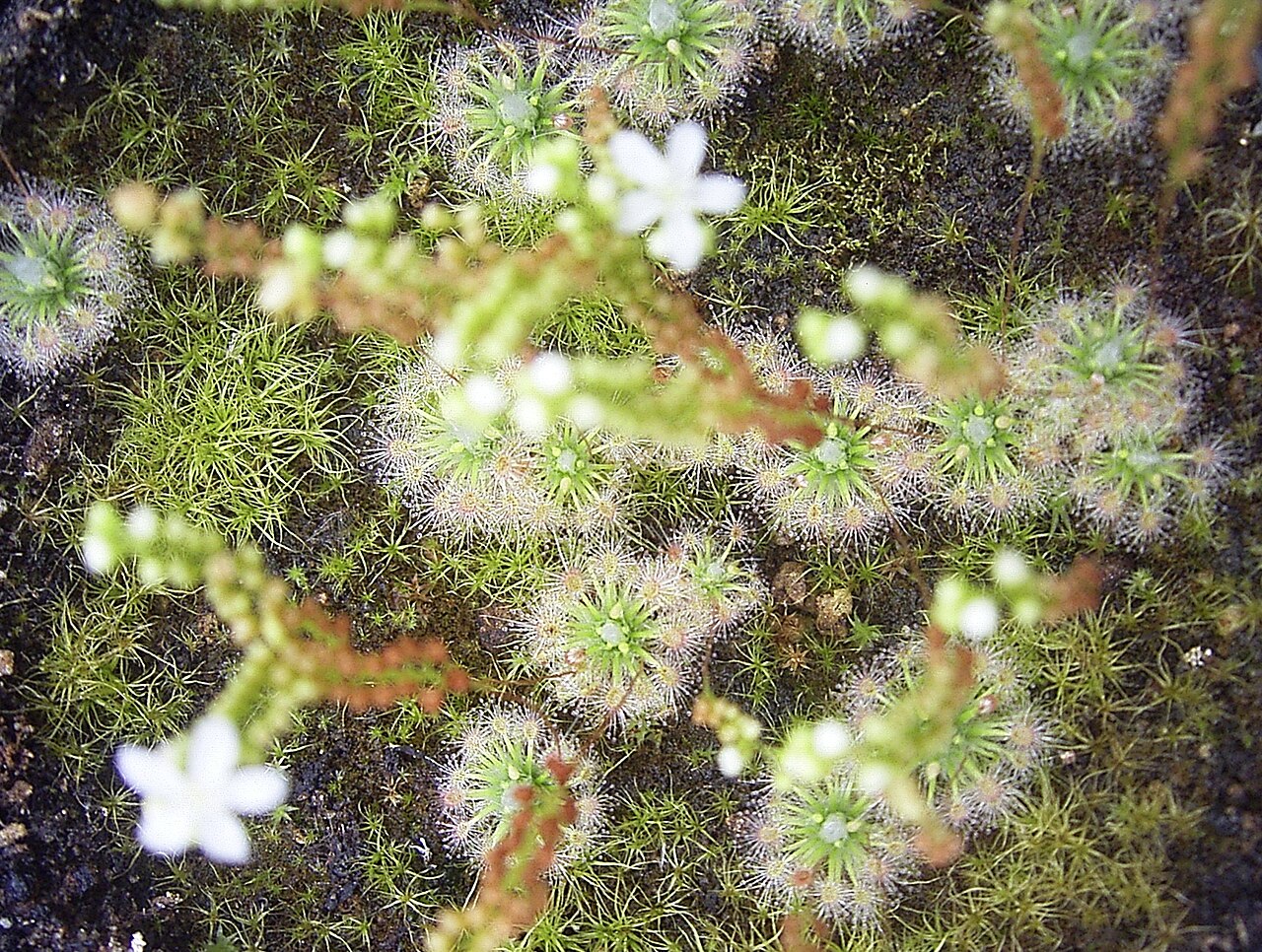
A minute, fibrous-rooted, perennial rosette at most 1.5 cm across and 3 cm tall. At the heart of the rosette stands a tuft of shining stipules. The flowers are white to cream and appear from September to December, sometimes into January. We did not find precise leaf and flower measurements in any source consulted.
Similar species
There are several small, white-flowered pygmy sundews in the south-west, including Drosera occidentalis and D. pygmaea. Because D. paleacea used to be more broadly conceived, older records under this name are not automatically reliable: some of the plants formerly included are now treated as separate species. A hand lens, a flowering plant and the key in Lowrie (2013) are needed.
The trap and how it works
An active flypaper trap in miniature. The leaf blades carry stalked glands with a sticky droplet; the long marginal tentacles catch the prey and bend it to the centre of the leaf, where shorter glands take over digestion. The prey consists of springtails, mites and the smallest flies.
Habitat and ecology
White sand and sandy clay (D1, W7), in open places that are moist in winter. The plant grows in the wet months, flowers in spring and early summer and rests in the driest period, withdrawn into its stipules.
Distribution and elevation
Endemic to south-west Australia. FloraBase records the species in its current sense only for the Warren bioregion, the cool, wet extreme south-west between Augusta and Walpole. Older sources give a much larger range, reflecting the former, broader delimitation of the species.
- Recorded (quarter-degree cells)
Forms and variation
In the current concept no subspecies are recognised. Forms formerly placed as subspecies under D. paleacea have, as far as we could establish, been split off as species; exactly which we could not check in the primary literature. Like most pygmy sundews the plant forms gemmae.
Where and when to see it
Search from October to December in open patches of white sand in the extreme south-west, in sunny weather, since the flowers open only in sun. A rosette a centimetre and a half across can only be found on your knees. Because the species is regarded in Western Australia as poorly known and rare, a well-documented record is valuable; report it rather than publicising the site.
Conservation status
On the global IUCN Red List the species is listed as Near Threatened (NT). In Western Australia it is listed as Priority One among poorly known flora, suggesting that in its current delimitation it is known from few sites. It is not listed in CITES. Uncertainty: we could not explain from the primary literature the difference between the broad older range and the restriction to the Warren bioregion in FloraBase.
Scientific name
Drosera paleacea | de Candolle, 1824
Drosera paleacea was described in 1824 by the Swiss botanist Augustin Pyramus de Candolle, in his Prodromus Systematis Naturalis Regni Vegetabilis, volume 1, page 318 — one of the earliest-described "pygmy sundew" species. The species is endemic to south-western Western Australia, and the type material will have come from there. However, the precise locality, collector and collection date of the original type material could not be established with certainty. The epithet paleacea comes from the Latin palea ("chaff, scale") with the suffix -aceus, meaning "chaffy" or "having small scale-like structures." It is a descriptive name, referring to the small, scale-like hairs or stipules of the plant.
World Checklist of Vascular Plants (WCVP), via Plants of the World Online (POWO), Royal Botanic Gardens, Kew.