All species › Caryophyllales › Sundew family › Drosera zonaria
Drosera zonaria
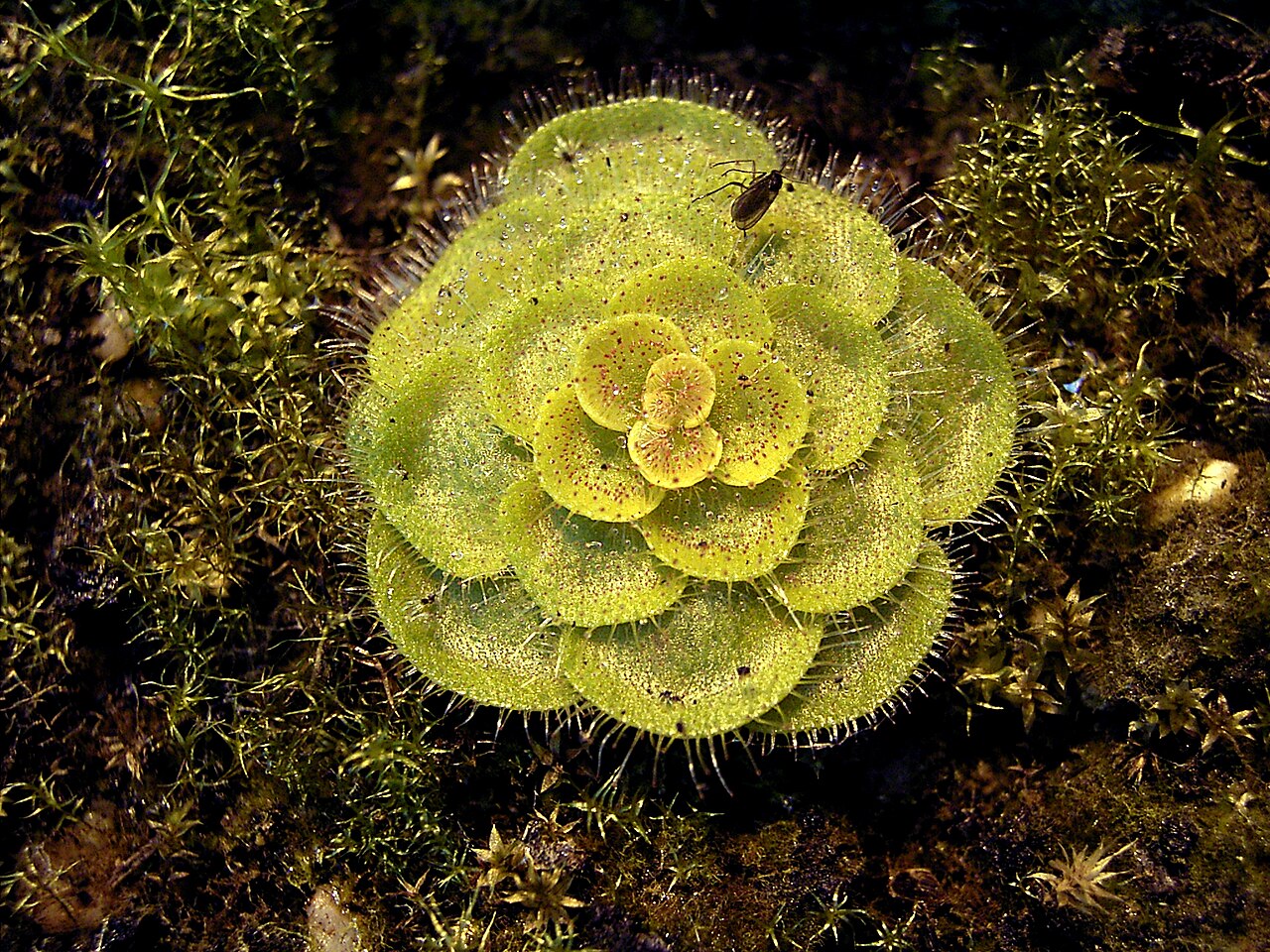
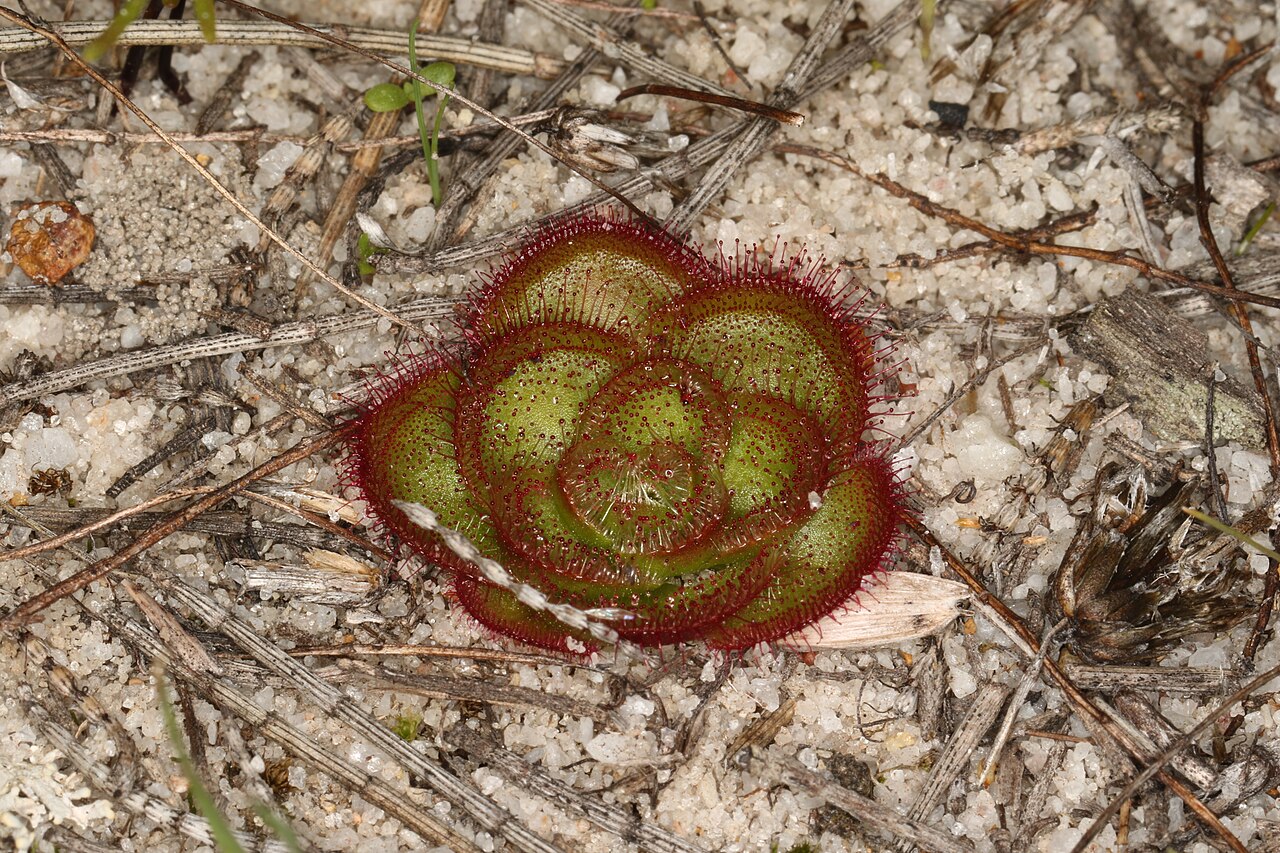
An enigmatic rosetted sundew of south-west Australia. Drosera zonaria forms a tight rosette of kidney-shaped leaves in concentric rings, each with a crimson margin — hence the name, 'zoned'. But it flowers almost only after a bushfire, so rarely that its first documented flowering was recorded only in 1954, more than a century after its description.

Identification
A tight, flat rosette 5 to 7 cm across with 20 to 30 green to red leaves arranged in concentric layers. The leaves are kidney-shaped, typically about 1 cm wide, with crimson margins. After fire, white, sweetly scented flowers appear on scapes 4 to 5 cm tall. In summer everything above ground dies back and the plant retreats into a fleshy tuber lying 10 to 30 cm deep in the sand.
Similar species
Its closest relatives are Drosera erythrorhiza and D. rosulata, also tuberous rosette plants of section Erythrorhiza. The flowers resemble those of D. erythrorhiza. The best distinction in D. zonaria is the leaf rosette itself: small kidney-shaped leaves in tight concentric rings with a conspicuous red margin. D. rosulata flowers regularly in autumn and grows at swamp margins, not in dry, deep sand.
The trap and how it works
An active flypaper trap held close to the ground. The rosette leaves lie flat on the soil and carry stalked glands with a sticky droplet on the upper surface and along the margin. Whatever crawls over the ground or lands briefly — ants, springtails, small beetles and midges — becomes entangled, after which the tentacles slowly bend inwards and the glands secrete digestive enzymes. Nitrogen, phosphorus and minerals from the prey are absorbed through the same leaf surface. Because the plant is in leaf for only a few months each year, that food goes straight into the tuber, which has to carry the plant through the next dry summer.
Habitat and ecology
Deep quartz sand in open woodland or coastal heath (D1, B5, B6). The tuber lies deep enough to survive hot summers and fires; after fire, once competing vegetation has been swept away, the plant flowers.
Distribution and elevation
Endemic to south-west Western Australia, from around Perth south-east to near Esperance. One observer also records it in mallee north of Ravensthorpe, together with D. pycnoblasta. Altitudinal limits are not published.
- Recorded (quarter-degree cells)
Forms and variation
Jules Émile Planchon described the species in 1848. Its status was later doubted: George Bentham questioned it in 1864, and it was omitted from the standard works of Diels and Gardner in the twentieth century. After its rediscovery near Guildford in 1952 and first documented flowering in May 1954 it was again recognised as a species. No subspecies are recognised. That flowering is triggered by fire is, according to a common hypothesis, linked to the ethylene released by burning; this has not been proven experimentally.
Where and when to see it
Without fire the rosette is all there is to see, and it is worth it: search open sand in woodland and heath in winter for the tight, red-rimmed rings against the ground. Anyone wanting to see it flower must aim for the first season after a (prescribed) burn. Never dig for the tuber: it lies deep and the plant does not survive it.
Conservation status
Assessed as Least Concern (LC) on the IUCN Red List; not listed in CITES. The species has a broad range. Because the plant depends on fire for reproduction, the fire regime is a key factor: too little fire means no flowers and no seed, while ordinary clearing pressure around Perth shrinks its habitat.
Scientific name
Drosera zonaria | Planchon, 1836
Drosera zonaria was described in 1848 by the French botanist Jules Émile Planchon, published in Annales des Sciences Naturelles, Botanique, series 3, volume 9, page 303. The species was first collected near the Swan River Colony (southwestern Australia) by the botanist James Drummond; however, the specimens Drummond collected were only two barren rosettes without flowers, which caused taxonomic confusion for over a century. An exact collection date could not be established. The name zonaria is derived from the Latin/Greek "zona" (belt, band, zone) and likely refers to the banded or zoned colour patterns on the leaves — the plant is known as the "painted sundew" for its crimson leaf margins and colouring ranging from green to red; explicit confirmation in the original description could not be located.
World Checklist of Vascular Plants (WCVP), via Plants of the World Online (POWO), Royal Botanic Gardens, Kew.