All species › Caryophyllales › Sundew family › Drosera closterostigma
Drosera closterostigma
One of the pygmy sundews that Neville Marchant and Allen Lowrie described in 1992 in their revision of this group in the Kew Bulletin. The name refers to the stigma: closter is Greek for a spindle, and the stigmas of this species are spindle-shaped. As in related species, the decisive feature is a floral detail no more than a millimetre across.

Identification
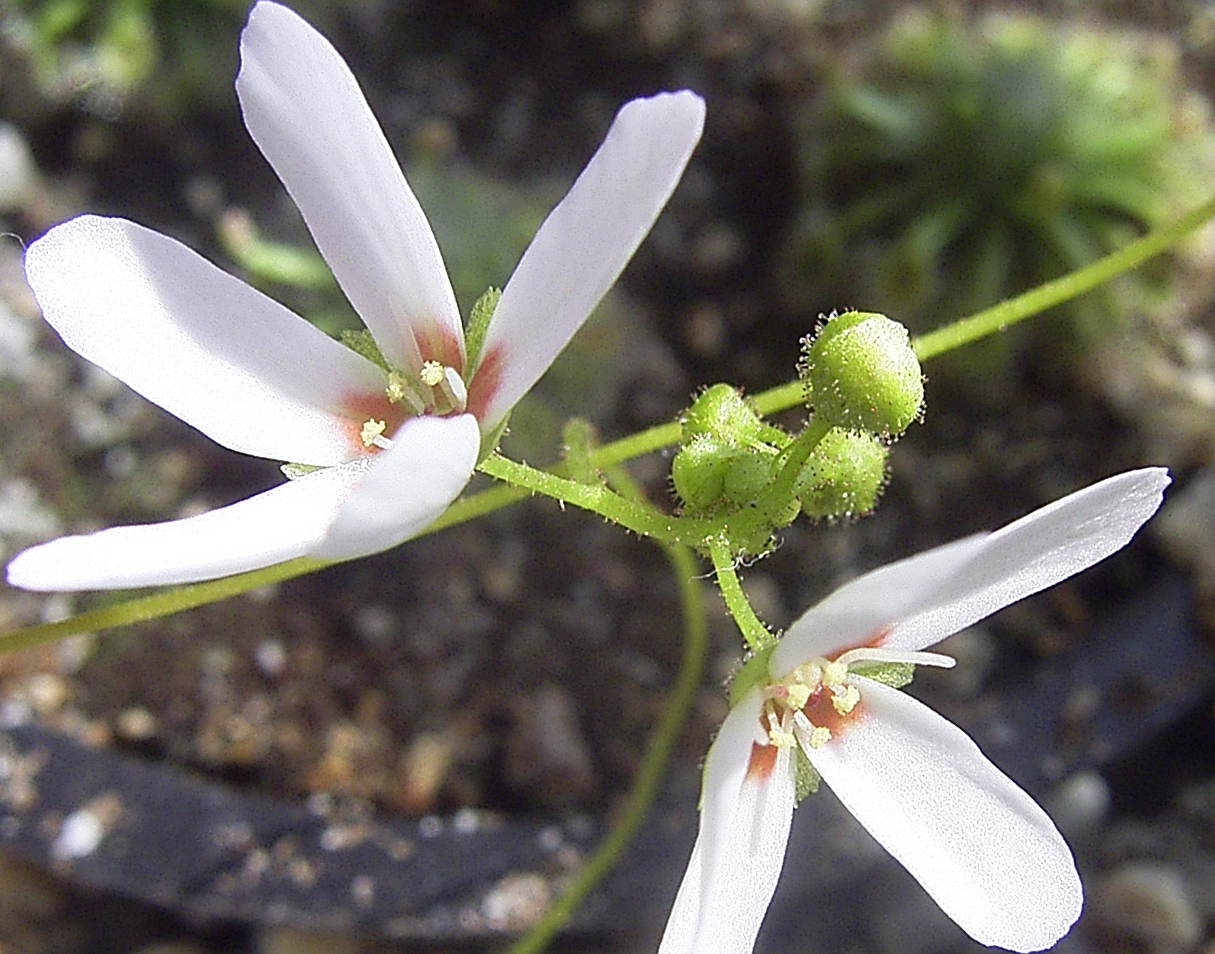
A perennial, fibrous-rooted pygmy sundew with a rosette no more than 1.8 cm across; with its flowering stem the plant reaches 4 cm. At its heart stands the cone of silvery stipules. The flowers are white to pink and appear in October and November. The diagnostic feature is the shape of the stigmas, which are spindle-shaped rather than club- or cushion-shaped. Precise leaf measurements could not be found in the accessible sources.
Similar species
Several white- or pink-flowered pygmy sundews with similar rosettes grow on the northern sandplains and the coastal plain, including Drosera eneabba, Drosera enodes and Drosera dichrosepala. The distinction lies mainly in stigma shape, stipules and calyx, and can hardly be made without a lens and a flower. The habitat, at the margins of wet depressions, helps narrow the search area.
The trap and how it works
An active flypaper trap. The leaves bear stalked glands with a sticky droplet; small animals of the wet sandy ground, especially springtails and gnats, stick to them. The tentacles then bend towards the prey and digestive enzymes are secreted. In pygmy sundews the long marginal tentacles often react within minutes.
Habitat and ecology
Sandy soils at the margins of wet depressions (FloraBase): the zone around seasonal swamps that is waterlogged in winter and dries out in late spring (W7, D1). That late drying fits the flowering in October and November. In summer the plant rests as a bud of stipules.
Distribution and elevation
Endemic to the south-west of Western Australia. FloraBase lists the Geraldton Sandplains, Jarrah Forest and Swan Coastal Plain bioregions.
- Recorded (one-degree cells)
Forms and variation
No subspecies or varieties have been described. Like all pygmy sundews, the species forms gemmae at the heart of the rosette in late autumn; they are dispersed by raindrops and grow into genetically identical plants.
Where and when to see it
Search in October and early November at the edges of wet depressions on the sandplains, on the transition from wet to dry sand. Kneel and use a hand lens; only then are the spindle-shaped stigmas visible. Photograph the flower from directly above for later comparison.
Conservation status
Assessed as Least Concern (LC) on the IUCN Red List and listed as not threatened in Western Australia. Not in CITES. Seasonal wetlands in the south-west are under pressure from drainage and falling groundwater, but the species' range is relatively large.
Scientific name
Drosera closterostigma | Marchant & Lowrie, 1992
Described by N.G. Marchant & Lowrie, in Kew Bulletin, volume 47, no. 2, p. 322 (29 June 1992). The precise type locality could not be established. The species occurs in Western Australia. From the Greek klostēr ("spindle") and stigma — "spindle-shaped stigma", referring to the shape of the stigmas, which distinguishes this species from related ones.
World Checklist of Vascular Plants (WCVP), via Plants of the World Online (POWO), Royal Botanic Gardens, Kew.