All species › Caryophyllales › Sundew family › Drosera leucoblasta
Drosera leucoblasta
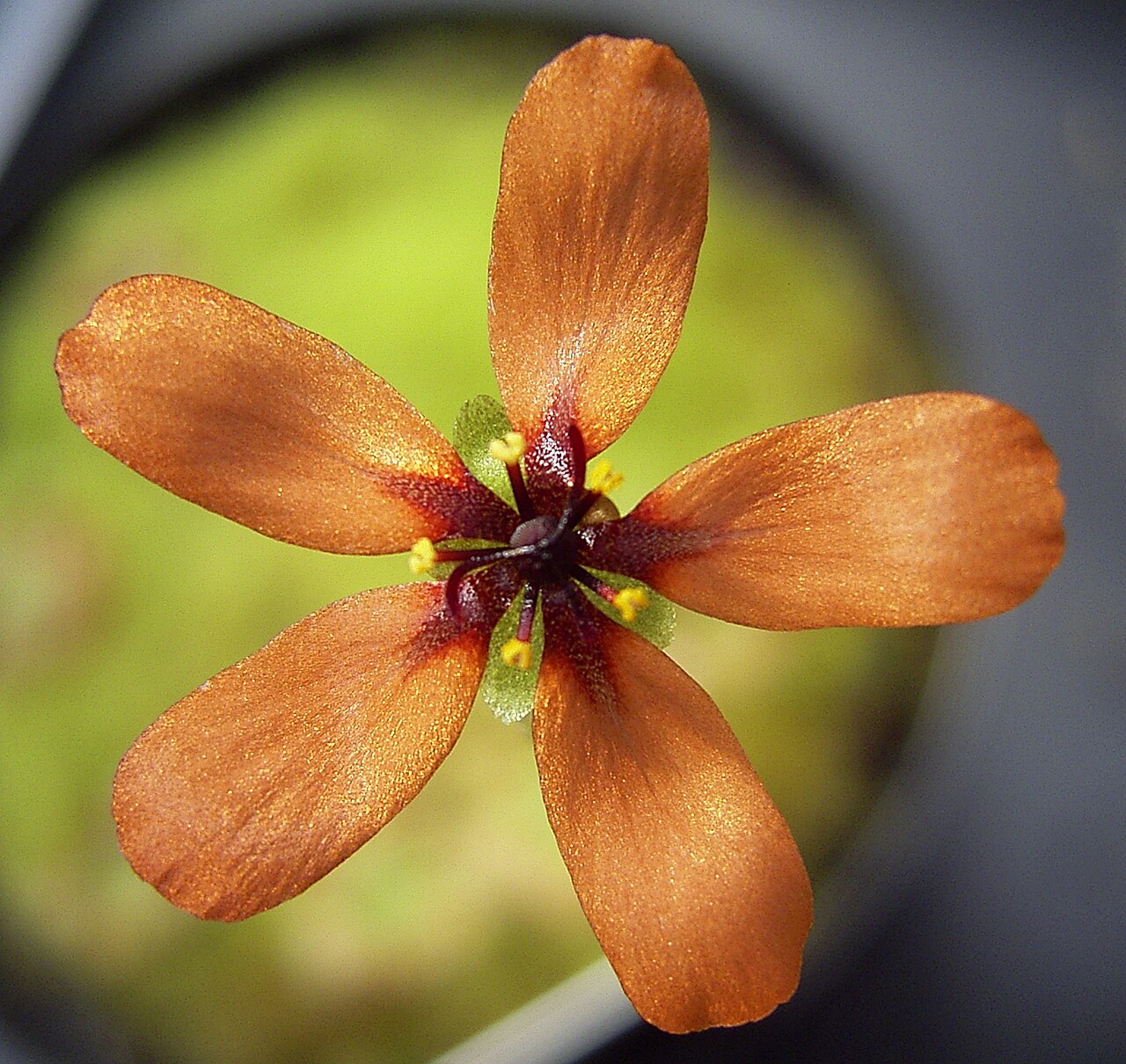
The best known and most widespread of the orange-flowered pygmy sundews, called Wheel Sundew in Western Australia. The flower is large for so small a plant and in many forms has a dark, star-shaped centre. George Bentham described Drosera leucoblasta as early as 1864 in his Flora Australiensis; the name is Greek for 'white bud', probably a reference to the white stipules at the heart of the rosette.
Identification
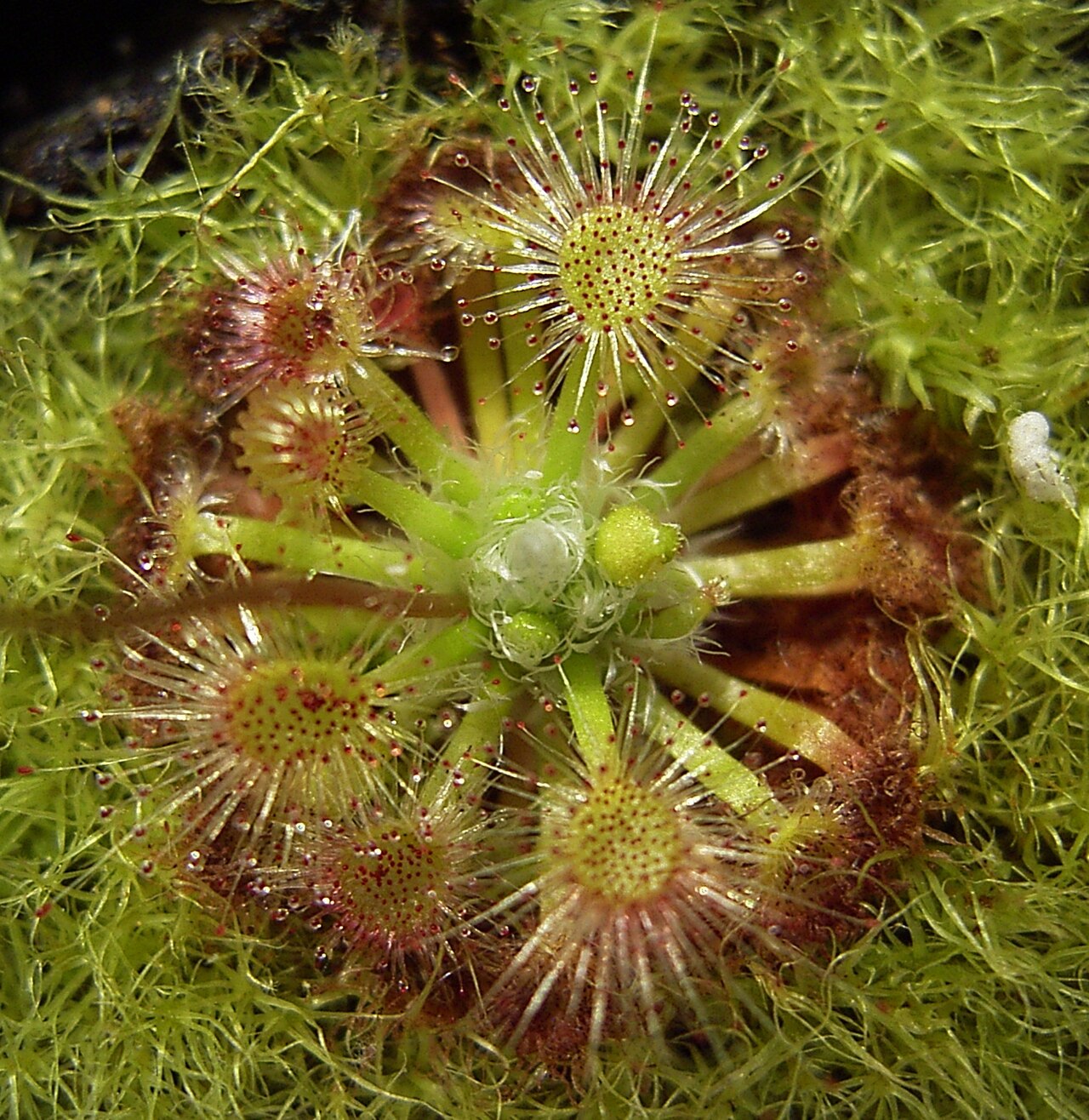
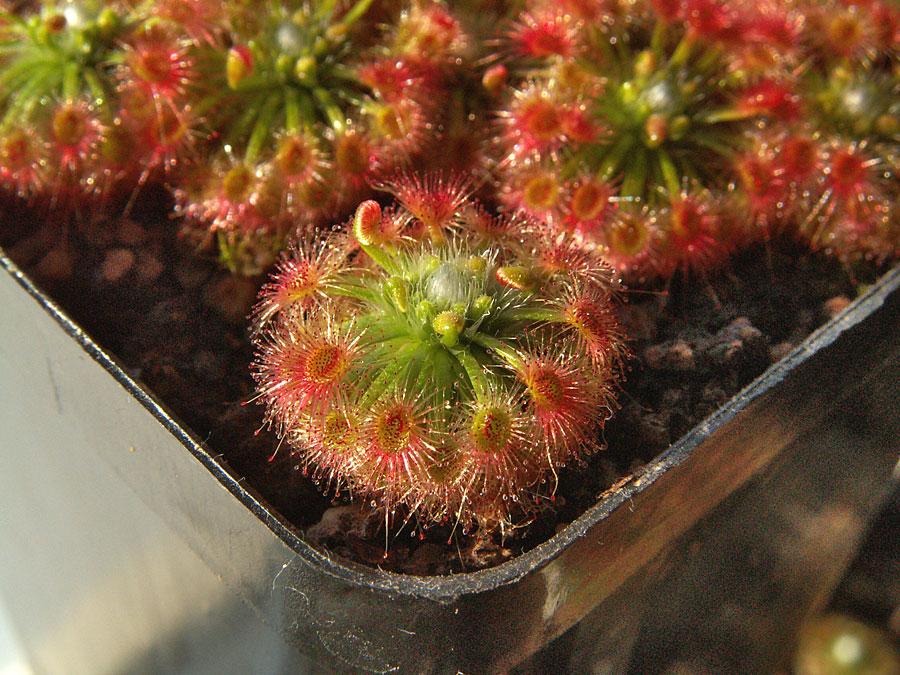
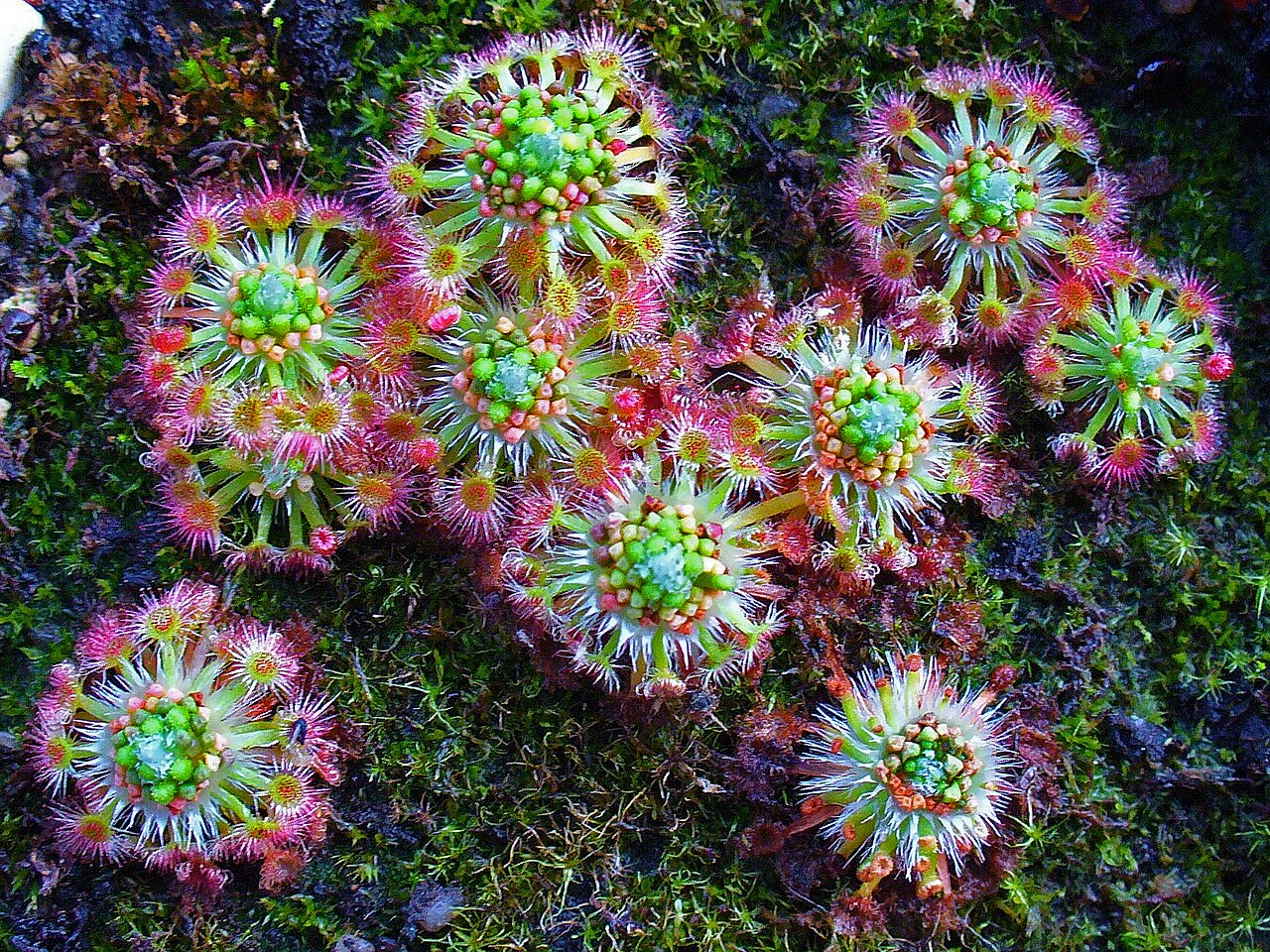
A flat, fibrous-rooted rosette about 2 cm across; in flower the plant reaches 3 to 12 cm tall. The flowers are strikingly large for such a small plant, about 2 cm across, usually orange, sometimes white-pink or red. The petals are narrow and straight with rounded tips. Many forms have a red to black marking at the centre forming a star; the filaments are red to black, the stigmas thickened and light orange to black, the ovary green to black. Flowering from August to November.
Similar species
Drosera echinoblastus is almost identical but has green filaments and lacks the dark pigmentation; moreover the ranges do not overlap. D. callistos has broader petals. D. hyperostigma and D. platystigma have broad, wedge-shaped petals and egg-shaped stigmas. A hand lens and a look at the colour of filaments and stigmas settle most doubtful cases.
The trap and how it works
An active flypaper trap in miniature. The leaf blades carry stalked glands with a sticky droplet; the long marginal tentacles catch the prey and bend to the centre of the leaf. The catch consists of springtails, mites and the smallest flies of the open laterite ground.
Habitat and ecology
Lateritic clay and accumulations of laterite or sandy gravel, often among low heath (D3, B5, D1). The plant grows through the wet winter, flowers in spring and rests in summer, withdrawn to a bud within the white stipules.
Distribution and elevation
Endemic to south-west Australia, in a broad band across the Darling Scarp, through the Wheatbelt and along the south coast near Albany to the Esperance district. FloraBase lists the Avon Wheatbelt, Esperance Plains, Geraldton Sandplains, Jarrah Forest and Mallee bioregions.
- Recorded (quarter-degree cells)
Forms and variation
No subspecies or varieties have been formally described, but the species is visibly variable in the colour of the flower centre, filaments and stigmas, and in flower colour itself. Like most pygmy sundews it forms gemmae at the end of the growing season that are flung away by raindrops.
Where and when to see it
From mid-September to mid-October, on a sunny afternoon, the large orange flowers are impossible to miss on open laterite. Kneel to look at the star-shaped marking and the colour of the filaments; that is the key to the name. The plant is a good introduction to pygmy sundews: common, large-flowered and found over a wide area.
Conservation status
On the global IUCN Red List the species is listed as Least Concern (LC); in Western Australia it is regarded as not threatened. It is not listed in CITES. Thanks to its large range the species as a whole is not in danger, although many Wheatbelt sites are confined to road verges and small bushland remnants.
Scientific name
Drosera leucoblasta | Bentham, 1864
Described by George Bentham in 1864, in "Flora Australiensis", volume 2, p. 458. Drosera miniata Diels is a synonym of this species. Only "Australia" is stated, without a more precise locality. From the Greek leukos ("white") and blastos ("shoot, bud") — "white-shoot/bud", probably referring to pale new growth or flower buds.
World Checklist of Vascular Plants (WCVP), via Plants of the World Online (POWO), Royal Botanic Gardens, Kew.