All species › Caryophyllales › Sundew family › Drosera scorpioides
Drosera scorpioides
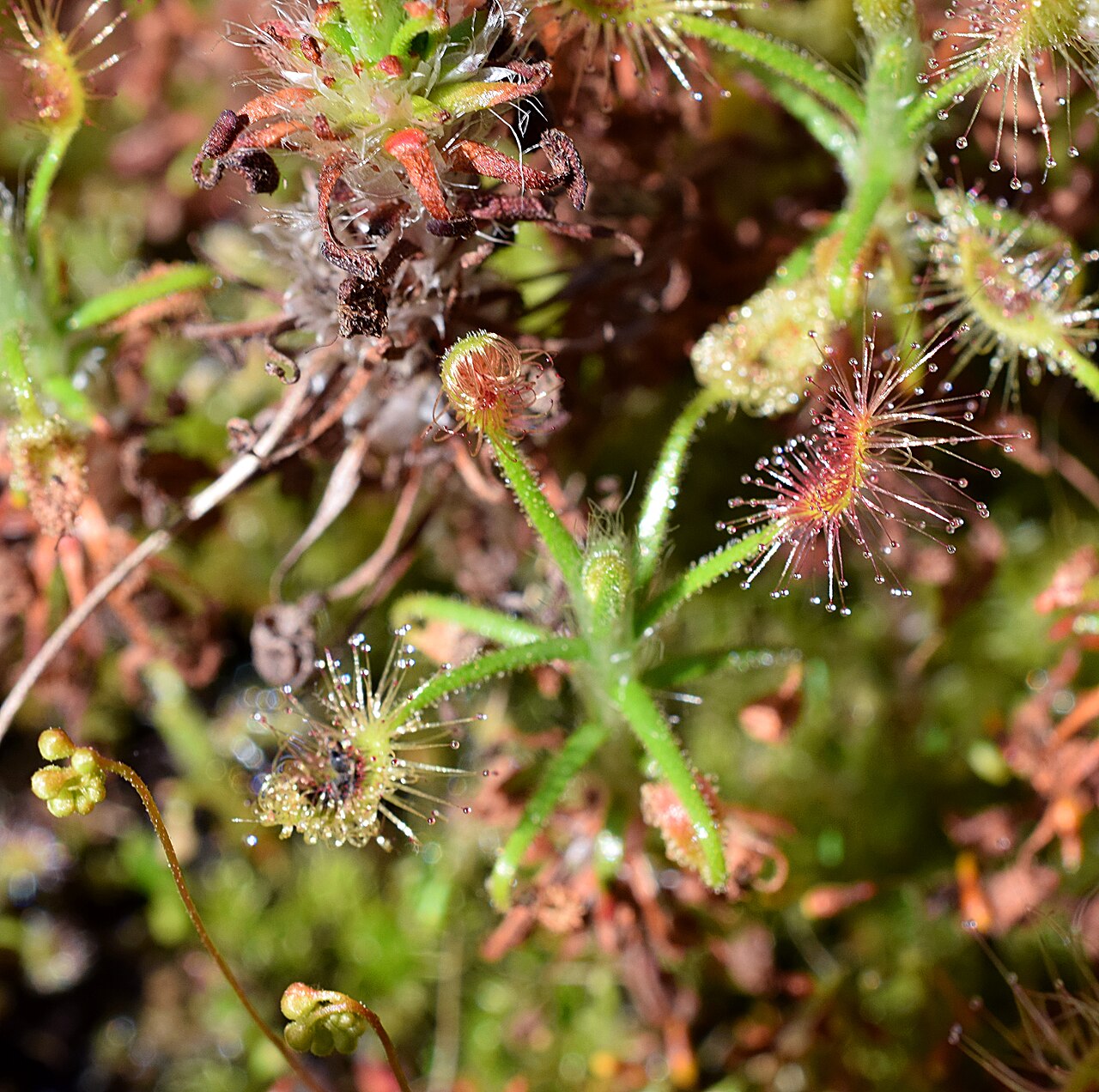
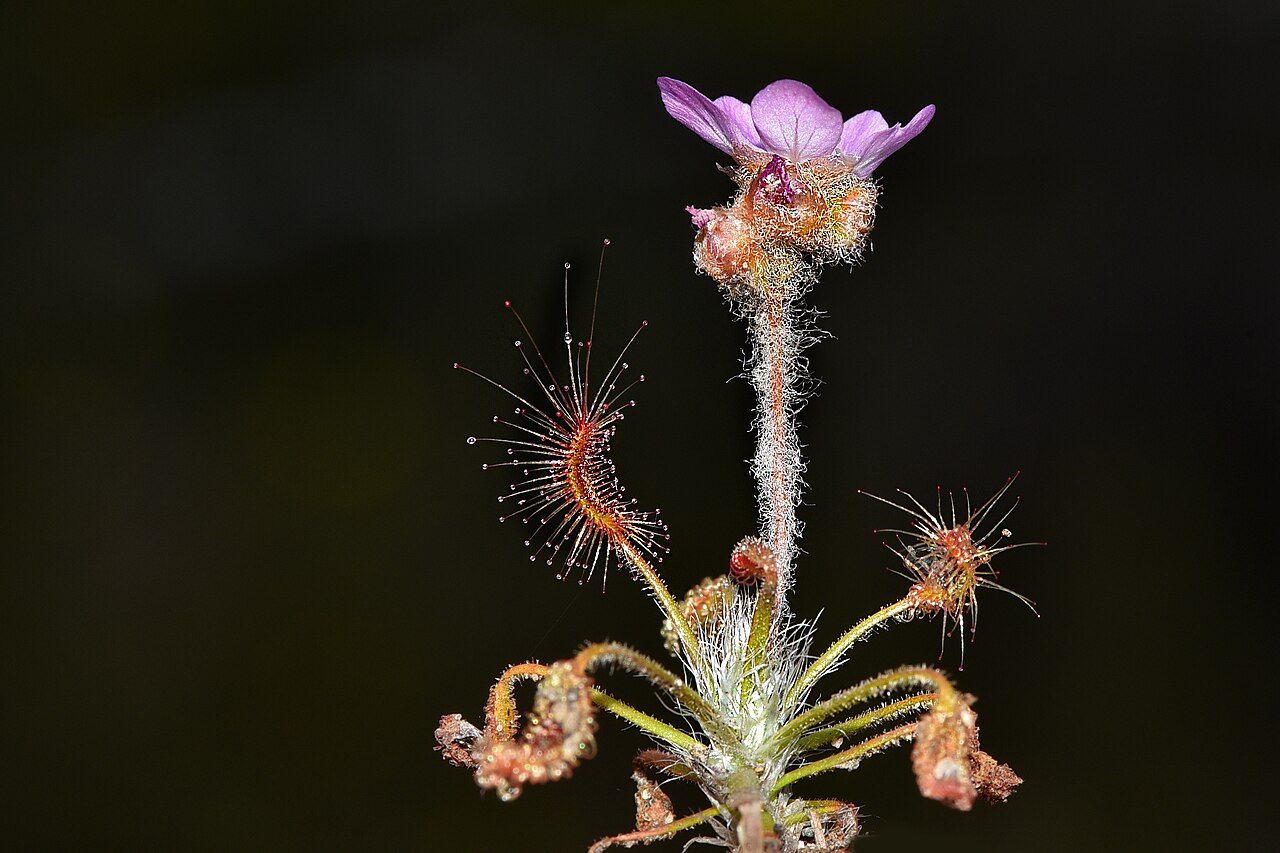
A giant among dwarfs. Drosera scorpioides belongs to the pygmy sundews of south-west Australia but grows unusually large for the group: rosettes up to about five centimetres across on a small stem that over the years can reach a decimetre. It grows in jarrah forest and along the south coast.
Identification
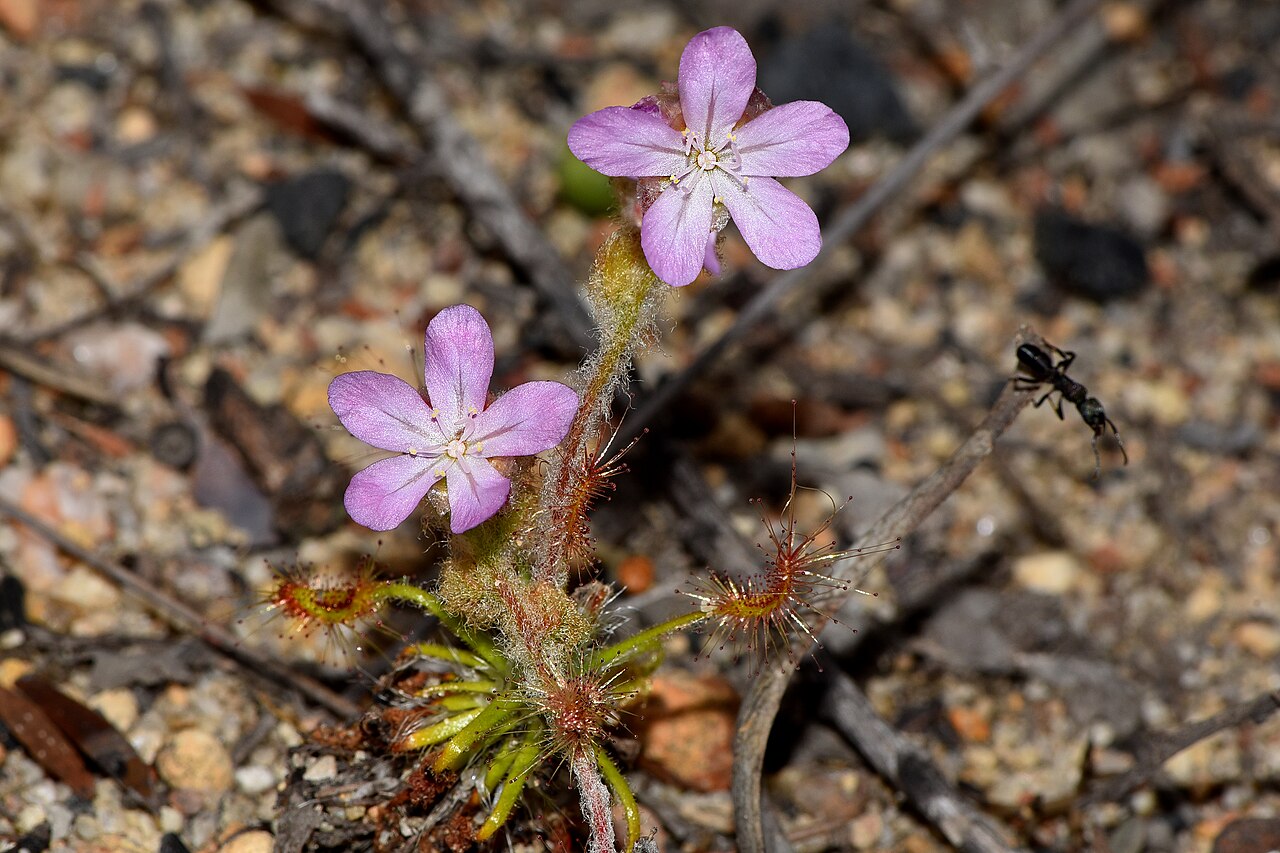
A pygmy sundew with a rosette up to about 5 cm across that over the years comes to stand on an ascending stem; older plants can thus reach about 10 cm. Depending on the form, the species can live up to seven years — long for a pygmy sundew. The flowers are pink and white and appear between August and October. The epithet means 'scorpion-like', presumably after the coiled inflorescence or the curved stem. Exact leaf and flower measurements are not published in the sources consulted.
Similar species
Its size and stem make D. scorpioides easy to recognise among the pygmies. Other 'tall' pygmy species exist, and the hardest confusions arise with young plants that have not yet formed a stem; these resemble numerous other pink- or white-flowered pygmies. Look then at the size of the rosette and the stipule bud, and at older plants in the same population.
The trap and how it works
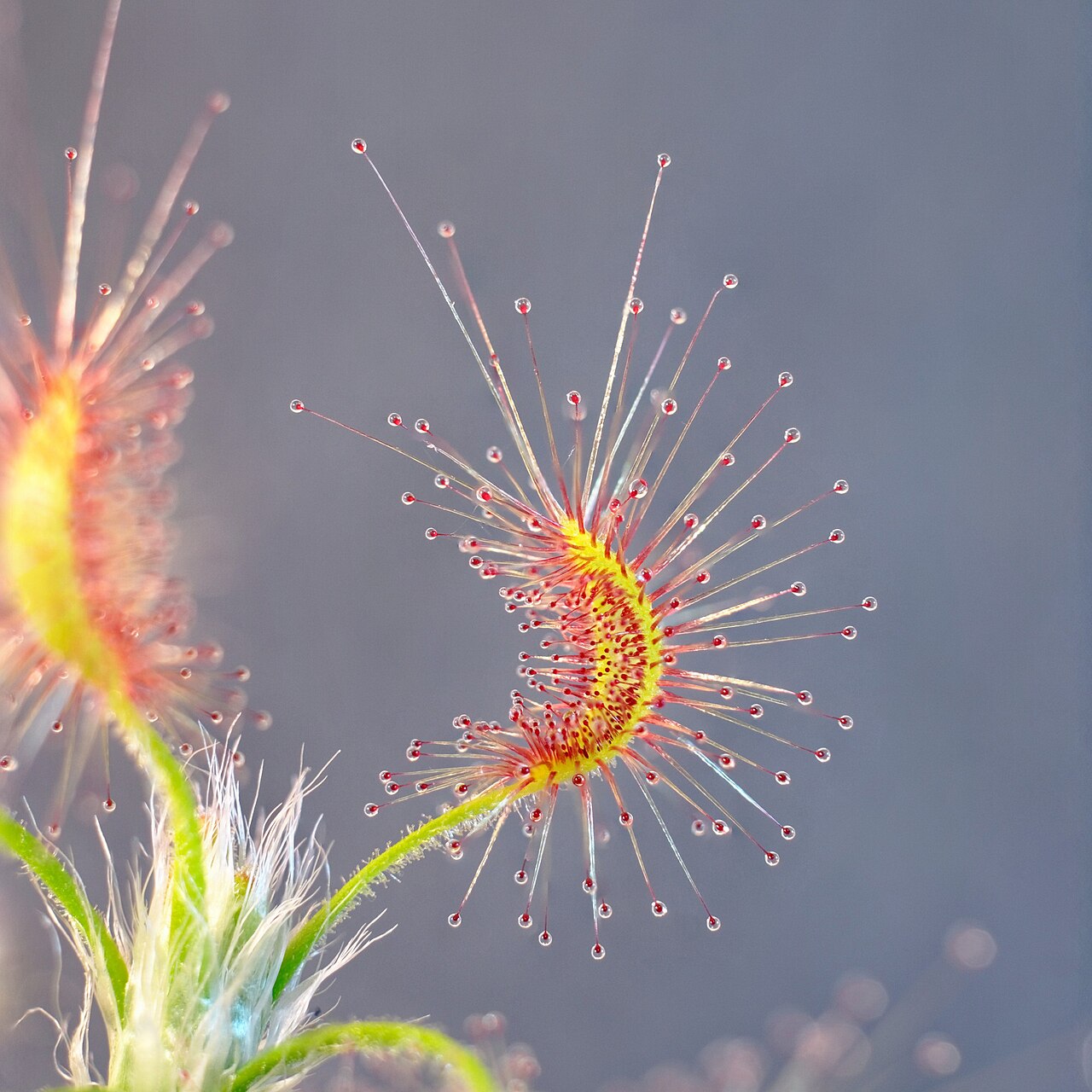
An active flypaper trap in miniature. Each leaf blade, often no larger than a pinhead to a few millimetres, carries stalked glands on its margin and upper surface, each holding a glistening sticky droplet; the marginal tentacles are usually the longest. A small animal that touches the droplets sticks fast, after which the tentacles bend towards the centre of the blade and press the prey against the digestive glands. The glands secrete enzymes and absorb nitrogen, phosphorus and minerals from whatever dissolves. Given the scale, the catch consists of the very smallest: springtails, mites, aphids, thrips and minute midges moving over or just above the sandy ground.
Habitat and ecology
White sand and clay near swamps, on sand ridges and on laterite (W7, D3), often in open jarrah forest (B6). The species thus has a broad choice of sites within the south-western forest belt.
Distribution and elevation
Endemic to south-west Australia: the jarrah forest region and the south coast. A closer range boundary and altitudinal limits are not published in the sources consulted.
- Recorded (quarter-degree cells)
Forms and variation
Jules Émile Planchon described the species in 1848. No formal subspecies are recognised, but the sources refer to different 'forms' that differ in lifespan. Like other pygmy sundews it forms gemmae, which are relatively large in this species.
Where and when to see it
August to October, when the pink-and-white flowers are open. Search open spots with little leaf litter in the jarrah forest, near swamp margins and on laterite. Old plants with a clear stem are the easiest to recognise; leave them be, for they are years old.
Conservation status
Assessed as Least Concern (LC) on the IUCN Red List; not listed in CITES. The species has a broad range in the jarrah forest, much of which is managed as state forest or reserve. Bauxite mining, root rot (Phytophthora) and altered fire regimes are the main landscape pressures in that forest.
Scientific name
Drosera scorpioides | Planchon, 1848
Drosera scorpioides was described in 1848 by Jules Émile Planchon, published in Annales des Sciences Naturelles, Botanique, série 3, volume 9: 288. The type material originates from the area of the Swan River, Western Australia, collected by James Drummond in 1848 (preserved as syntype/isotype material in herbaria at Kew, Vienna and London, among others). The name is descriptive, derived from Greek/Latin "scorpioides" (scorpion-like): Planchon chose this name because the arrangement and shape of the leaves reminded him of a scorpion.
World Checklist of Vascular Plants (WCVP), via Plants of the World Online (POWO), Royal Botanic Gardens, Kew.