All species › Caryophyllales › Sundew family › Drosera pedicellaris
Drosera pedicellaris
One of the smallest and most localised pygmy sundews of Western Australia. Drosera pedicellaris was discovered only in 1997 and described by Allen Lowrie in 2002, and to this day it is known from no more than three small areas in the northern sandplains. It owes its name to the feature that gives it away best: the unusually long stalks beneath the flowers.
Identification
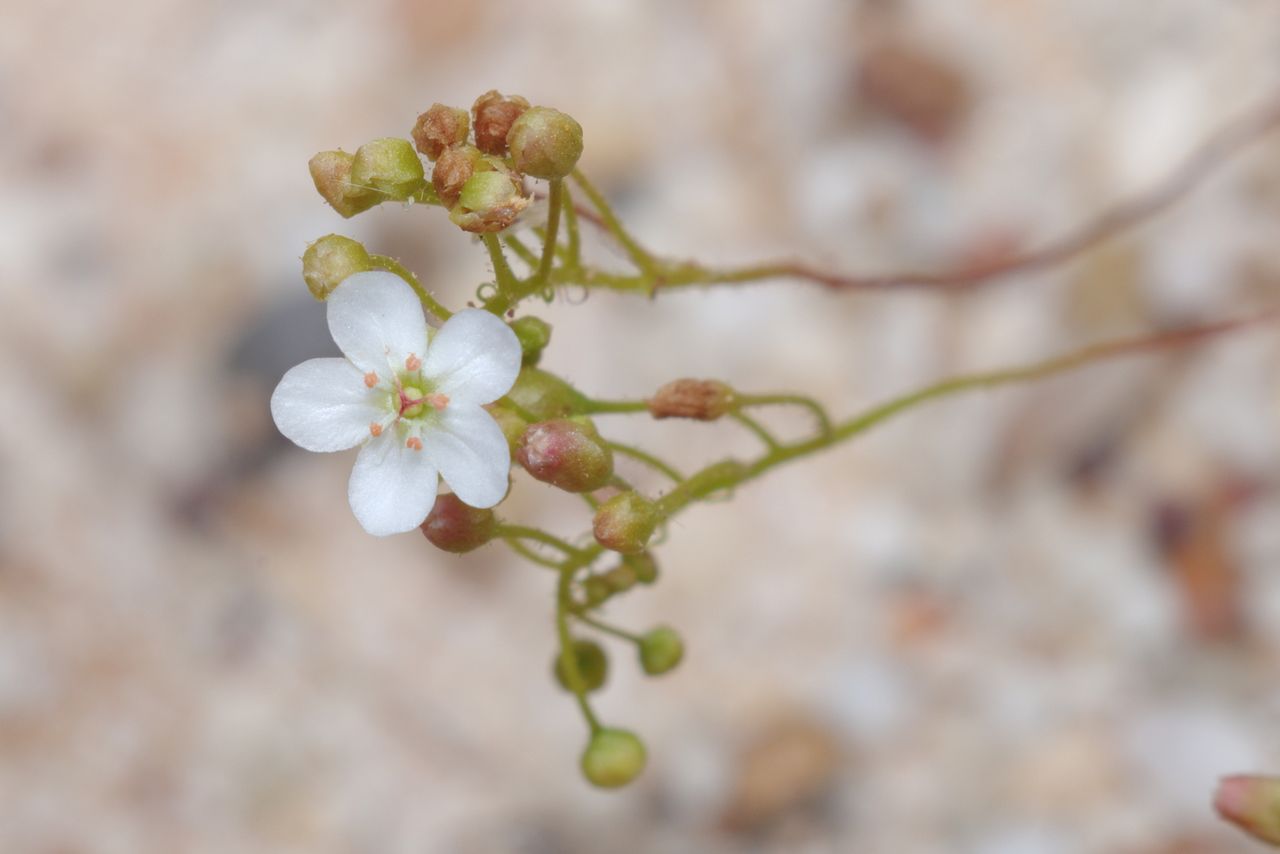
An open, ground-hugging rosette 1 to 1.8 cm across with up to twenty active leaves. Young leaves are held semi-erect, older ones almost horizontal. The petiole is 4 to 5 mm long, 0.8 mm wide at the base and tapering to a thread of 0.1 mm; it carries a round blade about 1 mm across. The plant produces one to three thread-like inflorescences up to 5.5 cm tall bearing up to twenty flowers in all, each on a conspicuously long pedicel. The five petals are white with a green base and up to 3.5 mm long; the pollen is orange. The seeds are ellipsoid and 0.4 to 0.5 mm long.
Similar species
Its closest relative is Drosera parvula, also white-flowered and also of white sand, but with a range further south. The decisive difference lies in the pedicels: in D. pedicellaris they are exceptionally long, so the flowers stand loosely apart. Other white-flowered pygmies of the northern sandplains need a lens and a good key; look at the shape of the stipule bud, the hairiness and the stigmas.
The trap and how it works
An active flypaper trap in miniature. Each leaf blade, often no larger than a pinhead to a few millimetres, carries stalked glands on its margin and upper surface, each holding a glistening sticky droplet; the marginal tentacles are usually the longest. A small animal that touches the droplets sticks fast, after which the tentacles bend towards the centre of the blade and press the prey against the digestive glands. The glands secrete enzymes and absorb nitrogen, phosphorus and minerals from whatever dissolves. Given the scale, the catch consists of the very smallest: springtails, mites, aphids, thrips and minute midges moving over or just above the sandy ground. With leaf blades under a millimetre across, these are among the smallest traps in this guide.
Habitat and ecology
Only on white sand in open heathland (D1, B5), between about 80 and 300 m elevation. These are the nutrient-poor quartz sands of the northern sandplains, with a low, open cover of small shrubs leaving room for pygmy species on the bare sand between them.
Distribution and elevation
Endemic to Western Australia and known from only three small areas in the northern sandplains: in the district east of Geraldton, around Pindar, and in Badgingarra National Park. The entire known range is thus small and fragmented.
- Recorded (one-degree cells)
Forms and variation
No subspecies or varieties are recognised. The species belongs to the pygmy sundews (section Bryastrum in the older treatment, now often Lamprolepis) and like its relatives probably forms gemmae in the centre of the rosette; the original description is the main source.
Where and when to see it
The best time is October and November, when the thread-like inflorescences with white flowers stand above the minute rosettes and the plant can be found. Outside that window it is almost invisible among lichen and bare sand. In Badgingarra keep to the paths: open sandy patches between the shrubs are exactly where this species grows, and a small population can be wiped out by trampling in a single season.
Conservation status
Assessed as Vulnerable (VU) on the IUCN Red List; not listed in CITES. The reasons are its very small, fragmented range and the threats within it: clearing for agriculture and a fire regime that strikes too often or at the wrong time. Part of its sites lie in a national park, which offers protection; the rest lie in a landscape that has largely been brought under cultivation.
Scientific name
Drosera pedicellaris | Lowrie, 2002
Drosera pedicellaris was described in 2002 by the Australian botanist Allen Lowrie, in the journal Nuytsia, volume 15(1), pages 59–62, under the title "Drosera pedicellaris (Droseraceae), a new species from south-west Western Australia". The holotype was collected by Allen Lowrie himself on 14 November 1997 near Three Springs in Western Australia, in deep beige sand between and under low shrubs on heathland; the specimen is held at the Perth herbarium (PERTH 5849489). The epithet pedicellaris is descriptive, referring to the distinctly long flower stalks (pedicels) of this species, a feature that distinguishes it from related pygmy sundews.
World Checklist of Vascular Plants (WCVP), via Plants of the World Online (POWO), Royal Botanic Gardens, Kew.