All species › Caryophyllales › Sundew family › Drosera peruensis
Drosera peruensis
The sundew of the Peruvian Andes. Drosera peruensis was described in 2002 by the Brazilian botanist Tânia Silva and the Panamanian botanist Mireya Correa, and has since been one of the few sundews known from the eastern slopes of the Andes. The 2016 revision of the Andean sundews extended its range into Ecuador, and the authors proposed treating it as endangered; at the type locality it even seems to have vanished, although the habitat there is still intact.
Identification
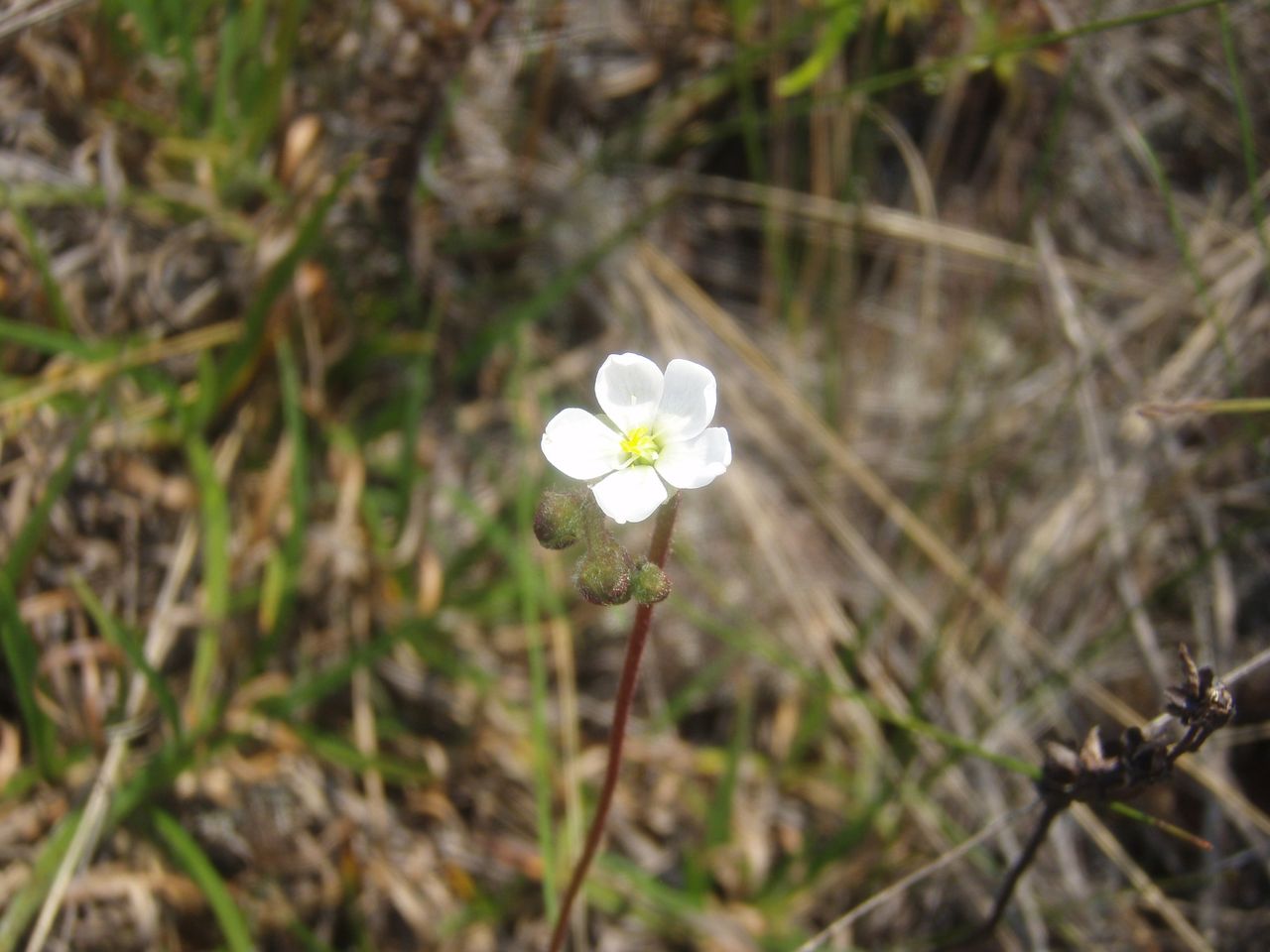
A perennial plant forming upright columns densely clothed in the persistent dead leaves of earlier seasons, topped by a rosette of narrowly spatulate leaves usually 7 to 14 mm, exceptionally 20 to 28 mm long. Young leaves are coiled at the tip. The stipules are triangular, 5 to 7 mm long and 1.5 to 3 mm wide. The scape is 50 to 150, sometimes up to 215 mm long, with white or pale pink-tinged flowers. The inflorescence and calyx bear sessile glands and ordinary hairs.
Similar species
The closest relatives are Drosera condor, which grows about 80 km further north in the Cordillera del Cóndor, and Drosera cendeensis of the Venezuelan Andes. D. condor has much longer leaves of 40 to 70 mm, larger ridged stipules and pink to violet-pink flowers; D. cendeensis has upright leaves up to 140 mm and pink flowers. The columns of dead leaves with a small rosette on top are the best field character of D. peruensis.
The trap and how it works
An active flypaper trap. The small rosette on top of the column catches crawling and flying insects in the cool, damp climate of the dwarf forest. The tentacles bend towards the prey, which is then digested.
Habitat and ecology
Quartzitic sandy soil and cracks in sandstone in humid parts of dwarf forest and shrubland, at about 2,000 to 2,830 m, in the sub-Andean ranges (D2, B5, B4). The column form keeps the rosette above the surrounding vegetation and litter.
Distribution and elevation
Peru, in the regions of Cajamarca, Pasco and Ucayali, and Ecuador, in Zamora-Chinchipe province, in scattered, isolated populations in the sub-Andean ranges. Precise localities are not given in this guide because the species is considered endangered.
- Recorded (one-degree cells)
Forms and variation
No varieties are recognised. With D. condor and D. cendeensis the species forms a small group of Andean sundews with coiled young leaves and narrowly spatulate leaves, clearly distinct from all other Neotropical species. The scattered populations over a large area suggest there are undiscovered sites.
Where and when to see it
A species to approach with restraint. The sub-Andean ranges of Peru and Ecuador are remote and poorly accessible. Anyone finding the plant should photograph it on the spot, record elevation and habitat, and share localities only with researchers; new sites are valuable for conservation.
Conservation status
Not assessed for the global IUCN Red List and not listed in CITES. The authors of the 2016 revision proposed the category endangered, on the basis of the small area of occupancy, fragmentation and declining quality and extent of habitat. The species may have disappeared from its type locality. Deforestation, road building and mining are the main threats in the region.
Scientific name
Drosera peruensis | Silva & Correa, 2002
Drosera peruensis was described in 2002 by Tânia Regina dos Santos Silva and Mireya D. Correa, in the journal Novon, volume 12, issue 4, pages 543–545, under the title "Drosera peruensis (Droseraceae), a New Species from Peru". The species is known from the Pasco region of Peru, specifically the Oxapampa area in the Cordillera Yanachaga, where it grows in scrubland on white sandstone; the exact collector and precise collection date could not be established with certainty. The epithet peruensis is a toponym, referring directly to Peru, the country where the species was discovered and to which it is endemic.
World Checklist of Vascular Plants (WCVP), via Plants of the World Online (POWO), Royal Botanic Gardens, Kew.