All species › Caryophyllales › Sundew family › Drosera planchonii
Drosera planchonii
A climbing sundew from south-eastern Australia: not a flat rosette but a thin, twining stem that holds on to surrounding shrubs with sticky leaves and can reach well above the ground. Drosera planchonii belongs to the tuberous sundews, which pass the hot, dry summer as an underground tuber and sprout in the cool, wet winter. The name, published in 1848 by Planchon from a name by Joseph Dalton Hooker, was long treated as a subspecies of the Western Australian D. macrantha and is now accepted again as a species in its own right.

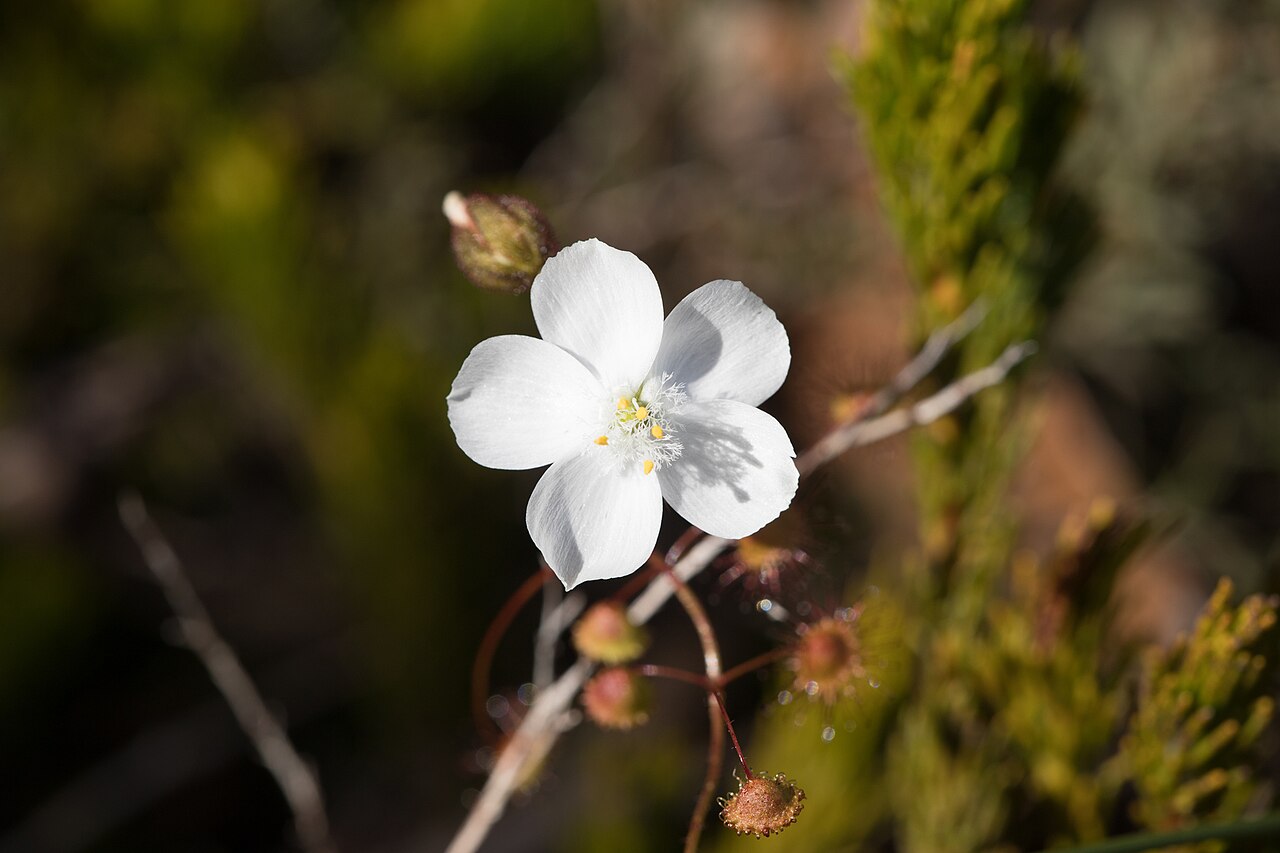
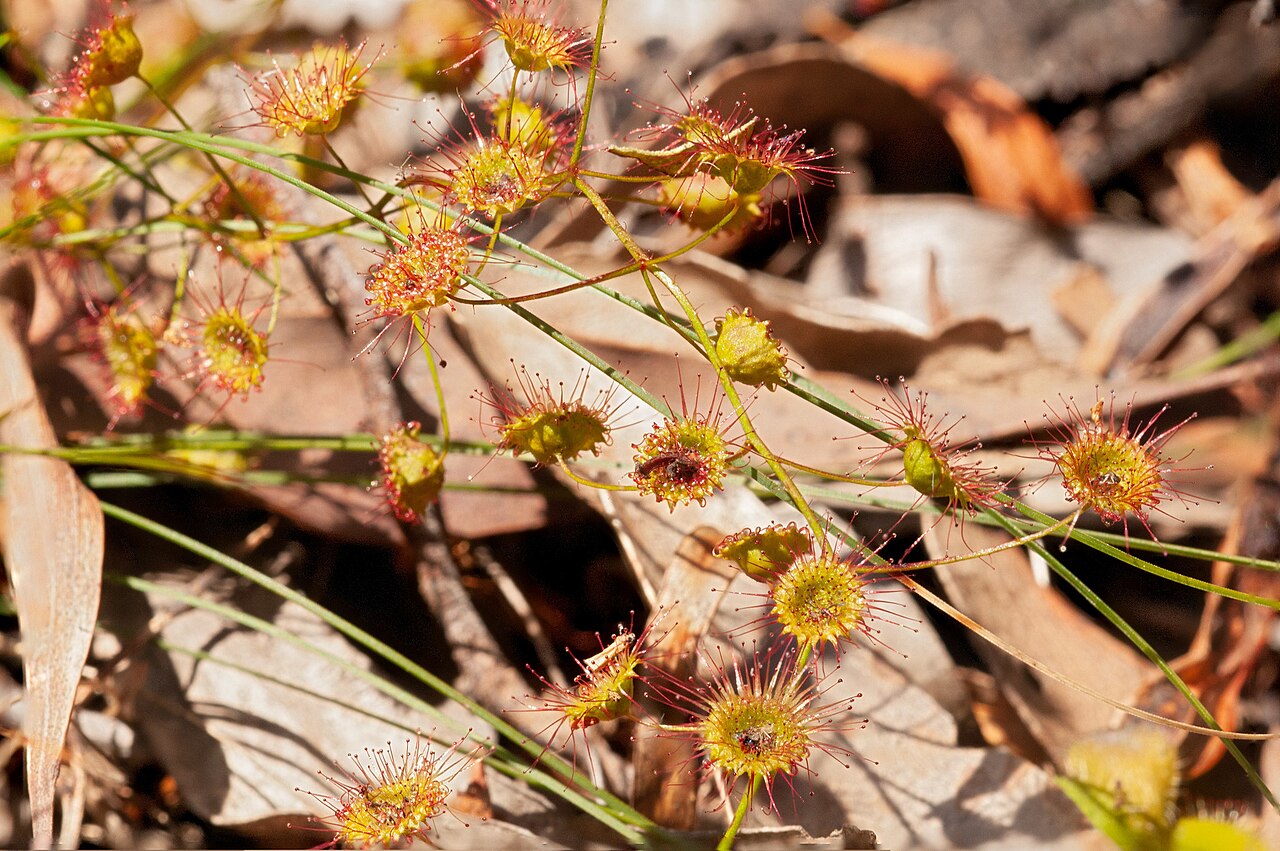
Identification
A perennial tuberous plant. In autumn a thin, usually unbranched or sparingly branched stem grows from the tuber and climbs up through the vegetation or scrambles over it. The stem leaves are in small groups and have a small, peltate to crescent-shaped blade with tentacles, on a stalk that can wind round twigs of other plants — this is how the leaves hold the plant itself upright. A few small basal leaves sometimes sit at the foot of the stem. The flowers appear during winter and spring at the top of the stem. Reliable measurements and flower colour from a current revision could not be consulted for this guide; the size fields are therefore left empty.
Similar species
The closest relative is Drosera macrantha from Western Australia, in which D. planchonii was long included as a subspecies; their ranges do not overlap. In south-eastern Australia other climbing or erect tuberous sundews, such as D. auriculata and D. hookeri, may grow at the same sites; these have an erect stem with a separate basal rosette or a different leaf shape and flower colour. The differences lie mainly in the structure of the calyx, the hairiness and the shape of the stem leaves.
The trap and how it works
An active flypaper trap, and one that doubles as a climbing organ. The tentacles on the small blades carry sticky droplets that hold insects; the tentacles bend towards the prey and enzymes digest it. Because the plant works its way up into the shrub layer, it catches more flying insects than sundews lying flat on the ground. The same stickiness helps the stem stay hooked on twigs of other plants.
Habitat and ecology
Open, dry to damp heath and scrub (B5), open eucalypt woodland (B6) and sandy ground (D1), on acid, nutrient-poor sands and gravels. The sites are moist in winter and bone-dry in summer; the plant escapes that drought by resting underground as a tuber. It needs a supporting vegetation of low shrubs to climb in and benefits from open patches after fire.
Distribution and elevation
South-eastern Australia: South Australia and Victoria, where the species is fairly common in suitable places, and Tasmania, where it is rarer. Most documented records come from south-eastern South Australia and western and central Victoria. No published altitudinal range was found; the elevation field is left empty.
Forms and variation
No varieties are recognised within D. planchonii. Its taxonomic history is complicated, though: the name has been treated in turn as a species, a variety and a subspecies of D. macrantha, and older literature and field guides therefore sometimes use D. macrantha subsp. planchonii for this plant.
Where and when to see it
Go in late winter and early spring, when the stems are full grown and the plant is in flower. Search open heath and light eucalypt woodland on sand; the stems are thin and show up mainly by the glitter of droplets among the twigs of low shrubs. Look on a sunny morning, when the flowers are open. Never pull at the stems: the plant has only one stem per season and does not replace it.
Conservation status
The species has not been assessed for the global IUCN Red List and is not in CITES. In South Australia and Victoria it is still fairly common in remaining heath and open woodland. Important threats are the loss of native vegetation to agriculture and development, fires that are too frequent or absent altogether, and soil disturbance, which can damage the tubers.
Scientific name
Drosera planchonii | J.D. Hooker
Drosera planchonii was published in 1848 by the French botanist Jules Émile Planchon in the Annales des Sciences Naturelles, Botanique, third series, volume 9, page 294, based on a manuscript name by Joseph Dalton Hooker (hence the author citation "Hook.f. ex Planch."). The species is endemic to Australia (current taxonomic treatments place it as a subspecies of Drosera macrantha); the precise type locality, collector and collection date could not be established with certainty. The epithet planchonii is an eponym that likely honours the French botanist Jules Émile Planchon (1823–1888), who published an important monograph of the Droseraceae (in the very 1848 work in which this species was published); however, that the name was specifically dedicated to him could not be fully confirmed.
World Checklist of Vascular Plants (WCVP), via Plants of the World Online (POWO), Royal Botanic Gardens, Kew.