All species › Caryophyllales › Sundew family › Drosera platypoda
Drosera platypoda
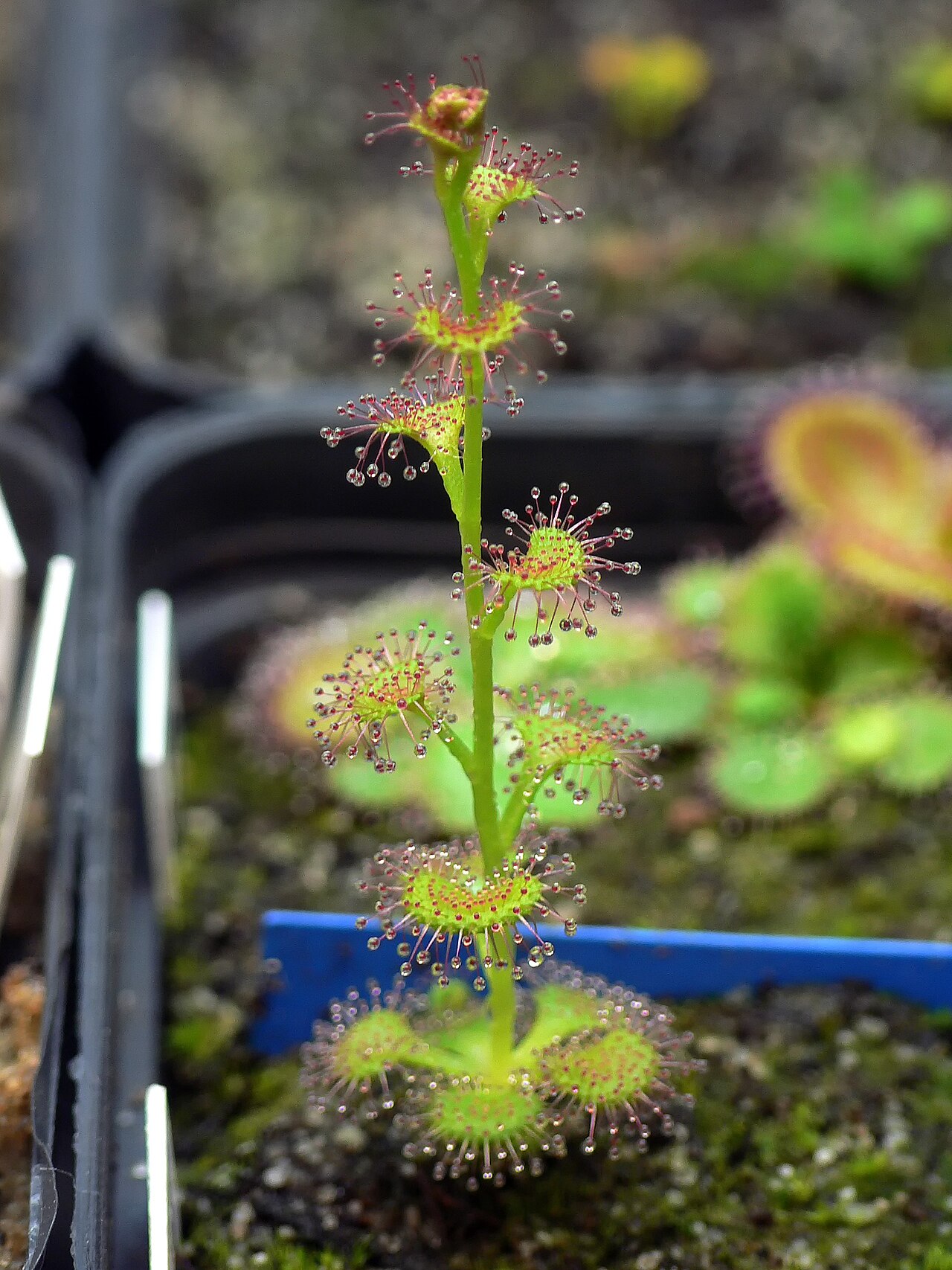
A fan-leaved sundew from the far south-west of Australia, and one of the ten species of the small section Stolonifera. Drosera platypoda — 'the broad-footed' — survives the dry summer as an underground tuber and appears after the first winter rains with a small rosette on the ground and an erect stem above it bearing scattered trapping leaves.


Identification
An erect, perennial tuberous plant 15 to 20 cm tall. At the base there is a rosette of leaves; further leaves are scattered (alternate) along the stem. Typical of the section are the fan-shaped blades, widening from a narrow base to a broad upper edge set with tentacles. The flowers are white and appear from August to November, peaking around October. Exact measurements of blade and flower are not published in the sources consulted.
Similar species
The confusion lies within section Stolonifera. Drosera stolonifera produces two or three obliquely ascending lateral stems from the base rather than one stem with a rosette; D. ramellosa has one to three lower stems of 4 to 12 cm and inflorescences arising from the rosette; D. prostrata and D. rupicola have prostrate and semi-erect lateral stems respectively. Combine the build — rosette plus erect stem with scattered leaves — with the range: D. platypoda is the species of the south-west between Manjimup, the Scott River and Cape Riche.
The trap and how it works
An active flypaper trap with a leaf shape of its own. The leaves are fan-shaped: a narrow base widening into a blade whose upper edge is set with long tentacles, sometimes in whorls of three or more along the stem. Small insects that walk into that edge or land on it stick to the droplets, after which the tentacles bend over the prey and the glands secrete enzymes. As in all tuberous sundews, much of the nitrogen and phosphorus absorbed goes into the tuber that has to carry the plant through summer.
Habitat and ecology
Winter-wet sandy soils in heathland: sand, sandy clay and sometimes gravelly ground in damp places (W7, B5, D1). In winter the water stands at or above the surface here; in summer the soils dry out completely and the plant withdraws into its tuber.
Distribution and elevation
Endemic to south-west Western Australia: from around Manjimup south-west to the area around the Scott River, and east to Cape Riche. FloraBase places it in the Avon Wheatbelt, Esperance Plains, Jarrah Forest, Mallee and Warren bioregions. Altitudinal limits are not published.
- Recorded (quarter-degree cells)
Forms and variation
The species was described in 1854 by Nikolai Turczaninow; Drosera flabellata Benth. is a synonym. It is placed in subgenus Ergaleium, section Stolonifera, together with D. stolonifera, D. ramellosa, D. prostrata, D. rupicola and five other species. No subspecies are recognised within D. platypoda.
Where and when to see it
Go in September–October, when the stems are full grown and the white flowers are open; sunny mornings after a wet week are ideal, because the tentacles are then full of droplets. Search wet open heath and hollows where water has stood in winter. The sites are boggy in spring; keep to the paths and leave the tubers in the ground.
Conservation status
Assessed as Least Concern (LC) on the IUCN Red List; not listed in CITES, and rated not threatened in FloraBase. The species is scattered across the south-west, partly in forest areas and reserves. Drainage, clearing and altered fire regimes are the general threats to winter-wet heath in this region.
Scientific name
Drosera platypoda | Turczaninow, 1854
Drosera platypoda was described in 1854 by the Russian botanist Nikolai Stepanovich Turczaninow, in the Bulletin de la Société Impériale des Naturalistes de Moscou, volume 27, page 343. The species is endemic to southwestern Western Australia, in an area stretching from Manjimup to around the Scott River and east to Cape Riche, where it grows on winter-wet sandy soils in heathland; the precise type locality, collector and collection date could not be established with certainty. The epithet platypoda is descriptive, derived from the Greek platys ("broad, flat") and pous/podos ("foot"), referring to the "flat-footed" appearance of this species' basal leaf rosette.
World Checklist of Vascular Plants (WCVP), via Plants of the World Online (POWO), Royal Botanic Gardens, Kew.