All species › Caryophyllales › Sundew family › Drosera praefolia
Drosera praefolia
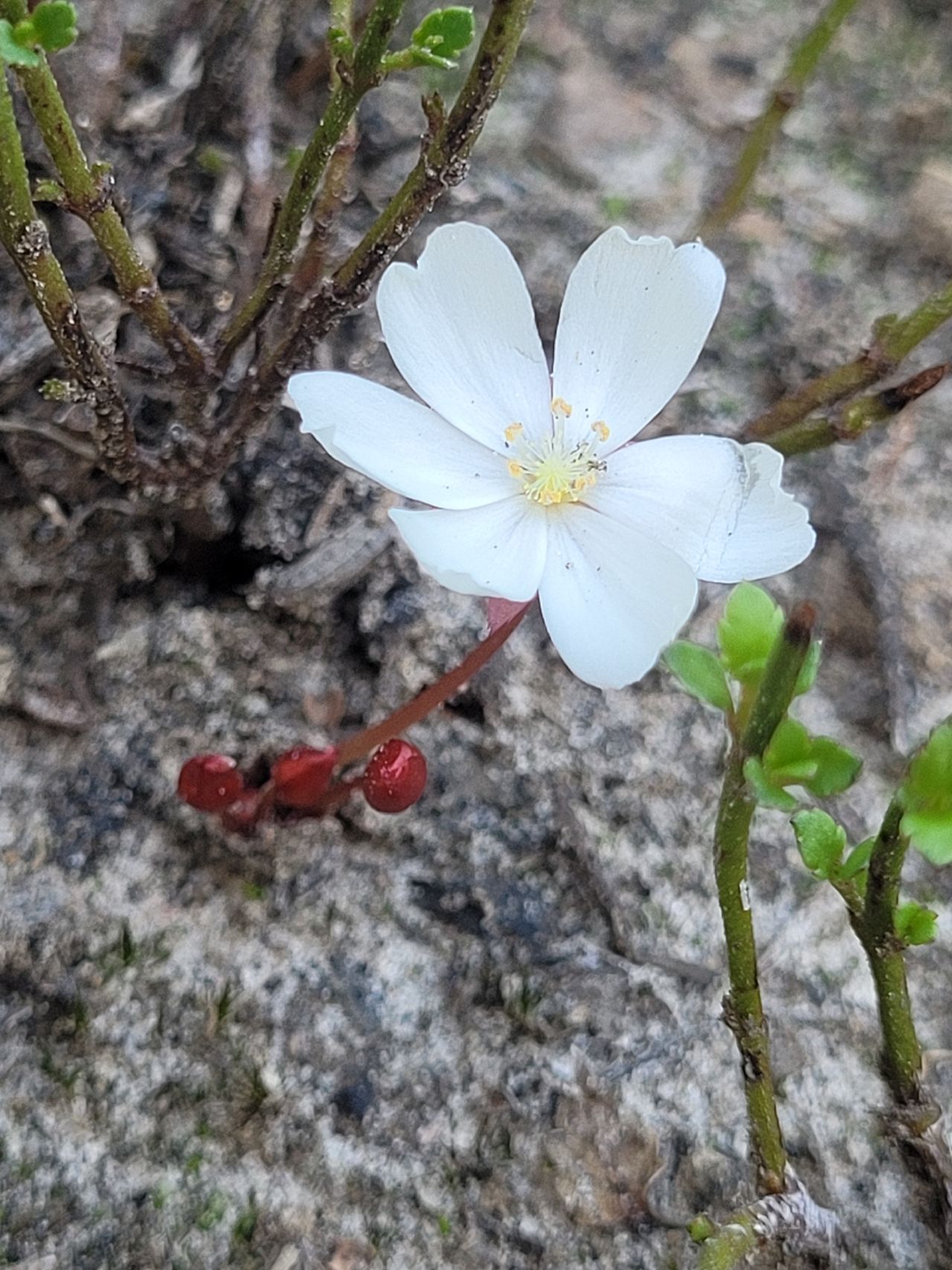
A tuberous rosetted sundew with an inverted life rhythm: it flowers first and only afterwards makes its leaves. That makes Drosera praefolia one of the few sundews in flower on bare ground in autumn. Contrary to what the area label in this series suggests, it is not a plant of south-west Australia but of South Australia, on the Fleurieu Peninsula and Kangaroo Island.
Identification
A flat rosette 4 to 6 cm across, with green, sometimes red, ovate to obovate leaves lying against the ground. The character behind the name — praefolia, 'before the leaf' — is the sequence: the flowers appear in April and May, and only once flowering is over do the leaves emerge. Underground there is a white tuber. Flower colour and exact leaf and flower measurements are not given in the sources consulted; those fields are left empty.
Similar species
The only serious confusion is with Drosera whittakeri, under which D. praefolia was long treated as a variety or subspecies. Three differences separate them: in D. praefolia the leaves appear after flowering (in D. whittakeri before or at the same time), the leaves are ovate to obovate, and the tuber is white, whereas that of D. whittakeri is orange. The last character cannot be used in the field without damaging the plant, which should not be done.
The trap and how it works
An active flypaper trap held close to the ground. The rosette leaves lie flat on the soil and carry stalked glands with a sticky droplet on the upper surface and along the margin. Whatever crawls over the ground or lands briefly — ants, springtails, small beetles and midges — becomes entangled, after which the tentacles slowly bend inwards and the glands secrete digestive enzymes. Nitrogen, phosphorus and minerals from the prey are absorbed through the same leaf surface. Because the plant is in leaf for only a few months each year, that food goes straight into the tuber, which has to carry the plant through the next dry summer.
Habitat and ecology
Lateritic clay-sands, loam and decomposed shale in open woodland (B6, D3). These are free-draining, nutrient-poor soils that stay moist in winter and dry out in summer, under an open eucalypt canopy.
Distribution and elevation
Endemic to South Australia: from the southern Fleurieu Peninsula south to Kangaroo Island. The species therefore does not occur in Western Australia; the label 'south-west Australia' in this guide's working list is incorrect for it. Altitudinal limits are not published.
- Native
Forms and variation
Johann Gottlieb Otto Tepper described the species in 1892. Its rank was long disputed: Raymond Hamet (1907), John McConnell Black (1924) and Allen Lowrie (1989) successively treated it as a lower rank under D. whittakeri. In 2008 Lowrie and John Conran reinstated it as a species on the basis of the white tuber, the leaf shape and the timing of leaf emergence. That view is followed here; anyone using an older flora will find the plant under D. whittakeri.
Where and when to see it
The special moment is April and May, the start of the South Australian wet season, when the flowers appear above bare ground before a single leaf is visible. Anyone coming later, in winter, sees rosettes that look little different from D. whittakeri. Leave the tuber alone: the only hard distinguishing character is underground, but digging kills the plant.
Conservation status
Assessed as Least Concern (LC) on the IUCN Red List; not listed in CITES. The species has a limited range, but the sources consulted name no specific threat. The Fleurieu Peninsula and Kangaroo Island have lost much native vegetation to agriculture, and on Kangaroo Island the great fire of 2019–2020 affected much open woodland; how this species responded is not recorded in the sources consulted.
Scientific name
Drosera praefolia | Tepper, 1892
Drosera praefolia was described in 1892 by the German-Australian naturalist Johann Gottlieb Otto Tepper, in the journal Botanisches Centralblatt, volume 50, page 353; Tepper had already sent material and a description to Ferdinand von Mueller in 1882, but Mueller's name for it was never validly published. The type material was collected by Tepper himself on the Fleurieu Peninsula in South Australia; the species occurs naturally from the southern part of this peninsula to Kangaroo Island. The exact collection date could not be established with certainty, but must predate 1892. The epithet praefolia appears to combine the Latin prae ("before, in front of") and folium ("leaf"), but Tepper's precise intended meaning for this name could not be established with certainty in the sources consulted.
World Checklist of Vascular Plants (WCVP), via Plants of the World Online (POWO), Royal Botanic Gardens, Kew.