All species › Caryophyllales › Sundew family › Drosera radicans
Drosera radicans
A small, erect tuberous sundew with one of the smallest ranges among its relatives in this guide: it is known only from a limited area north of Geraldton, on the northern edge of south-west Australia's winter-rainfall zone. Drosera radicans was described as a species only in 1982.
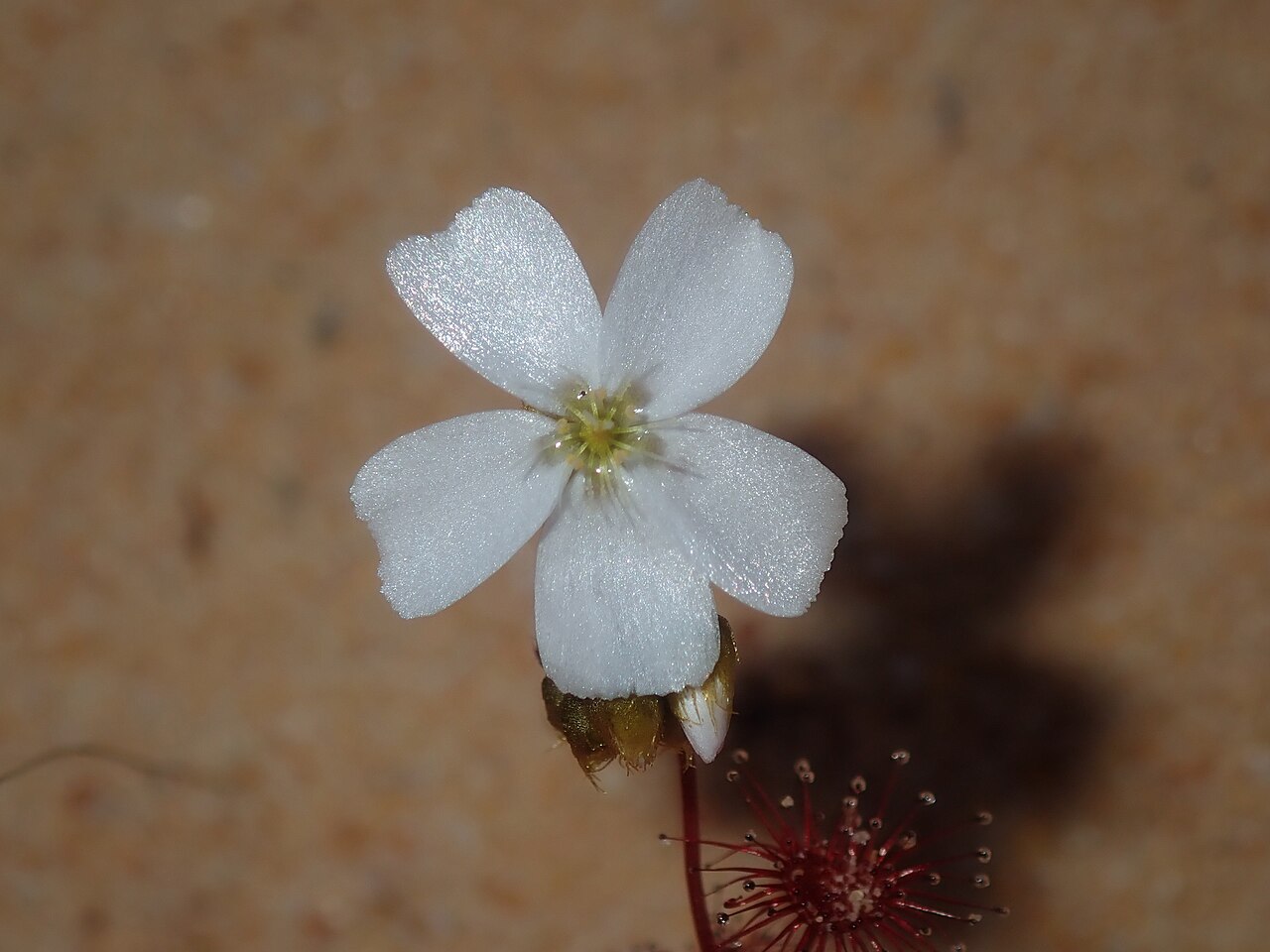
Identification
A perennial tuberous plant with an erect stem 7 to 18 cm tall, along which small glandular trapping leaves are scattered. The flowers are white and appear in August and September. The epithet radicans means 'rooting'. Further details — leaf shape, leaf and flower measurements, features of the tuber — are not given in the sources consulted and must be sought in the original description; those fields are therefore left empty.
Similar species
Several erect tuberous sundews with small peltate leaves grow in the northern part of south-west Australia's winter-rainfall zone. D. radicans differs from the climbing species such as Drosera pallida and D. subhirtella in its low height and straight habit. A firm identification against other small erect species needs a good key to section Ergaleium; the sources consulted name no specific look-alike.
The trap and how it works
An active flypaper trap, but held well above the ground. The leaves along the stem are small, peltate and often cup-shaped, with longer tentacles on the margin and shorter ones on the blade. Flying insects — midges, small flies, sometimes bees or butterflies drawn to the flowers — touch the droplets and stay hanging. The marginal tentacles then bend inwards and the blade partly closes around the prey, after which the glands secrete enzymes and absorb the dissolved nutrients. Because the traps are spread along an upright or climbing stem, the plant sweeps a much larger volume of air than a rosette on the ground.
Habitat and ecology
Winter-wet sites on sand or sandy clay (W7, D1): hollows that become saturated or briefly flooded in the wet months and dry out completely in summer. The plant then sits underground as a tuber.
Distribution and elevation
Endemic to Western Australia and known only from a relatively small area north of Geraldton; this guide's working list names the district between Kalbarri and Geraldton. Altitudinal limits are not published.
- Recorded (one-degree cells)
Forms and variation
The species was described in 1982 by N.G. Marchant, in the same year in which he also named or reclassified other Western Australian tuberous sundews, such as D. subtilis and subspecies of D. stolonifera and D. subhirtella. It belongs to subgenus Ergaleium. No subspecies or varieties are recognised.
Where and when to see it
August and September, the heart of the wet season on the northern sandplains, are the best months: the stems are full grown and the white flowers open. Search hollows where water lies in winter. Because the range is small, it applies doubly here: leave the plants standing and the tubers alone.
Conservation status
Assessed as Least Concern (LC) on the IUCN Red List; not listed in CITES. The small range lies in a district where much land has been brought under cultivation, but the sources consulted name no specific threat.
Scientific name
Drosera radicans | Marchant, 1982
Drosera radicans was described in 1982 by the Australian botanist Neville Gordon Marchant, in "Flora of Australia", volume 8, page 384. The type specimen was collected on 10 August 1974 by D. & N. McFarland, near Northampton, north of Geraldton, Western Australia, in a swampy habitat. The specimen is held in the PERTH herbarium (number PERTH 6140440). The epithet radicans is Latin for "rooting" or "taking root" (from radix, "root"). It likely refers to the rooting stems of this erect, tuberous species. This reading is based on the standard botanical meaning of the term and could not be confirmed in a dedicated etymological source for this specific species.
World Checklist of Vascular Plants (WCVP), via Plants of the World Online (POWO), Royal Botanic Gardens, Kew.