All species › Caryophyllales › Sundew family › Drosera ramellosa
Drosera ramellosa
One of the most widespread species of the fan-leaved section Stolonifera: from Kalbarri in the north to Cranbrook and east to Mount Ragged, well beyond Esperance. Drosera ramellosa — 'the finely branched' — is a small, inconspicuous tuberous plant that appears on sandy hollows in the wet winter months.
Identification
A perennial tuberous plant with a basal rosette and one to three erect stems 4 to 12 cm tall. The leaves are alternate along the main stems. Characteristically, the inflorescences arise not at the top of those stems but from the basal rosette. The leaves have the fan shape typical of the whole section, with tentacles along the broad upper edge. Flowering July to September. Flower colour and exact measurements are not given in the sources consulted.
Similar species
The combination of erect stems with alternate leaves and inflorescences arising from the rosette separates D. ramellosa from the other species of section Stolonifera. Drosera platypoda is larger, up to 20 cm, and grows only in the far south-west. Drosera stolonifera has obliquely ascending lateral stems, D. prostrata prostrate ones. Above all, look at where the inflorescence comes from.
The trap and how it works
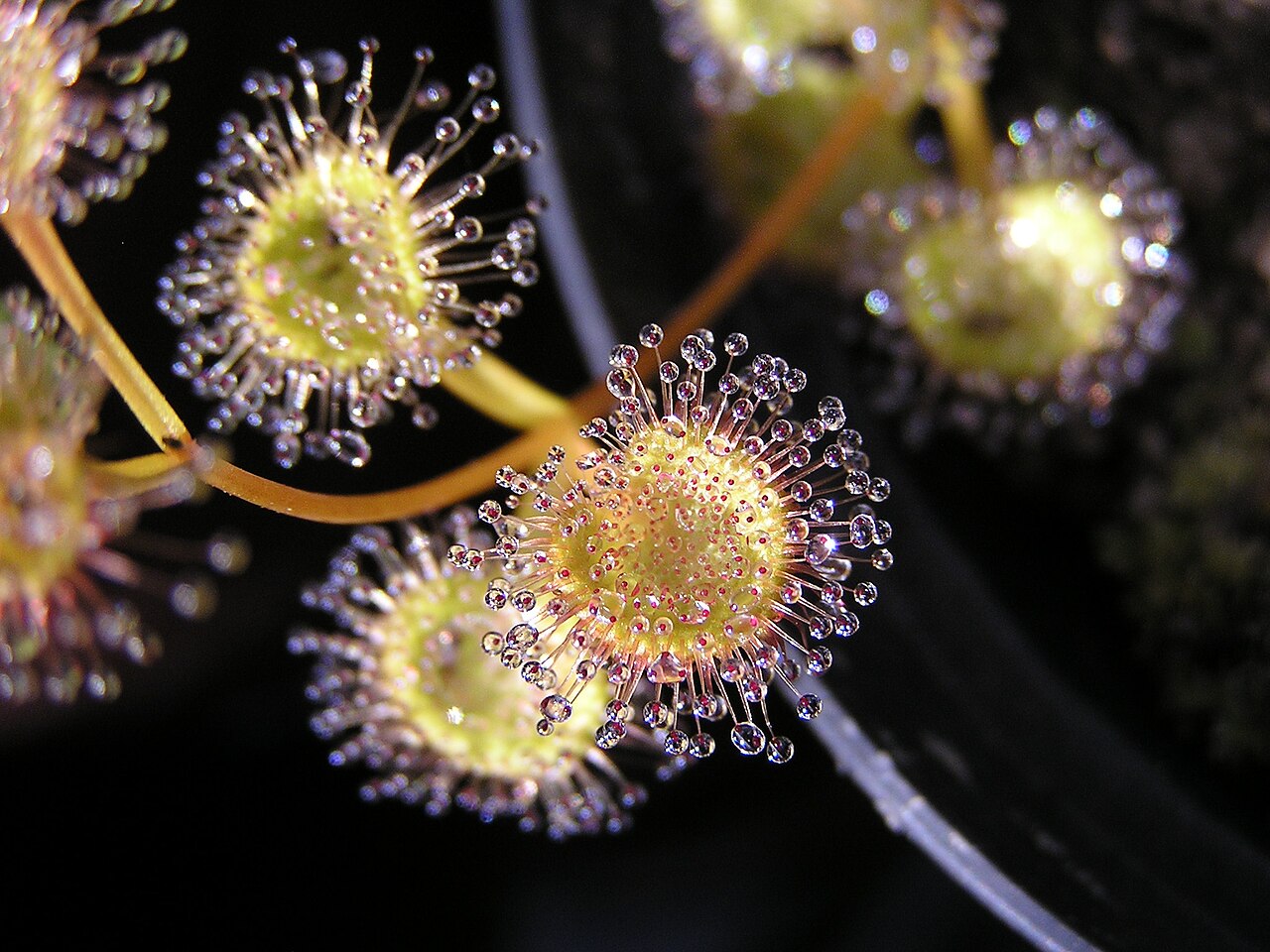
An active flypaper trap with a leaf shape of its own. The leaves are fan-shaped: a narrow base widening into a blade whose upper edge is set with long tentacles, sometimes in whorls of three or more along the stem. Small insects that walk into that edge or land on it stick to the droplets, after which the tentacles bend over the prey and the glands secrete enzymes. As in all tuberous sundews, much of the nitrogen and phosphorus absorbed goes into the tuber that has to carry the plant through summer.
Habitat and ecology
Winter-wet sandy or sand-clay soils (W7, D1), in open heath and scrub (B5). In the wet months water stays in or on the soil; in summer everything dries out and the plant survives as a tuber.
Distribution and elevation
Endemic to Western Australia, with one of the largest ranges in its section: from Kalbarri south to Cranbrook and east to Mount Ragged, north-east of Esperance. This guide's working list summarises it as Kalbarri to Israelite Bay. Altitudinal limits are not published.
- Recorded (quarter-degree cells)
Forms and variation
Johann Georg Christian Lehmann described the species in 1844. Four years later Jules Émile Planchon described the same plant again as Drosera penduliflora; George Bentham reduced that name to synonymy in 1864. No subspecies or varieties are recognised.
Where and when to see it
July to September is the time, in the middle of the wet season. Search open sandy places that are moist or boggy in winter. The plant is small and green, and only stands out when you see the droplets glinting on the fan-shaped leaf edges or the inflorescences rising from the rosette. Leave the tubers in the ground.
Conservation status
Assessed as Least Concern (LC) on the IUCN Red List; not listed in CITES. With a very large range the species as a whole is not threatened. Locally, winter-wet hollows are lost to drainage and clearing, especially in the wheatbelt.
Scientific name
Drosera ramellosa | Lehmann, 1844
Drosera ramellosa was described by the German botanist Johann Georg Christian Lehmann, in his work "Pugillus", volume 8, page 40, in 1844. The species is endemic to Western Australia, ranging from Kalbarri in the south to Cranbrook and east to Mount Ragged. The exact collection site, collector and collection date of the type specimen could not be established with certainty. The epithet ramellosa is a Latin diminutive derived from ramulus/ramellus ("little branch"), and thus likely means "finely branched" or "with small branchlets". This fits the species' description as having erect, branching main stems. This reading follows from the Latin word formation but could not be confirmed in a dedicated etymological source.
World Checklist of Vascular Plants (WCVP), via Plants of the World Online (POWO), Royal Botanic Gardens, Kew.