All species › Caryophyllales › Sundew family › Drosera rechingeri
Drosera rechingeri
A yellow-flowered pygmy sundew of the hills around Geraldton, and one of the few in this area for which flower colour is already a good first clue. Drosera rechingeri was described in 1987 by the Swedish botanist Arne Strid and is confined to a small area.
Identification
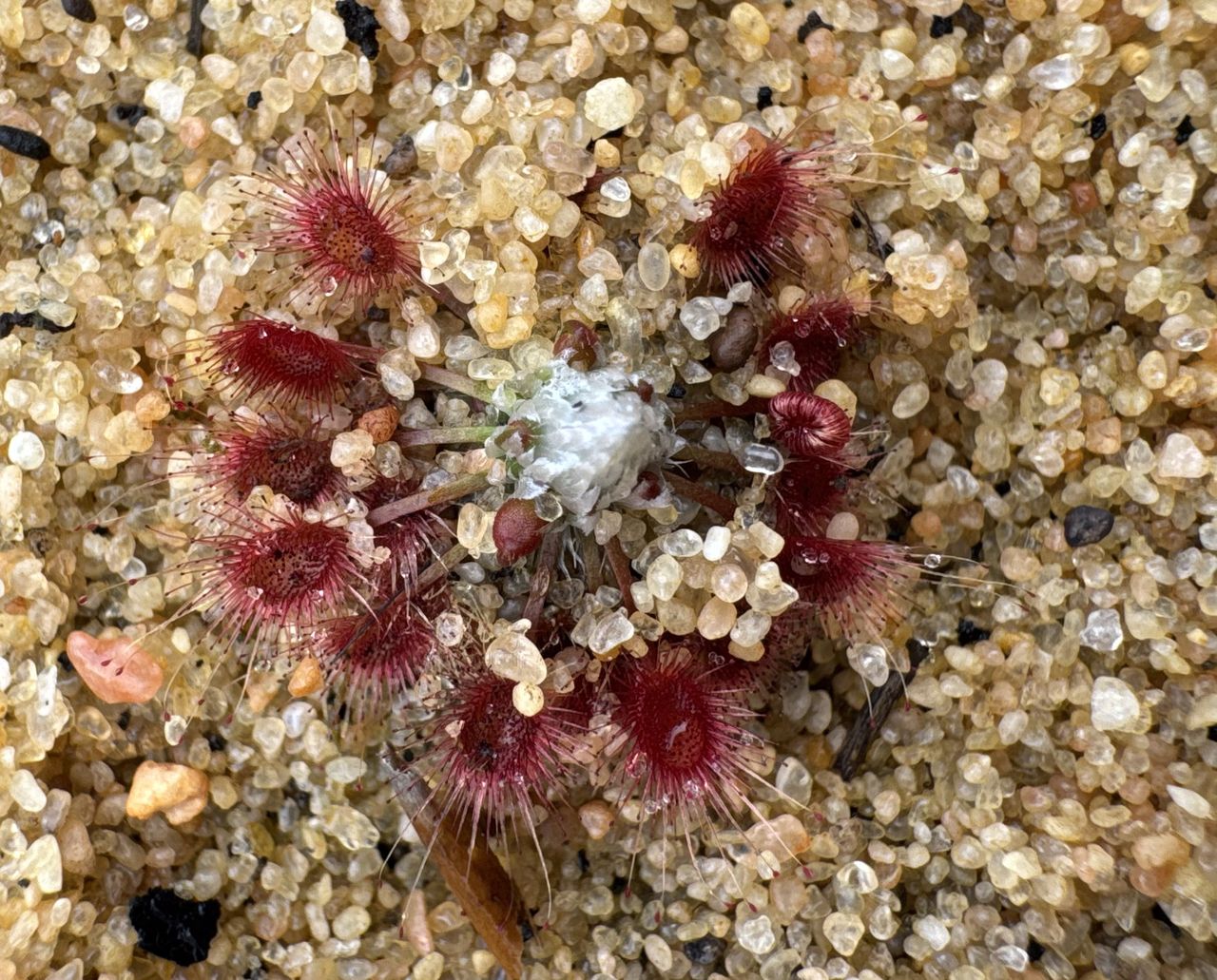
A fibrous-rooted perennial rosette plant at most 1.5 cm across and up to 4 cm tall with the inflorescence. The build is that of a typical pygmy sundew: a small rosette of stalked round blades with tentacles, around a bud of stipules. The flowers are yellow and appear in September and October. Exact leaf and flower measurements are not published in the sources consulted.
Similar species
Yellow flowers are not rare among pygmy sundews, but most yellow-flowered species grow elsewhere. Note the similarity of name with Drosera rechingerae, an Iranian species from an entirely different group — a mix-up that occurs in lists, though not in the field. Within the Geraldton area, a firm identification against other pygmies needs a lens and a key; characters of the stipule bud, stigmas and hairiness are decisive.
The trap and how it works
An active flypaper trap in miniature. Each leaf blade, often no larger than a pinhead to a few millimetres, carries stalked glands on its margin and upper surface, each holding a glistening sticky droplet; the marginal tentacles are usually the longest. A small animal that touches the droplets sticks fast, after which the tentacles bend towards the centre of the blade and press the prey against the digestive glands. The glands secrete enzymes and absorb nitrogen, phosphorus and minerals from whatever dissolves. Given the scale, the catch consists of the very smallest: springtails, mites, aphids, thrips and minute midges moving over or just above the sandy ground.
Habitat and ecology
Pale yellow or grey sand (D1), in low heath and scrub (B5). Further details of the site are not worked out in the sources consulted.
Distribution and elevation
Endemic to Western Australia, in the Geraldton Hills: the hill country around Geraldton, within the Greater Geraldton and Northampton local government areas. The known range is small. Altitudinal limits are not published.
- Recorded (one-degree cells)
Forms and variation
Arne Strid described the species in 1987; the name presumably honours the Austrian botanist Karl Heinz Rechinger, though this is not confirmed in the sources consulted. No subspecies or varieties are recognised. Like other pygmy sundews it probably forms gemmae, but this is not specifically recorded in the sources consulted.
Where and when to see it
September and October are the months, when the yellow flowers stand above the rosettes; without flowers the plant is practically impossible to find in the pale sand. The landscape around Geraldton has largely been brought under cultivation; remaining heath along roads and in reserves is where to look. Keep to paths and do not disturb the verge.
Conservation status
Assessed as Least Concern (LC) on the IUCN Red List; not listed in CITES. In Western Australia, however, the species is registered as Priority Three: known from several populations, some not in protected areas, and in need of further assessment. The small range in a largely cleared landscape is the main concern.
Scientific name
Drosera rechingeri | Strid, 1987
Drosera rechingeri was validly described in 1987 by the Swedish botanist Arne Strid, published in the journal Plant Systematics and Evolution, volume 155, pages 339–347 (cited specifically at p. 343). The holotype was collected in Western Australia, in Kalbarri National Park, near a site known as "Z Bend" on the Murchison River, by Arne Strid on 9 October 1982. The specific epithet honours the Austrian botanist Karl Heinz Rechinger (1906–1998), an authority on the flora of Southwest Asia and Greece who, after retiring, also collected in Western Australia (including in 1982, the same year the type of this species was collected). This is therefore an eponym.
World Checklist of Vascular Plants (WCVP), via Plants of the World Online (POWO), Royal Botanic Gardens, Kew.