All species › Caryophyllales › Sundew family › Drosera riparia
Drosera riparia
The riverbank sundew, for that is what the name means. Drosera riparia was described by Paulo Gonella and Fernando Rivadavia, two of the researchers who have thoroughly revised the Brazilian sundews over the past two decades. It is a species of the Chapada Diamantina in Bahia, a vast sandstone plateau in north-eastern Brazil with deep river valleys, waterfalls and a rich, partly endemic flora.
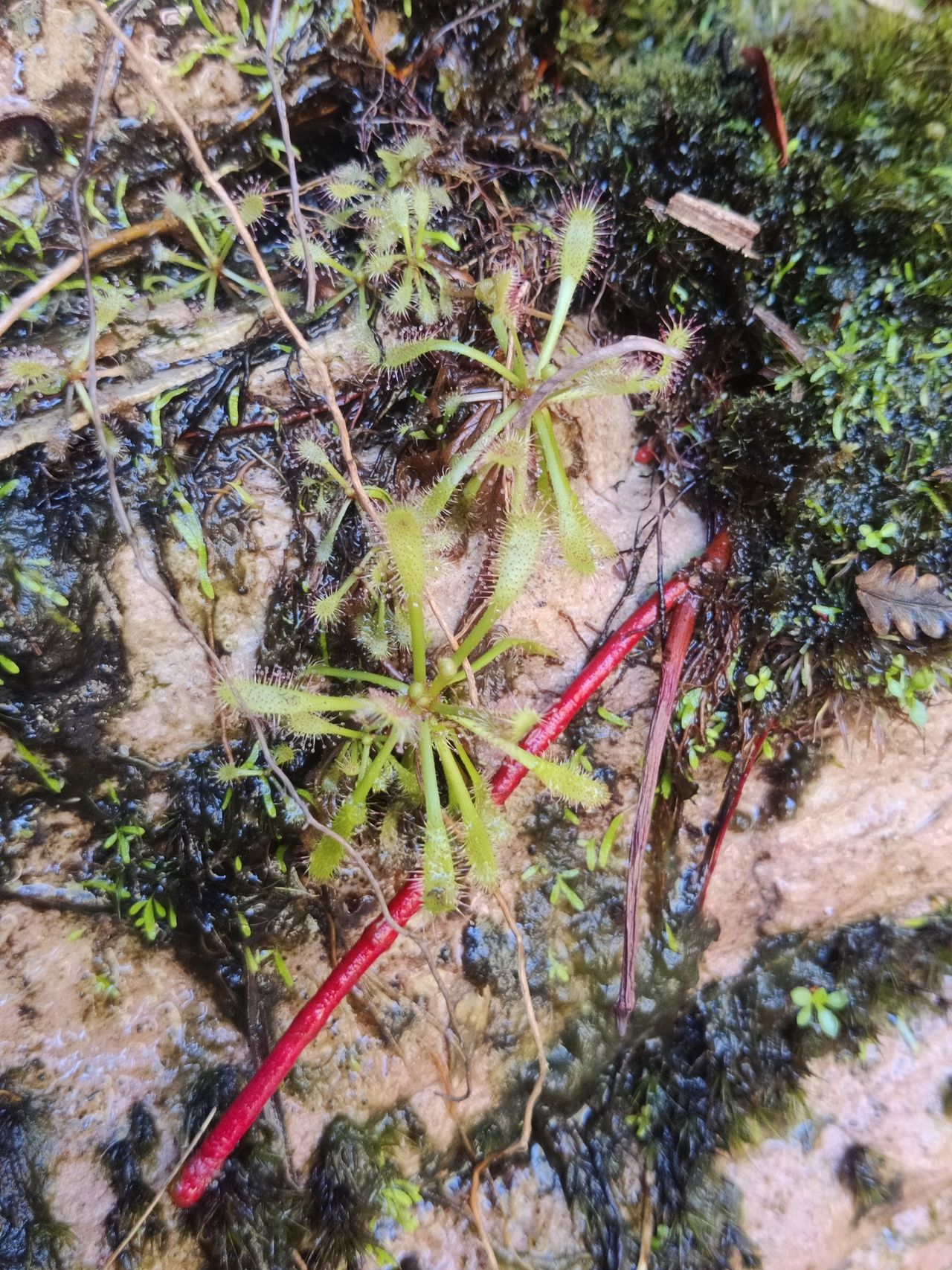
Identification
A perennial rosette plant with leaves densely set with tentacles and a scape with a few flowers. Photographs in the 2022 Brazilian synopsis show the plant in full sun, with a detail of the leaves and the tip of the inflorescence with an open flower; as in many sundews, the plant's colour differs between sun and shade. Exact measurements and a confirmed flower colour could not be checked here; the size fields are left empty.
Similar species
Several sundews grow in the Chapada Diamantina, including Drosera tentaculata with strikingly long marginal tentacles, Drosera tomentosa with woolly hairs and the widespread Drosera communis. A riverbank habitat is a first clue to D. riparia, but a confident identification needs the key in the 2022 synopsis.
The trap and how it works
An active flypaper trap. The tentacles catch small insects flying along the riverbank or walking over the wet ground, such as gnats, small flies and ants. The surrounding tentacles then bend towards the prey and secrete digestive enzymes.
Habitat and ecology
Wet, sandy or peaty banks of rivers and streams in the sandstone landscape of the Chapada Diamantina, and wet rock slabs along the water (W4, R1). The plant grows both in full sun and, judging by the photographs in the synopsis, in somewhat shaded places. The water of these rivers is often stained dark by humic acids, acid and very poor in nutrients.
Distribution and elevation
Endemic to north-eastern Brazil, in the state of Bahia, in the Chapada Diamantina. The exact range and an altitudinal range could not be checked here.
- Recorded (one-degree cells)
Forms and variation
No varieties are recognised. The Chapada Diamantina, like the Espinhaço range in Minas Gerais of which it is geologically the northern continuation, is a centre of endemism for sundews and for many other plant groups.
Where and when to see it
Chapada Diamantina National Park is well served by trails along rivers and waterfalls. In the wet season search the sandy and rocky banks of clear, dark-stained streams. Keep to the trails and do not trample the bank zones: that is exactly where most small sundews grow.
Conservation status
Not assessed for the global IUCN Red List and not listed in CITES. Part of the range lies within the national park. Threats are tourism along riverbanks, fire, and changes in water level through water abstraction and climate change. Little is known about population size or trends.
Scientific name
Drosera riparia | Gonella & Rivadavia, 2014
Drosera riparia was described in 2014 by Paulo Minatel Gonella and Fernando Rivadavia, published in Phytotaxa, volume 156(1): 31. The holotype was collected in Brazil, state of Bahia, municipality of Miguel Calmon, in the Parque Estadual das Sete Passagens near the waterfall Cachoeira do Coração, at about 850 m elevation, on 3 August 2012, by Gonella et al. (collection no. 543); the holotype is deposited in herbarium SPF (no. 208400), with isotypes at ALCB, HUEFS, MO, P and RB. The epithet riparia derives from the Latin ripa ("riverbank") and likely means "of riverbanks" — a descriptive reference to the species' habitat along a stream/waterfall in the Chapada Diamantina; an explicit etymological note from the original publication could not be consulted.
World Checklist of Vascular Plants (WCVP), via Plants of the World Online (POWO), Royal Botanic Gardens, Kew.