All species › Caryophyllales › Sundew family › Drosera rosulata
Drosera rosulata
A flat rosetted sundew with an underground tuber that flowers in the Australian autumn — long before most other sundews of the south-west appear above ground. Drosera rosulata belongs to the group around D. erythrorhiza, the 'red-rooted' sundews, and grows at the margins of swamps.
Identification
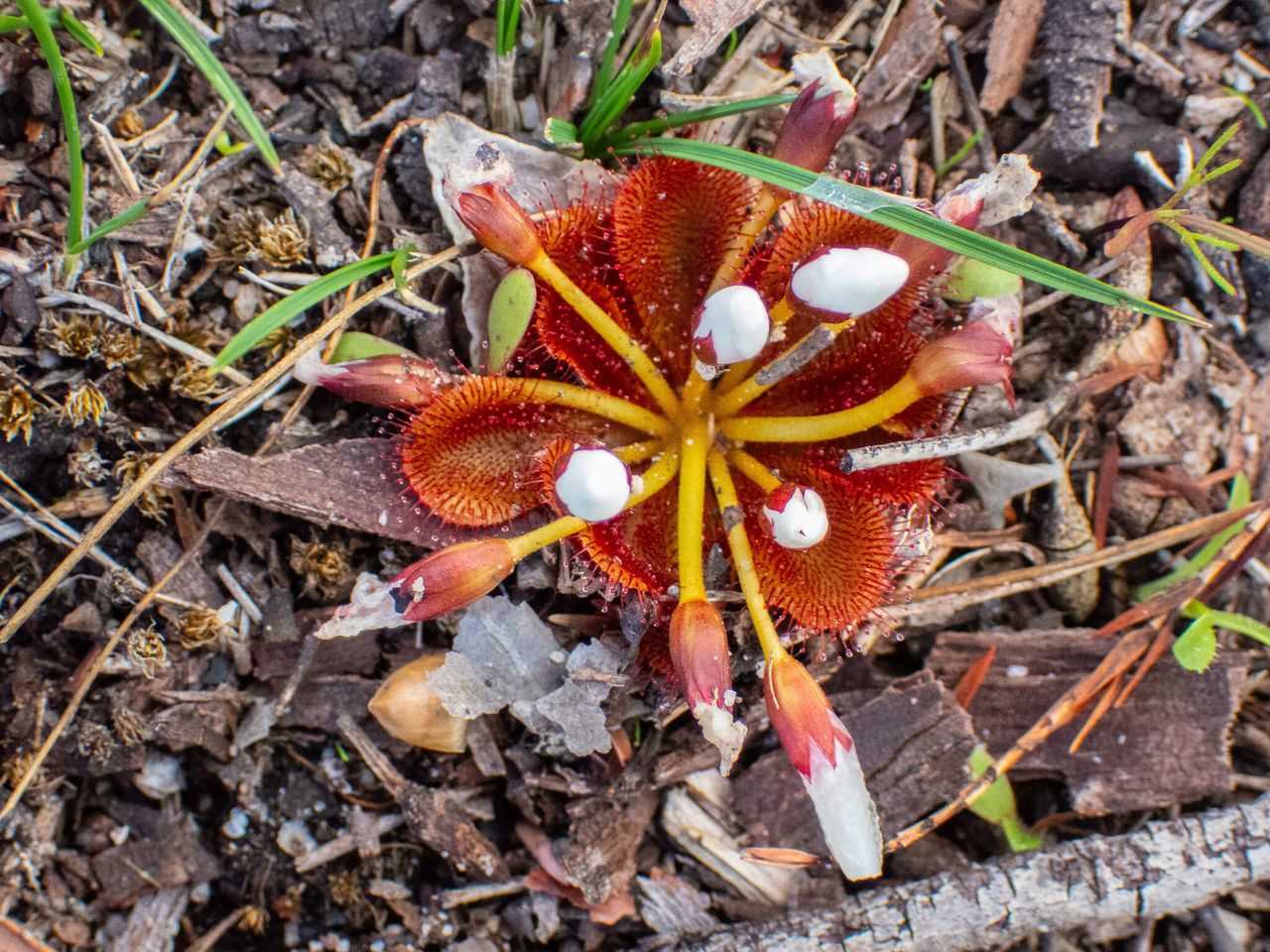
A flat, ground-hugging rosette about 7 cm across that reappears each wet season from a tuber. The leaves lie flat on the soil and carry the tentacles on their upper surface. The flowers are white and stand above the rosette from April to June. Exact leaf and flower measurements and details of the inflorescence are not published in the sources consulted.
Similar species
Its closest relatives are the other species of section Erythrorhiza, such as Drosera erythrorhiza and D. zonaria. D. zonaria has kidney-shaped leaves with crimson margins in concentric layers and flowers almost only after fire. How exactly D. erythrorhiza differs in the field is not worked out in the sources consulted. Autumn flowering and a swamp-margin habitat are good clues to D. rosulata, but a firm identification needs attention to leaf shape and inflorescence.
The trap and how it works
An active flypaper trap held close to the ground. The rosette leaves lie flat on the soil and carry stalked glands with a sticky droplet on the upper surface and along the margin. Whatever crawls over the ground or lands briefly — ants, springtails, small beetles and midges — becomes entangled, after which the tentacles slowly bend inwards and the glands secrete digestive enzymes. Nitrogen, phosphorus and minerals from the prey are absorbed through the same leaf surface. Because the plant is in leaf for only a few months each year, that food goes straight into the tuber, which has to carry the plant through the next dry summer.
Habitat and ecology
Sandy or clayey soils on the margins of swamps (W7, W4). These margins are saturated in winter and dry out in summer; the plant survives that dry period as a tuber deep in the ground.
Distribution and elevation
Endemic to south-west Western Australia. No closer range boundary is given in the sources consulted. Altitudinal limits are not published.
- Recorded (quarter-degree cells)
Forms and variation
Johann Georg Christian Lehmann described the species in 1844. Synonyms include Sondera rosulata and a later name Drosera rosulata Behr. The species is placed in subgenus Ergaleium, section Erythrorhiza. No subspecies are recognised.
Where and when to see it
The flowering time — April to June — is early: just after the first autumn rains. Anyone coming in spring sees only the rosettes. Search the margins of swamps, in the zone between open water and dry heath. Do not dig tubers.
Conservation status
Assessed as Least Concern (LC) on the IUCN Red List; not listed in CITES. The sources consulted name no specific threats. Swamp margins in south-west Australia are under pressure from drainage, clearing and declining winter rainfall.
Scientific name
Drosera rosulata | Lehmann, 1844
Drosera rosulata was described in 1844 by the German botanist Johann Georg Christian Lehmann, published in his work Novarum et minus cognitarum stirpium pugillus octavus (Nov. Stirp. Pug. 8), page 36. The species is endemic to southwestern Western Australia, where it grows on sandy or clayey soils at the margins of swamps. The precise type locality, collector and collection date of the 19th-century material used by Lehmann could not be established with certainty. The epithet rosulata is Latin for "rosette-forming" or "growing in a small rosette" (from rosula, "little rose/rosette"), and descriptively refers to the plant's leaf rosette, which reaches about 7 cm in diameter.
World Checklist of Vascular Plants (WCVP), via Plants of the World Online (POWO), Royal Botanic Gardens, Kew.