All species › Caryophyllales › Sundew family › Drosera roseana
Drosera roseana
A pygmy sundew of Western Australia whose taxonomic position is still in flux. Drosera roseana was described as a species in 1992 by N.G. Marchant and Allen Lowrie; Plants of the World Online treats it as a species in its own right, while the GBIF backbone treats it as a subspecies of D. paleacea. This guide follows its treatment as a species. The available sources on this plant are thin, and this text is therefore shorter than usual.
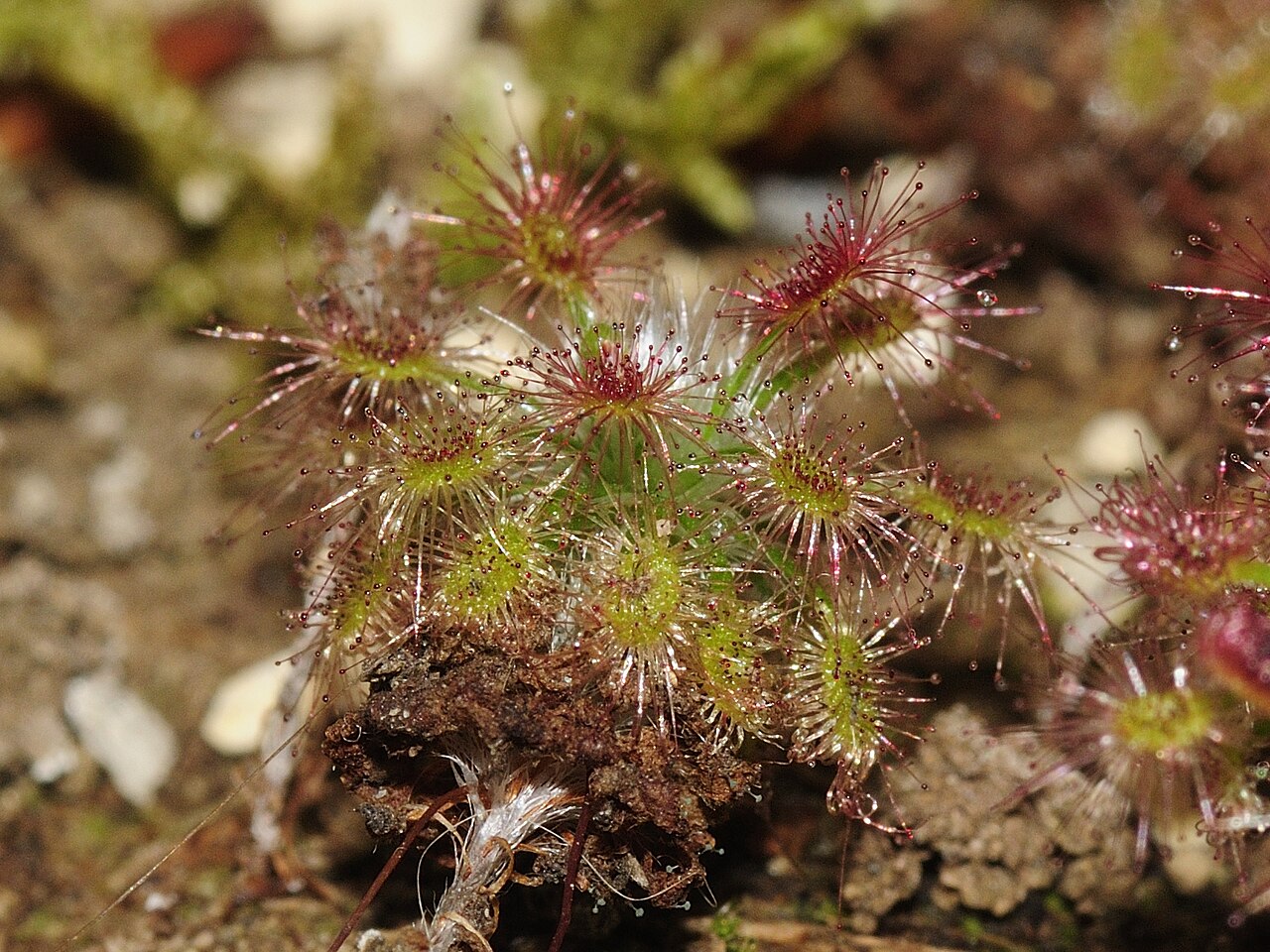
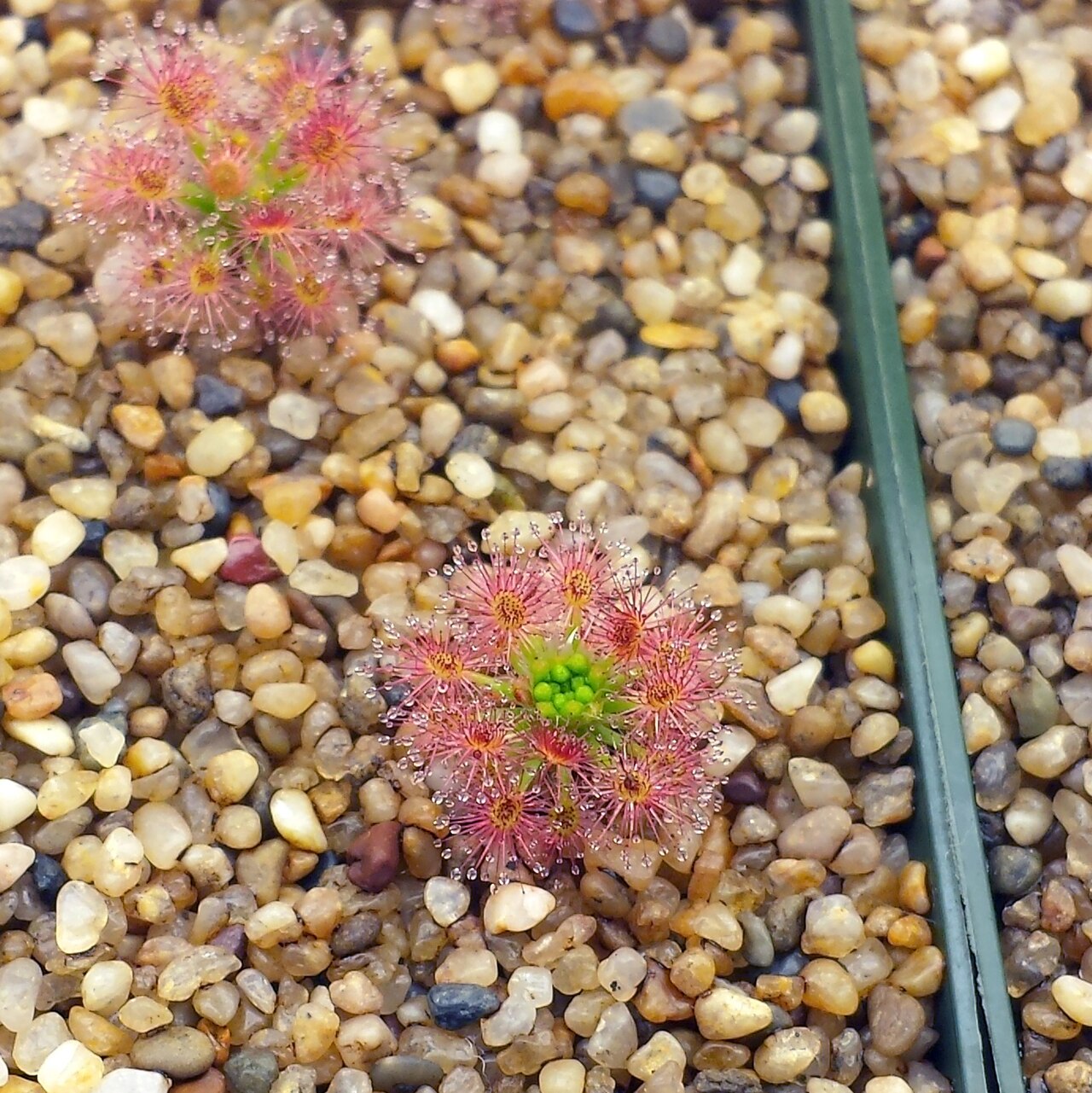
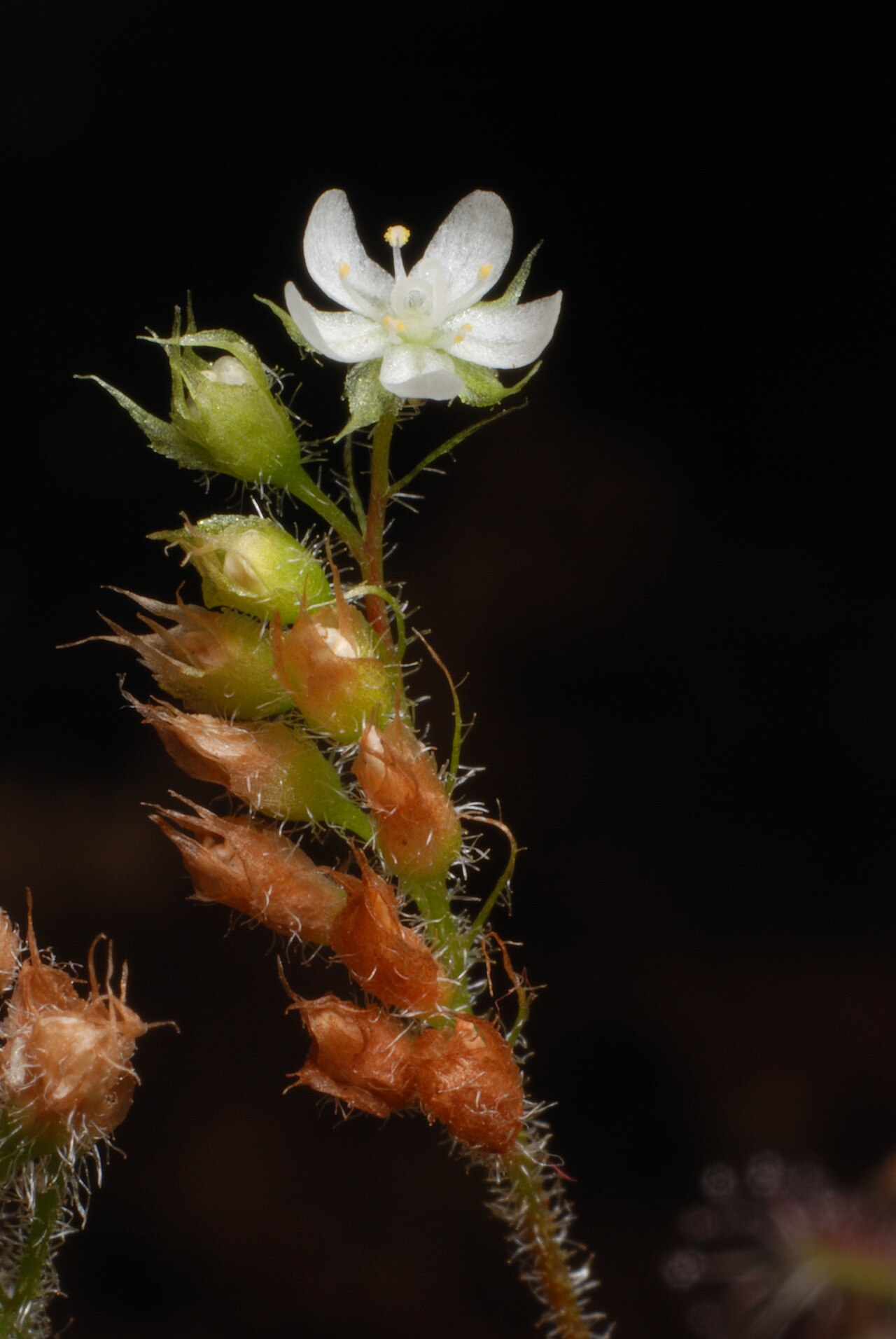

Identification
A typical pygmy sundew: a small rosette of stalked round blades with tentacles around a bud of stipules. The only character explicitly mentioned in the sources consulted is that the flowers are sweetly scented — a less common trait among pygmy sundews. Flower colour, flowering time and leaf and flower measurements are not given in accessible sources; all measurement fields are left empty. Anyone wishing to identify the plant needs the original 1992 description or Lowrie's 2013 handbook.
Similar species
The obvious confusion is with Drosera paleacea, of which part of the literature regards it as a subspecies. The difference between the two is not worked out in the sources consulted; the scent of the flower may be a clue, but that cannot be confirmed here.
The trap and how it works
An active flypaper trap in miniature. Each leaf blade, often no larger than a pinhead to a few millimetres, carries stalked glands on its margin and upper surface, each holding a glistening sticky droplet; the marginal tentacles are usually the longest. A small animal that touches the droplets sticks fast, after which the tentacles bend towards the centre of the blade and press the prey against the digestive glands. The glands secrete enzymes and absorb nitrogen, phosphorus and minerals from whatever dissolves. Given the scale, the catch consists of the very smallest: springtails, mites, aphids, thrips and minute midges moving over or just above the sandy ground.
Habitat and ecology
Further habitat details are not given in the sources consulted. The codes assigned — sand and open heath (D1, B5) — reflect the usual setting of the paleacea group and are a provisional estimate, not a published observation.
Distribution and elevation
Endemic to Western Australia. No closer delimitation of the range was found in accessible sources. Altitudinal limits are not published.
- Recorded (one-degree cells)
Forms and variation
Described in 1992 by N.G. Marchant and Allen Lowrie. Jan Schlauer later placed the plant under D. paleacea as subsp. roseana; GBIF follows that treatment, Plants of the World Online does not. That disagreement is the main open question surrounding this name.
Where and when to see it
Without reliable data on flowering time and sites, targeted searching is difficult. Before a visit, consult the FloraBase species profile or a local plant society, and treat every pygmy sundew on open sand with care: do not trample, do not move.
Conservation status
Assessed as Least Concern (LC) on the IUCN Red List; not listed in CITES. Further data on population size or threats were not found in the sources consulted.
Scientific name
Drosera roseana | Marchant & Lowrie, 1996
Drosera roseana was described in 1992 by Neville Gordon Marchant & Allen Lowrie, published in Kew Bulletin, volume 47(2): 327. The holotype was collected in Western Australia, on Millbrook Road, about 5 km east of the Albany Highway, on 17 October 1987 by Allen Lowrie, in peaty sand on the margins of swamps; the specimen is deposited in herbarium PERTH (no. 2344807). The precise origin of the epithet roseana could not be established with certainty. It may derive from the Latin roseus ("rosy, pink"), descriptively referring to the plant's colouring (its traps range from yellow-green through pink to deep red); an eponymous origin (named after a person called Rose) could likewise not be confirmed or ruled out.
World Checklist of Vascular Plants (WCVP), via Plants of the World Online (POWO), Royal Botanic Gardens, Kew.