All species › Caryophyllales › Sundew family › Drosera auriculata
Drosera auriculata
Drosera auriculata is the tallest and one of the most widespread species of the D. peltata complex: an erect tuberous sundew that can reach 60 cm in the Australian and New Zealand spring, with small peltate trapping leaves along its whole stem. It was long treated as a subspecies of D. peltata, but its glabrous sepals and long cylindrical seeds make it easy to separate.
Identification
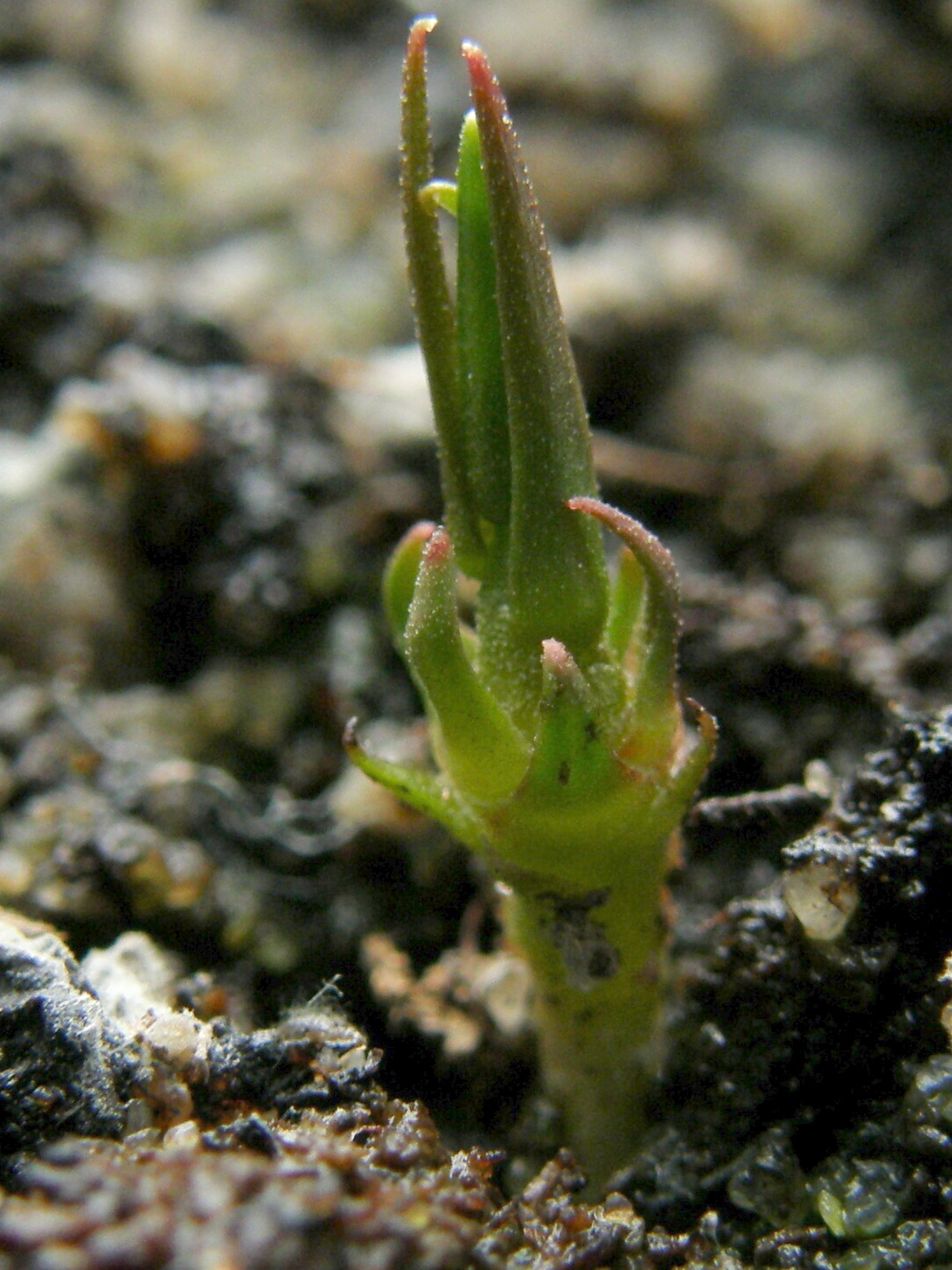
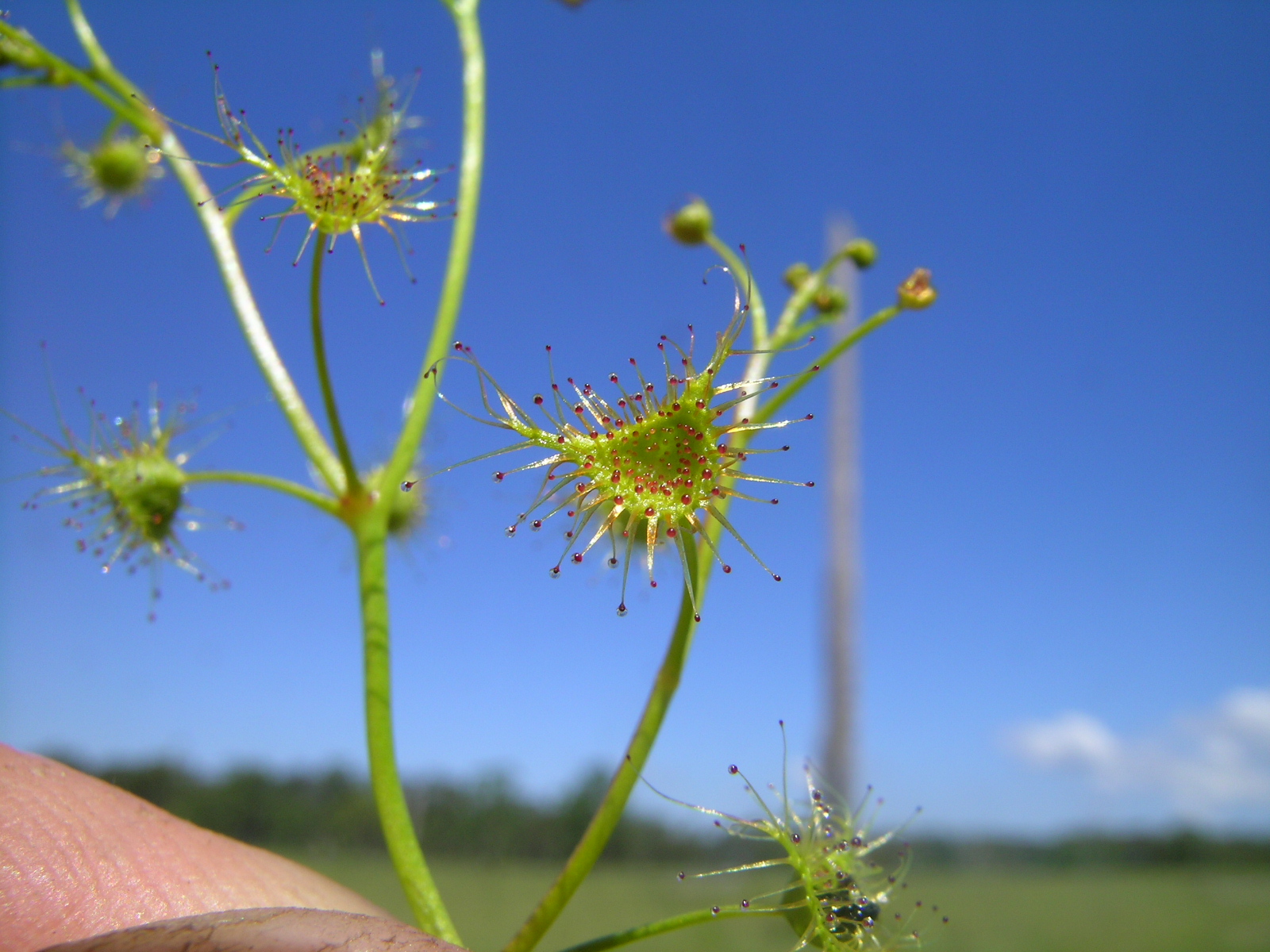
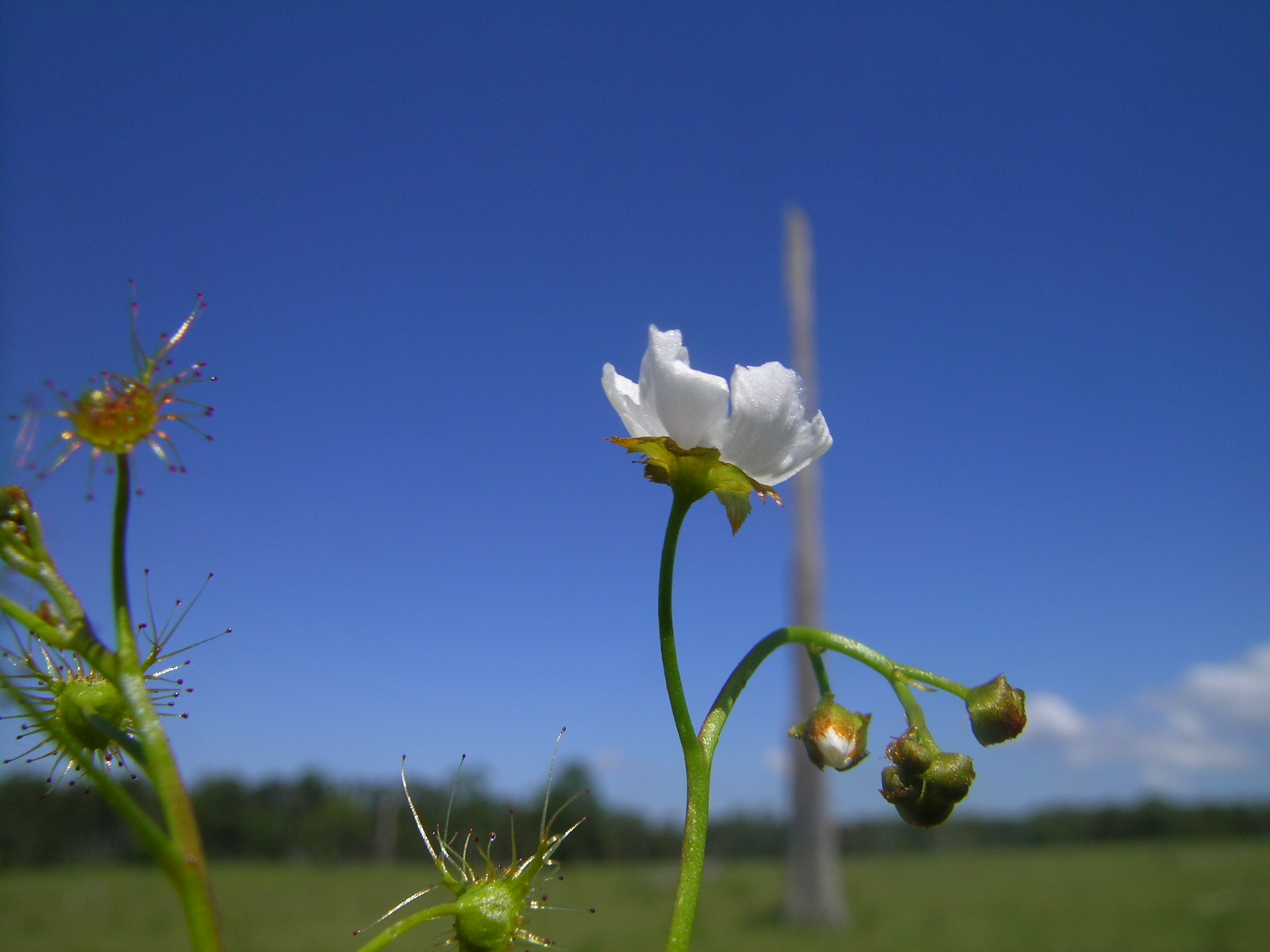
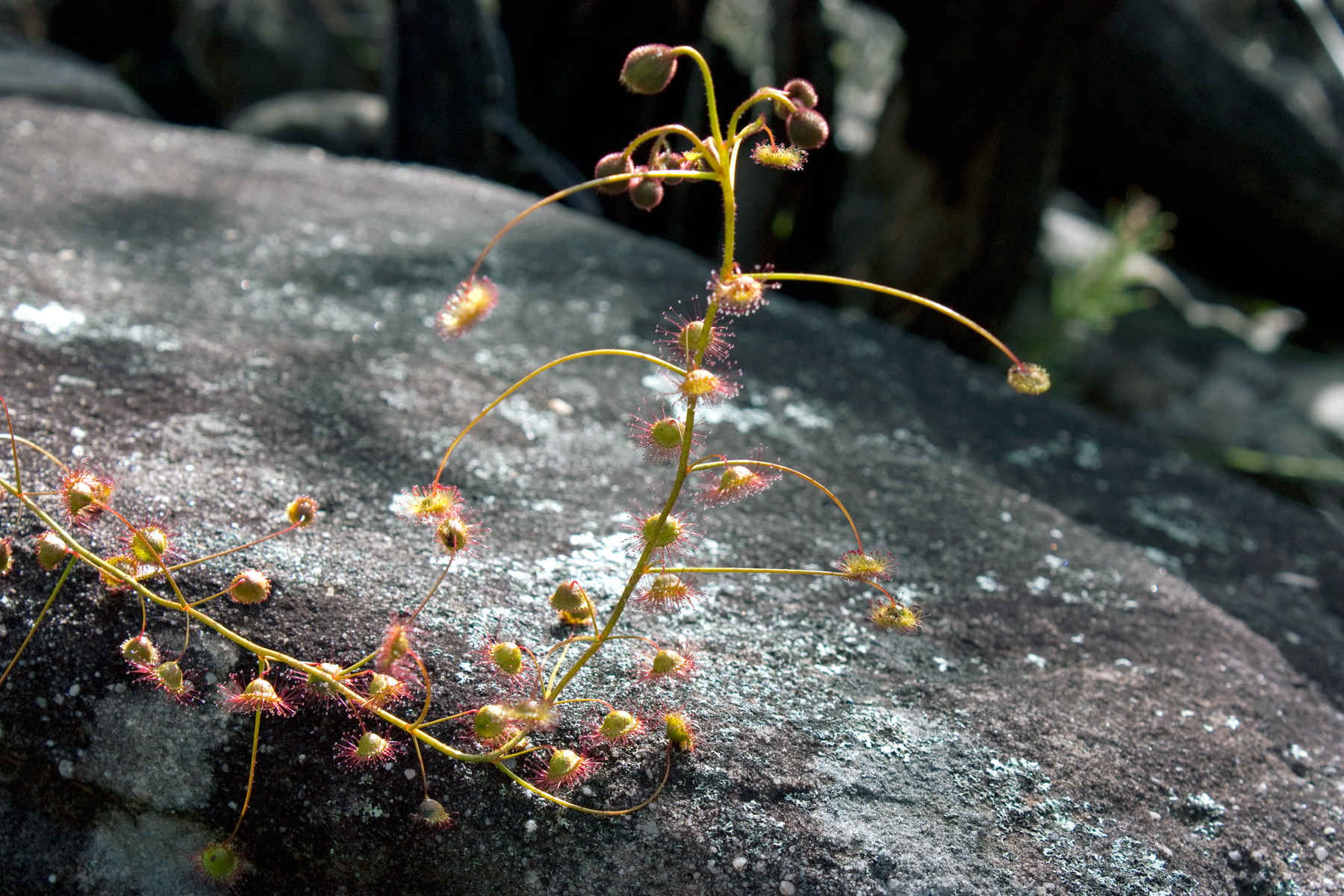
In winter a globose tuber at most 10 mm across produces an erect stem 9 to 60 cm tall, olive-green, in Tasmania sometimes maroon and in New Zealand sometimes red. The basal leaves are reduced and pressed to the ground. Along the stem stand peltate, crescent-shaped trapping leaves on stalks, together 5 to 19 mm long, often in groups of two to six towards the top. The terminal raceme carries two to fourteen flowers with obovate petals 3 to 10 mm long, white or more often pale pink. The sepals are glabrous, with an entire to weakly toothed margin. Each of the three styles is divided into 15 to 30 cylindrical segments; the seeds are cylindrical and 0.8 to 1.6 mm long.
Similar species
Within the D. peltata complex the glabrous calyx is the best character: D. peltata in the strict sense, D. gunniana, D. hookeri and D. gracilis all have hairy sepals. In addition the seeds of D. auriculata are longer and cylindrical, and its styles and petals are proportionally longer. D. hookeri is also much smaller and bright yellow-green; D. gunniana has pink to red tubers and densely hairy calyces with long hairs.
The trap and how it works
An active flypaper trap on a tall support. The marginal tentacles of the crescent-shaped leaves, especially those on the two 'ears' to which the species owes its name, are long and bend quickly towards a stuck insect; shorter central tentacles digest the prey. Because the leaves stand up to half a metre high along the stem, the plant catches many flying insects.
Habitat and ecology
Dry to damp places, often among rocks in forested country and on gravelly soil (B2, B6, R3), and elsewhere also on seasonally moist mineral soil. In New Zealand and Australia it also grows on disturbed ground such as verges and cuttings (H2). The plant sprouts in autumn or winter and rests as a tuber in summer.
Distribution and elevation
South-eastern Australia — Queensland, New South Wales, the Australian Capital Territory, Victoria, South Australia and Tasmania — and New Zealand, on the North and South Islands. The range description does not mention Queensland, but according to VicFlora and the International Carnivorous Plant Society the species does occur there. Altitudinal limits are not published in the sources consulted; the elevation field is left empty.
- Recorded (quarter-degree cells)
Forms and variation
The species was described by Planchon in 1848 based on a name by Backhouse. For a long time it was treated as D. peltata subsp. auriculata; the revision of the complex by Gibson, Conn and colleagues reinstated it as a separate species. Colour varies regionally: usually olive-green, in Tasmania sometimes maroon and in New Zealand sometimes red. Older literature and databases may still list it as a subspecies of D. peltata.
Where and when to see it
Search in spring, from July in Australia and from September in New Zealand, in open forest and on gravelly, rocky ground, and along verges and cuttings. The tall, slender stems with their sticky leaves and pink flowers show well in low light. Take a hand lens and check the calyx: a glabrous calyx confirms D. auriculata. Do not dig up tubers.
Conservation status
On the IUCN Red List the species is Least Concern (LC); it is not listed in CITES. The range is large and spans two countries; the species tolerates some disturbance and also grows on verges and cuttings. Locally it may decline with the loss of native forest vegetation and the spread of invasive plants.
Scientific name
Drosera auriculata | Backhouse ex Planchon, 1981
Originally named by James Backhouse, formally described by Jules Émile Planchon in 1848, in Annales des Sciences Naturelles, Botanique, series 3, volume 9, p. 295. Taxonomically unstable: reduced to D. peltata subsp. auriculata by Barry John Conn in 1981, though species status is still maintained by some authoritative sources. The precise type locality could not be established. The species (a tuberous sundew) occurs in south-eastern Australia. From the Latin auricula ("little ear") — probably referring to the ear-like appendages (stipules) at the leaf base, though this is not literally confirmed in a source.
World Checklist of Vascular Plants (WCVP), via Plants of the World Online (POWO), Royal Botanic Gardens, Kew.