All species › Caryophyllales › Sundew family › Drosera tracyi
Drosera tracyi
The largest sundew in North America, and one of the largest in the world growing from a simple basal tuft: a bundle of green threads beaded with glistening droplets, reaching half a metre tall. Drosera tracyi is a species of the Gulf of Mexico coastal plain, from Louisiana to north-west Florida and southern Georgia, where it grows in wet, open pine savannas and on seepage slopes that burn regularly. It was long treated as a variety of D. filiformis and is now — among others in Plants of the World Online and the Flora of North America — accepted as a species in its own right.
Identification
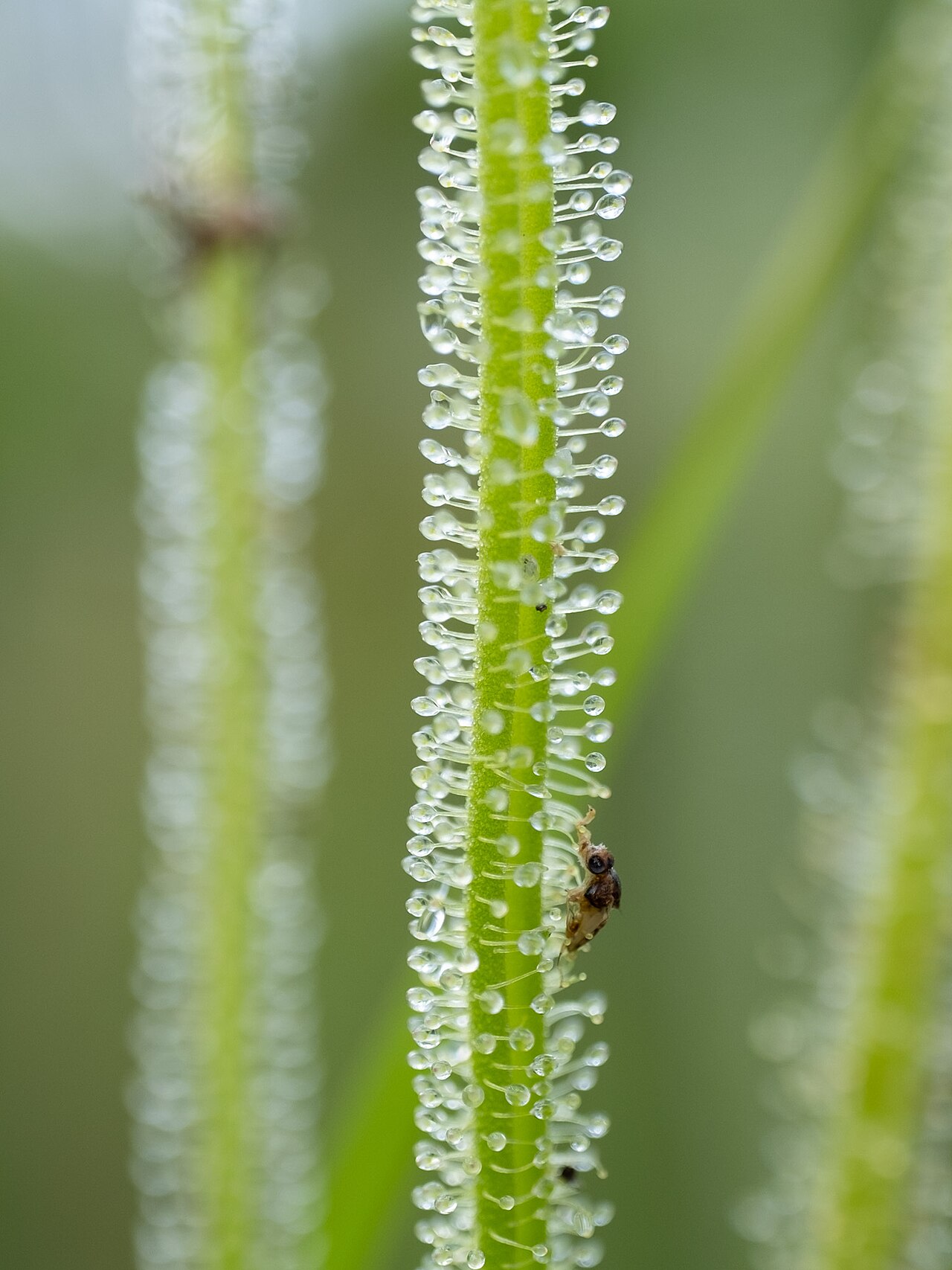
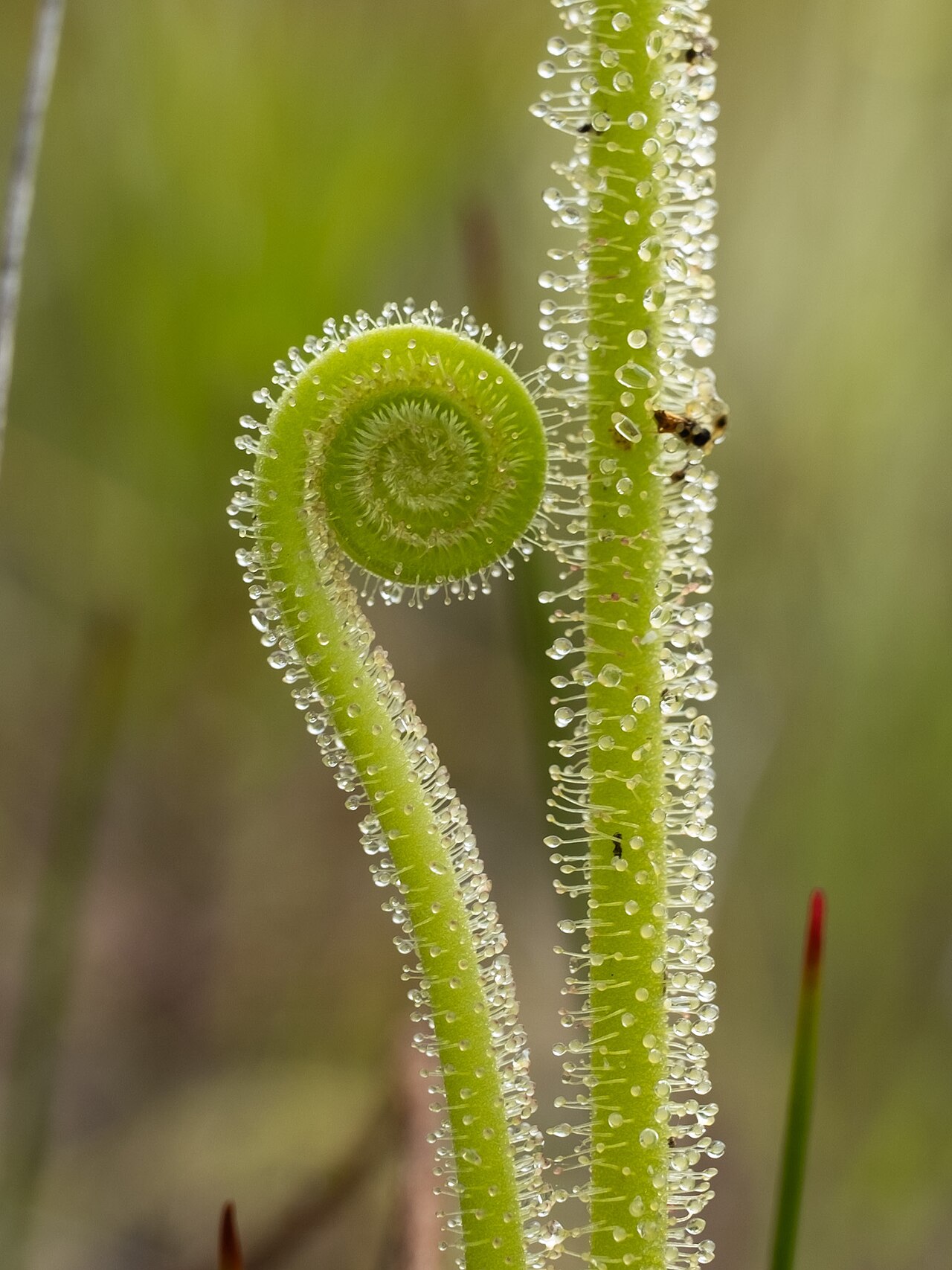
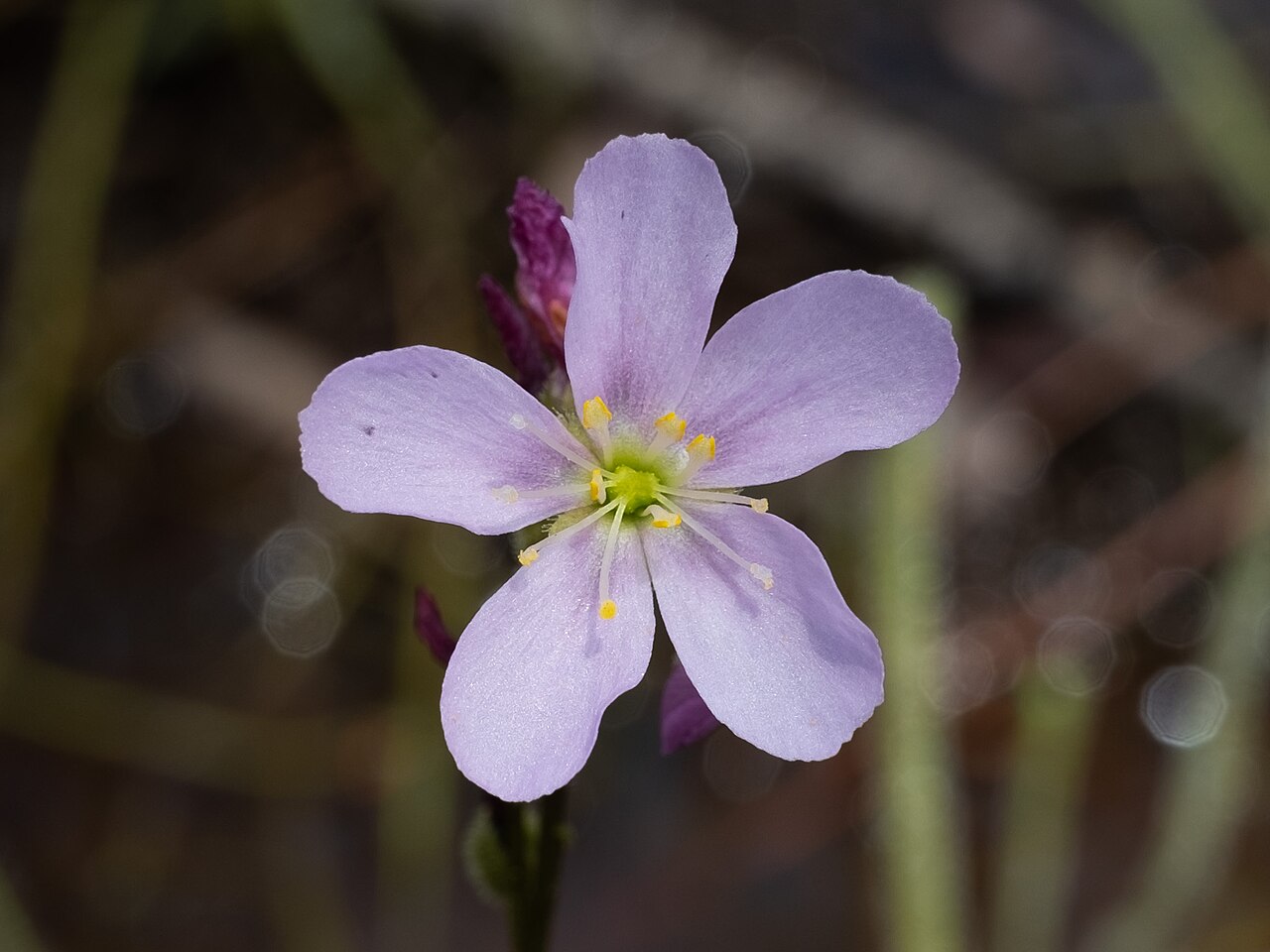
A perennial without an obvious stem, with a tuft of erect, thread-like leaves 20 to 50 cm long. There is no separate petiole or blade; the leaf carries stalked glands along almost its whole length, and here they are green, at most with a faint pinkish flush — the best field character. Young leaves unroll from the centre. The scape carries a one-sided raceme of a few to many flowers about 2 cm across, with five pale pink to pale lavender petals. In winter the plant forms a hibernaculum of folded young leaves.
Similar species
Only Drosera filiformis resembles it: that species is smaller, with leaves of at most about 25 cm, and has red to purplish-red tentacles and deeper pink flowers. The two barely overlap: D. filiformis is an Atlantic-coast species, D. tracyi one of the Gulf coast. In north-west Florida plants intermediate between them occur, and no sharp line can be drawn by eye there. Other sundews in the same area, such as D. capillaris, D. brevifolia and D. intermedia, have a rosette of stalked, broadened blades and cannot be confused.
The trap and how it works
An active flypaper trap. The droplets on the long threads work like a vertical flypaper: anything that flies against the tuft or crawls along it sticks fast. The tentacles bend towards the prey, and with larger prey the thread itself curves slightly round the insect. Because the leaf is so long and upright, this species catches more flying prey than the flat rosettes in the same habitat, including sizeable flies, bees and small butterflies. Digestion, as in all sundews, is by enzymes secreted from the glands, after which the dissolved nutrients are absorbed through the same glands.
Habitat and ecology
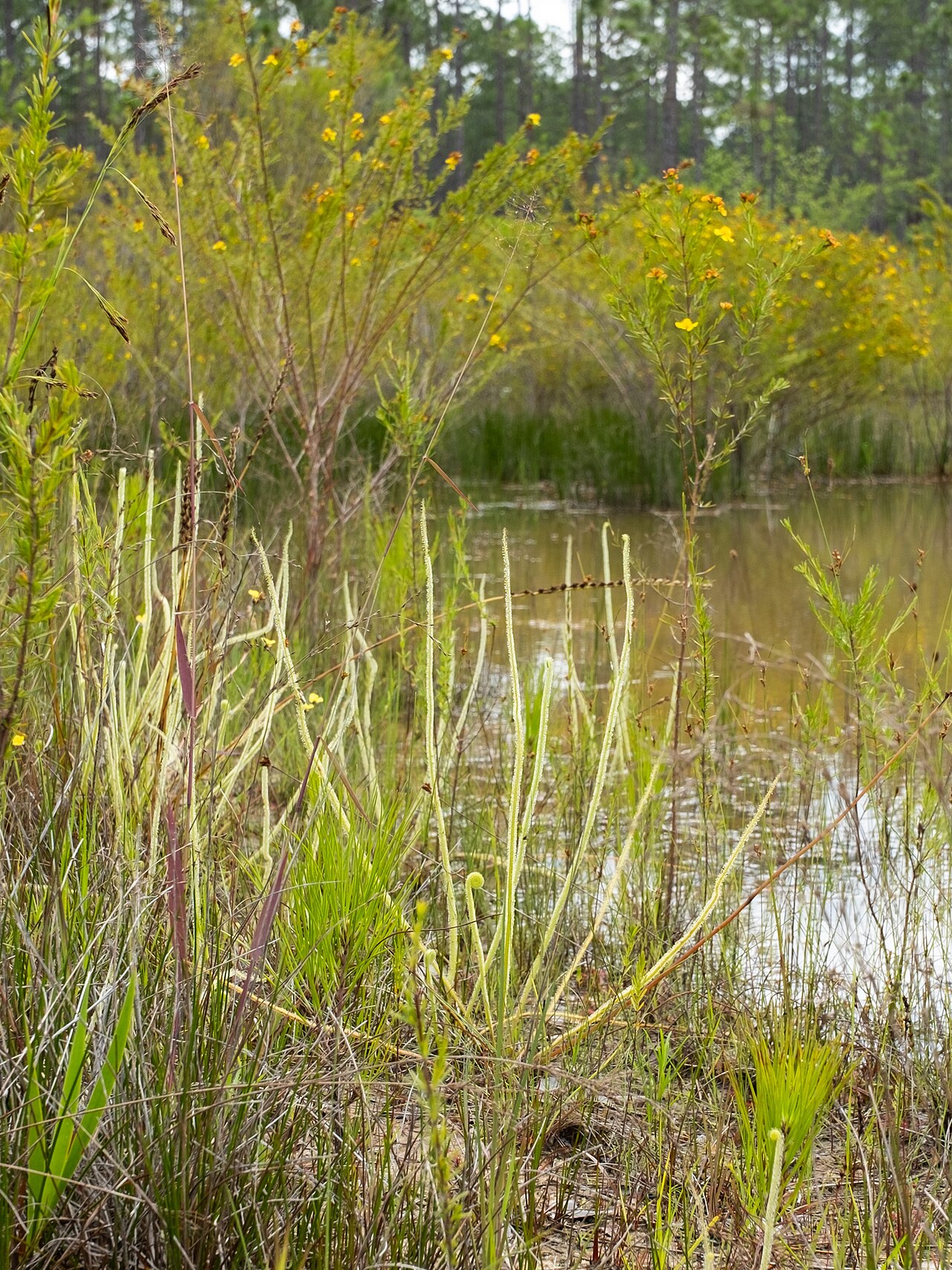
Wet, acid, nutrient-poor sand in open pine savannas and flatwoods (B6), on seepage slopes where groundwater trickles out at the surface, and along the edges of marshes and peaty hollows (W4). The species depends on regular fire to keep shrubs and tall grass back; without fire it disappears under the regrowth. It also establishes in wet roadside ditches and drains through pine forest (H1), where mowing and ditch maintenance keep the ground open.
Distribution and elevation
The coastal plain along the northern Gulf of Mexico in the south-eastern United States: north-west Florida (the Panhandle), southern Alabama, southern Mississippi, south-western Georgia and eastern Louisiana. It does not occur wild outside this area. Observation data are strongly concentrated in Florida, Alabama and Mississippi. The sites are all lowland near the coast; no published altitudinal range was found, so the elevation field is left empty.
Forms and variation
No varieties are recognised within D. tracyi. The relationship with D. filiformis does matter: the Florida plants known as D. filiformis var. floridana show characters of both and are regarded by some authors as a stabilised intermediate. Natural hybrids with other sundews of the region have also been reported; these do not get a page of their own in this guide.
Where and when to see it
May and June: the leaves are then at their longest and the flowers open. Search the wettest parts of a pine savanna that has burned in the last two or three years; there the tufts stand most open and show from afar as a silvery haze above the grass. Look into the light and the droplets glow. Many sites lie in nature reserves and state forests; keep to the paths, because seepage slopes are soggy and easily damaged.
Conservation status
The species has not been assessed for the global IUCN Red List and is not in CITES. Within its small range it is still locally plentiful, but the pine savannas of the Gulf coast have largely disappeared over the last century through forestry plantations, drainage, development and the suppression of natural fires. What remains is fragmented; the future of the species depends almost entirely on management with prescribed fire in the remaining natural areas.
Scientific name
Drosera tracyi | Macfarlane, 1906
The name was published in 1906 by Ludwig Diels as Drosera filiformis var. tracyi (attributed to "Macfarlane ex Diels"), in Engler's series Das Pflanzenreich (IV.112). The plant has also since been treated as a separate species, Drosera tracyi Macfarl., cited in L.H. Bailey's Standard Cyclopedia of Horticulture, volume 2, p. 1077 (1914). Botanists remain divided as to whether it should be treated as a distinct species or as a variety of D. filiformis. The precise type locality and collection details could not be established with certainty. The plant occurs naturally on the Gulf Coastal Plain, from Florida to Mississippi/Louisiana. The name tracyi is an eponym honouring a person named Tracy. It is likely Samuel Mills Tracy (1847–1920), an American botanist who served as head of the Mississippi Agricultural Experiment Station and carried out botanical fieldwork in the southeastern Gulf states — the plant's own distribution area. However, an explicit, source-confirmed link between the name and this person could not be found; the identification remains plausible but not confirmed with certainty.
World Checklist of Vascular Plants (WCVP), via Plants of the World Online (POWO), Royal Botanic Gardens, Kew.