All species › Caryophyllales › Sundew family › Drosera zigzagia
Drosera zigzagia
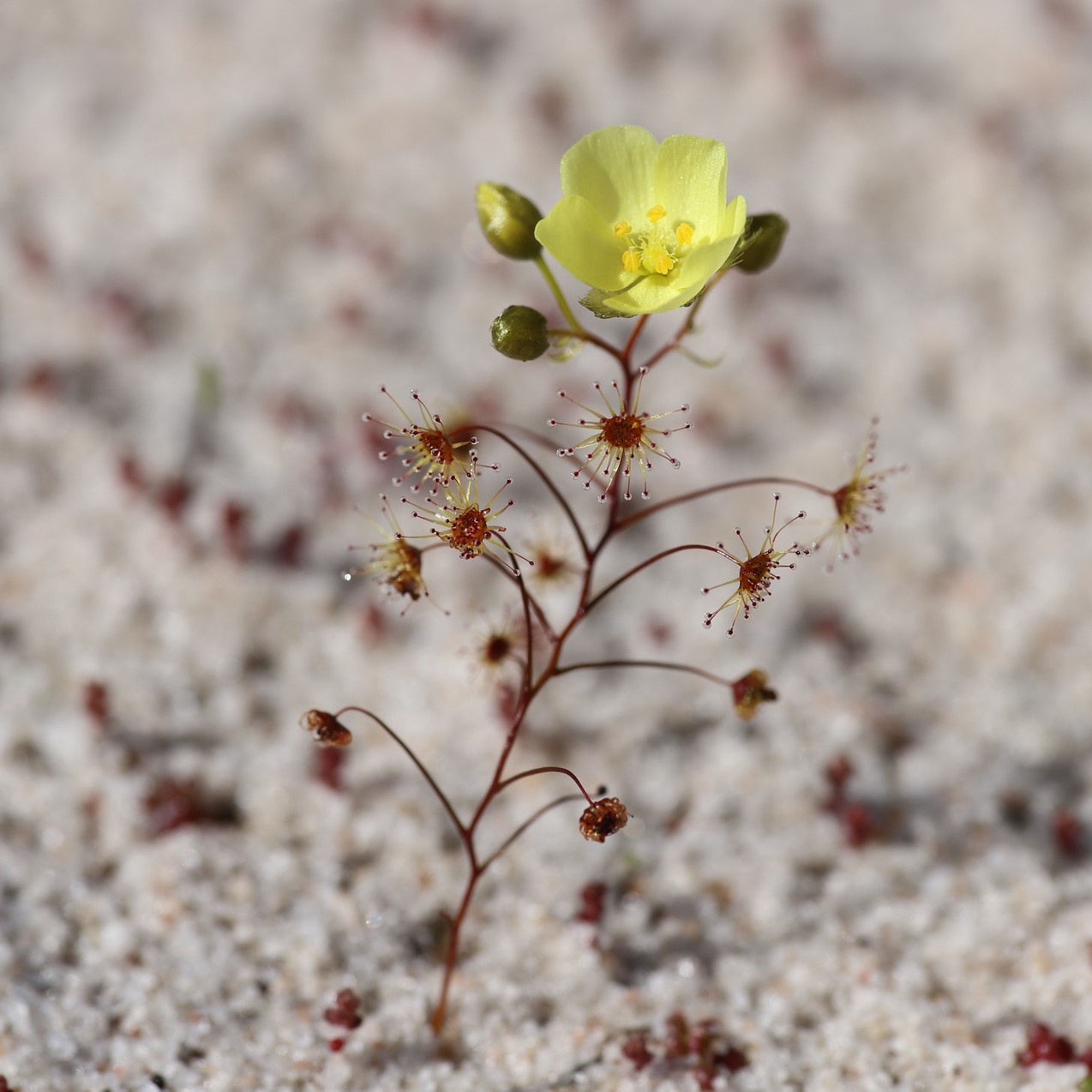
A small, erect tuberous sundew of the salt-lake margins of southern Western Australia, named after its striking stem, which changes direction at every leaf. Drosera zigzagia flowers yellow and often grows together with the white-flowered D. salina.
Identification
An erect perennial tuberous plant 5 to 7 cm tall, with a zigzag stem along which the small trapping leaves stand singly and alternately — the stem bends at each leaf. The inflorescence carries four to nine yellow flowers, which appear in August and September. Exact leaf and flower measurements are not published in the sources consulted.
Similar species
Drosera salina grows on the same salt-lake margins, also small and erect, but with white flowers and without the clear zigzag stem. Other yellow-flowered tuberous sundews such as D. subhirtella and D. sulphurea are climbers tens of centimetres long and do not grow by salt lakes.
The trap and how it works
An active flypaper trap, but held well above the ground. The leaves along the stem are small, peltate and often cup-shaped, with longer tentacles on the margin and shorter ones on the blade. Flying insects — midges, small flies, sometimes bees or butterflies drawn to the flowers — touch the droplets and stay hanging. The marginal tentacles then bend inwards and the blade partly closes around the prey, after which the glands secrete enzymes and absorb the dissolved nutrients. Because the traps are spread along an upright or climbing stem, the plant sweeps a much larger volume of air than a rosette on the ground.
Habitat and ecology
The margins of salt lakes, on brown sandy loam (D4, D1). There the plant often grows together with Drosera salina, Stylidium species, Levenhookia leptantha and Frankenia — a characteristic assemblage of the sandy transition zone around salt lakes.
Distribution and elevation
Endemic to Western Australia, in the south, around salt lakes. No closer delimitation is given in the sources consulted. Altitudinal limits are not published.
- Recorded (one-degree cells)
Forms and variation
Allen Lowrie described the species in 1999 and placed it in subgenus Ergaleium, section Ergaleium. A synonym is Drosera huegelii var. flaviflora W.Fitzg. ex Ewart, an older name that already pointed to the yellow flowers. No subspecies are recognised.
Where and when to see it
August and September, in sunshine, when the yellow flowers are open. Search the sandy, slightly raised margin of salt lakes, and look for small plants with a kinked stem among Frankenia and Stylidium. Keep off the salt crust — it is soft after rain and trampling leaves long-lasting marks.
Conservation status
Assessed as Least Concern (LC) on the IUCN Red List; not listed in CITES. The sources consulted name no specific threats. Salt-lake margins in the wheatbelt are, however, affected by the salinisation that follows clearing.
Scientific name
Drosera zigzagia | Lowrie, 1999
Drosera zigzagia was described in 1999 by Allen Lowrie, published in Nuytsia, volume 13(1), page 85 (within the article spanning pages 75–87). The species is endemic to Western Australia and occurs on the margins of salt lakes in brown sandy loam; a precise type locality with collector and collection date could not be established with certainty. The name zigzagia is a descriptive term, derived from the word "zigzag", and refers to the small, solitary carnivorous leaves that alternate along a zigzagging stem — a distinctive morphological feature of this species.
World Checklist of Vascular Plants (WCVP), via Plants of the World Online (POWO), Royal Botanic Gardens, Kew.