All species › Caryophyllales › Sundew family › Drosera rupicola
Drosera rupicola
The rock-dweller among the fan-leaved sundews of section Stolonifera. Drosera rupicola — 'living on rocks' — grows in loam at the foot of the granite domes that rise above the wheatbelt in the Western Australian interior, and has something its relatives lack: leaf blades that fold over their prey.
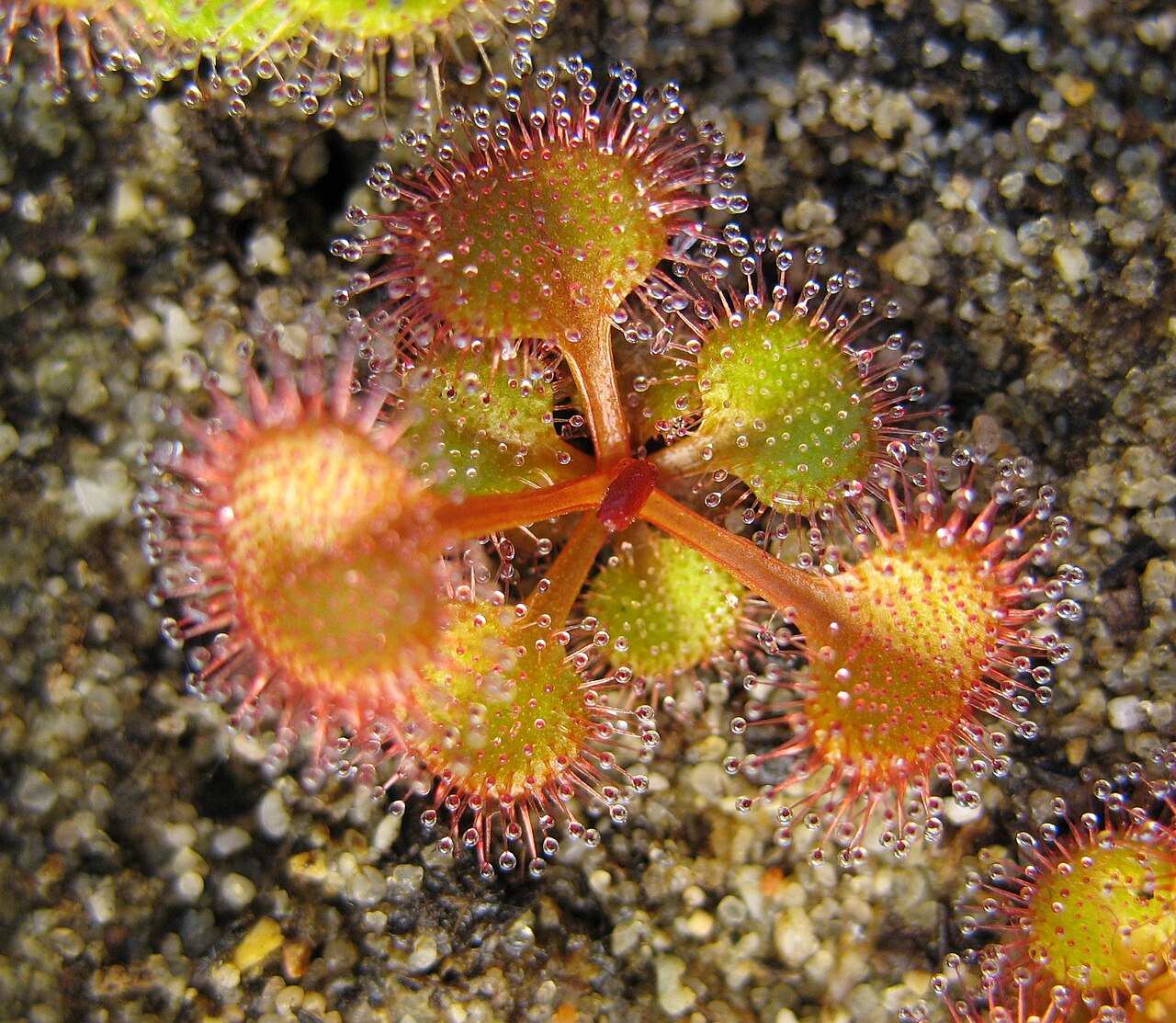
Identification
A perennial tuberous plant with three to five semi-erect lateral stems up to 15 cm long, bearing the fan-shaped trapping leaves typical of the section. The tuber is top-shaped (turbinate). The most striking character is the mobility of the leaf blade: it can fold over a captured insect. Flowering July to October. Flower colour and exact measurements are not given in the sources consulted.
Similar species
Within section Stolonifera, D. rupicola is distinguished by its turbinate tuber and mobile leaf blade. Drosera stolonifera, under which it was originally placed as a subspecies, also has obliquely ascending lateral stems, but grows in wet heath on the coastal plain around Perth and in jarrah forest. Drosera prostrata has prostrate stems and grows much further north. A habitat by granite outcrops inland is a strong clue to D. rupicola.
The trap and how it works
An active flypaper trap with a leaf shape of its own. The leaves are fan-shaped: a narrow base widening into a blade whose upper edge is set with long tentacles, sometimes in whorls of three or more along the stem. Small insects that walk into that edge or land on it stick to the droplets, after which the tentacles bend over the prey and the glands secrete enzymes. As in all tuberous sundews, much of the nitrogen and phosphorus absorbed goes into the tuber that has to carry the plant through summer. In D. rupicola this goes a step further than in its relatives: not only the tentacles but the blade itself moves and folds over the prey, so that more glands make contact at once.
Habitat and ecology
Loamy soils by granite outcrops (R3), in open woodland and scrub around those rocks (B6). The granite domes of the interior are islands of moisture: rainwater runs off the bare rock and collects at the foot, where the soil stays wet longer than on the surrounding plain.
Distribution and elevation
Endemic to Western Australia, across a large inland region: from Pithara to south-east of Hyden. This guide's working list names the Ballidu–Hyden district. Altitudinal limits are not published.
- Recorded (quarter-degree cells)
Forms and variation
N.G. Marchant described the plant in 1982 as Drosera stolonifera subsp. rupicola; Allen Lowrie raised it to species rank in 2005. No further forms are recognised within the species.
Where and when to see it
The granite outcrops of the wheatbelt are botanical hotspots in late winter and spring; search from July to October in the loam zone at the foot, where run-off keeps the soil wet. Many of these rocks are nature reserves; keep to paths, because the thin soil around granite domes recovers very slowly after trampling.
Conservation status
Assessed as Least Concern (LC) on the IUCN Red List; not listed in CITES. In an otherwise largely cleared wheatbelt, granite outcrops are often the last patches of natural ground; they are, however, under pressure from weeds, grazing and recreation.
Scientific name
Drosera rupicola | (Marchant) Lowrie, 1982
Drosera rupicola was recognised as a distinct species in 2005 by Allen Lowrie, published in Nuytsia, volume 15: 382; the name is a new combination based on the basionym Drosera stolonifera subsp. rupicola N.G.Marchant, which Neville Marchant had published in 1982 in Flora of Australia, volume 8: 384. The holotype was collected on 22 September 1971 by Neville G. Marchant at "Murray Rock," east of Hyden, in southwestern Western Australia, on loamy soils near granite outcrops; the specimen is deposited in herbarium PERTH (no. 6230954). The epithet rupicola is Latin for "rock-dweller" (from rupes, "rock," and -cola, "dweller of"), and refers directly to the species' habitat near granite outcrops — a descriptive name.
World Checklist of Vascular Plants (WCVP), via Plants of the World Online (POWO), Royal Botanic Gardens, Kew.