All species › Caryophyllales › Sundew family › Drosera schmutzii
Drosera schmutzii
Drosera schmutzii is a tuberous sundew found only on Kangaroo Island off the coast of South Australia. It was discovered as recently as 2002 by Father Erwin Schmutz, a priest and amateur botanist after whom it is named, and was described in 2008 by Allen Lowrie and John Conran. It is a close relative of D. whittakeri and D. aberrans.
Identification
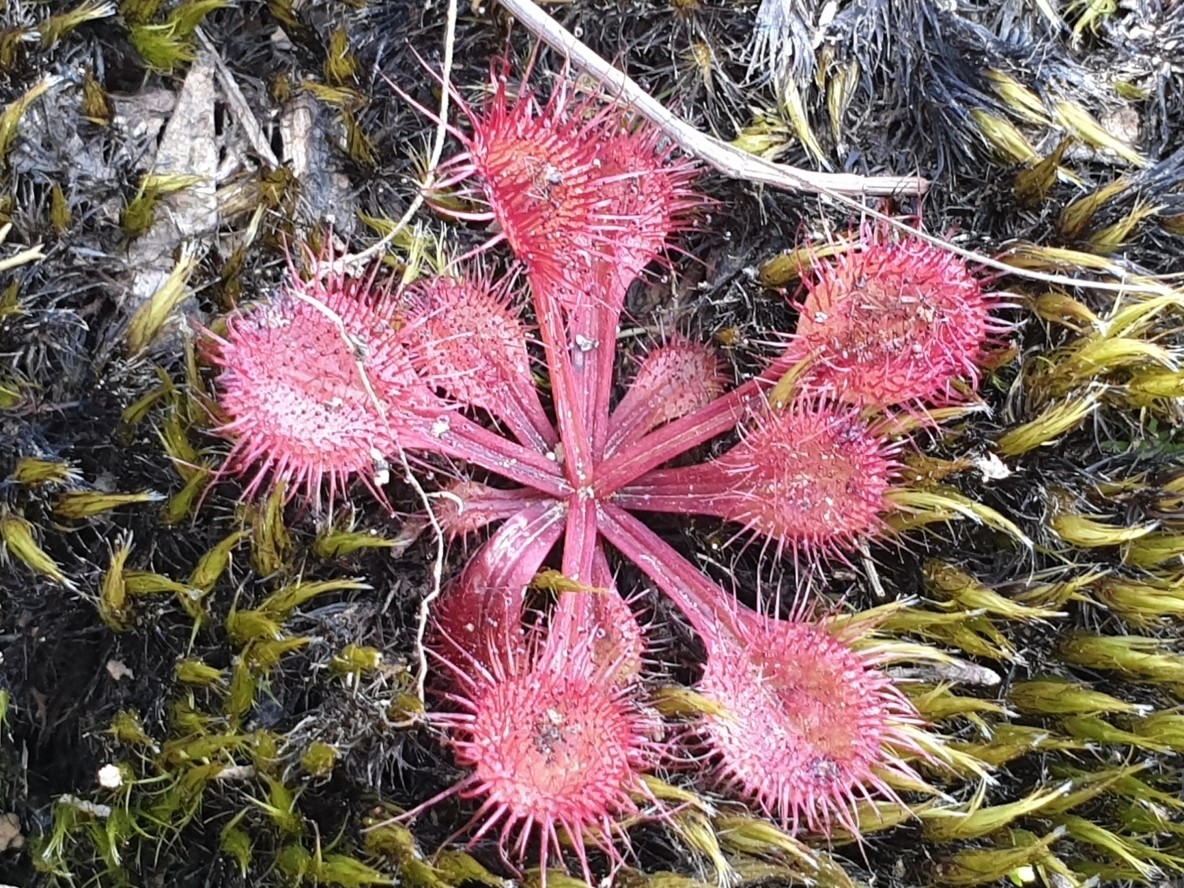
A compact rosette 3 to 4 cm across, with green to red leaves, growing from an underground tuber in the wet season. Unlike in its relatives, the leaves do not lie flat on the ground but are semi-erect; they have very narrow petioles without glands, with the sticky blade at the end. A second feature is that besides the basal rosette a few leaves stand in a whorl higher up on a short stem, separate from the rosette. Reliable data on the flowers were not available for this guide; that field is left empty.
Similar species
Drosera whittakeri, which also occurs in South Australia, has broad spatulate leaves lying flat in a rosette, without narrow stalks and without whorled leaves above the rosette. D. aberrans also has flat, sessile spatulate leaves and forms colonies by stolons. The combination of semi-erect leaves on narrow, eglandular stalks and the few separate whorled leaves is characteristic of D. schmutzii.
The trap and how it works
An active flypaper trap. The tentacles on the blades catch small insects in sticky mucilage; the tentacles bend towards the prey, which is then digested. The petioles themselves bear no glands and so catch nothing. Because the plant is above ground only in the cool, wet season, trapping falls in winter and early spring.
Habitat and ecology
Open places on sandy clay with laterite (D3), in scrub and heath with Allocasuarina muelleriana (B5). The species often grows with Stylidium tepperianum. In summer it survives as a tuber in the dried-out soil.
Distribution and elevation
Endemic to Kangaroo Island, South Australia, in the north and east of the island. The range description 'South Australia' is correct but broader than the actual range, which is confined to a single island. Altitudinal limits are not published in the sources consulted; the elevation field is left empty.
- Recorded (one-degree cells)
Forms and variation
No varieties are recognised. The species belongs to the group of tuberous rosette sundews around D. whittakeri, which since 2008 has been split into three species: D. whittakeri, D. aberrans and D. schmutzii. Its late discovery shows how incomplete knowledge of the Australian tuberous sundews was until recently.
Where and when to see it
Search in the Australian winter, June to September, in open places on lateritic sandy clay in the north and east of Kangaroo Island. The small rosettes with semi-erect leaves often grow among low scrub; look for Allocasuarina as a clue. Much of the island was burnt in the 2019–2020 bushfires; allow for closed areas and recovering vegetation.
Conservation status
On the IUCN Red List the species is Least Concern (LC); it is not listed in CITES. Its range, however, is small and confined to one island. The effects of the major 2019–2020 bushfires on its populations are not documented in the sources consulted; tuberous plants often survive fire well, but post-fire changes in vegetation and invasive species can degrade the sites. Loss of native vegetation to agriculture also plays a part on the island.
Scientific name
Drosera schmutzii | Lowrie & Conran, 2008
Drosera schmutzii was described in 2008 by Allen Lowrie and John G. Conran, in the journal Telopea, volume 12(2): 147–165, in a paper reviewing Drosera whittakeri sensu lato that split off this new species from Kangaroo Island. The type material comes from Kangaroo Island, South Australia (northern and eastern parts of the island). The species was first found in September 2002 by Father Erwin Schmutz. The exact holotype specimen (collector/date) could not be established with certainty. The species epithet honours Father Erwin Schmutz, who first discovered the plant on Kangaroo Island; it is therefore an eponym.
World Checklist of Vascular Plants (WCVP), via Plants of the World Online (POWO), Royal Botanic Gardens, Kew.