All species › Caryophyllales › Sundew family › Drosera spirocalyx
Drosera spirocalyx
A sundew of the Drosera montana alliance, described by Fernando Rivadavia and Paulo Gonella while unravelling that difficult complex. The name, spiral calyx, refers to a feature of the calyx that separates the species from its relatives. Drosera spirocalyx is endemic to Minas Gerais and one of many species recognised as distinct only in the recent revisions of the Brazilian sundews.
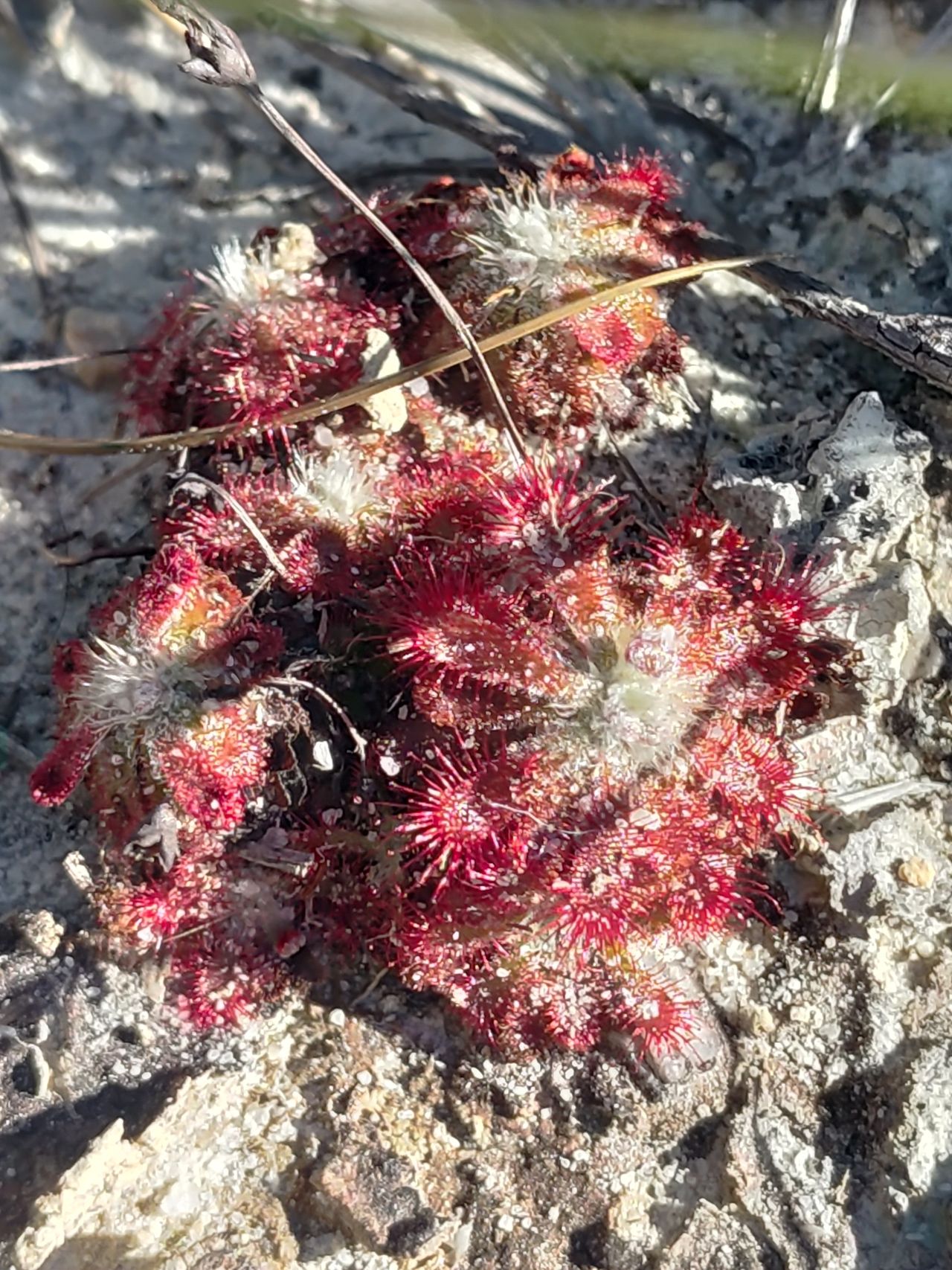
Identification
A small perennial rosette plant with spatulate leaves densely set with tentacles, turning red in sun, and a scape with a few flowers. The distinguishing character lies, as the name says, in the calyx. Exact measurements, a confirmed flower colour and a precise account of the calyx character could not be checked from the original sources; the size fields are therefore left empty.
Similar species
The closest relatives are Drosera montana, Drosera tomentosa and Drosera schwackei, species that all used to fall under D. montana. D. tomentosa is densely woolly; D. montana in the strict sense grows in the higher mountains of south-eastern Brazil. In the 2022 synopsis D. spirocalyx is shown on one distribution map with D. schwackei and Drosera chimaera, two other species confined to Minas Gerais. Identification needs a flowering plant, a hand lens and the key in the revision.
The trap and how it works
An active flypaper trap. The tentacles catch small insects walking over the ground or flying low above it, after which the surrounding tentacles bend towards the prey. The rosette lies close to the ground, so mainly crawling prey is caught.
Habitat and ecology
Open, wet to damp places in the campos rupestres of Minas Gerais: seepage zones along rock slabs, wet sandy ground and stream edges in quartzite country (R1, W4, D2). The plant needs full sun and soil that stays moist during the growing season.
Distribution and elevation
Endemic to the state of Minas Gerais in south-eastern Brazil, according to the distribution maps in the 2022 Brazilian synopsis. The exact location within the state and an altitudinal range could not be checked here.
- Recorded (one-degree cells)
Forms and variation
No varieties are recognised. The species belongs to the D. montana complex, revised in 2014, when former varieties were raised to species and new species described. Older records of D. montana from Minas Gerais may therefore also refer to this species.
Where and when to see it
In the wet season, November to March, search seepages in the quartzite mountains of Minas Gerais. Photograph flowers from the side and from below so that the calyx is clearly visible; without that detail the species can scarcely be separated from its relatives.
Conservation status
Not assessed for the global IUCN Red List and not listed in CITES. The species is confined to a single state; little has been published on population size or trends. Threats to the campos rupestres are fire, invasive grasses, mining and tourism.
Scientific name
Drosera spirocalyx | Rivadavia & Gonella, 2014
Drosera spirocalyx was described in 2014 by Fernando Rivadavia and Paulo Minatel Gonella, published in Phytotaxa, volume 172: 155. The holotype (SPF 213602) was collected by Fernando Rivadavia on 12 September 1999, along a trail in the Serra do Cipó, municipality of Santana do Riacho, in the state of Minas Gerais, Brazil. The name is compounded from Greek "speira" (spiral, coiled) and Latin "calyx" (calyx/sepals), likely referring to the twisted or spiral-shaped sepals of the species; however, this etymological interpretation could not be fully confirmed.
World Checklist of Vascular Plants (WCVP), via Plants of the World Online (POWO), Royal Botanic Gardens, Kew.