All species › Caryophyllales › Sundew family › Drosera stenopetala
Drosera stenopetala
Drosera stenopetala is one of the southernmost sundews in the world and belongs to a separate, ancient branch of the genus. The species is endemic to New Zealand and reaches the subantarctic Auckland Islands and Campbell Island. The epithet means 'with narrow petals'. With D. arcturi and the Tasmanian D. murfetii it forms subgenus Arcturia.
Identification
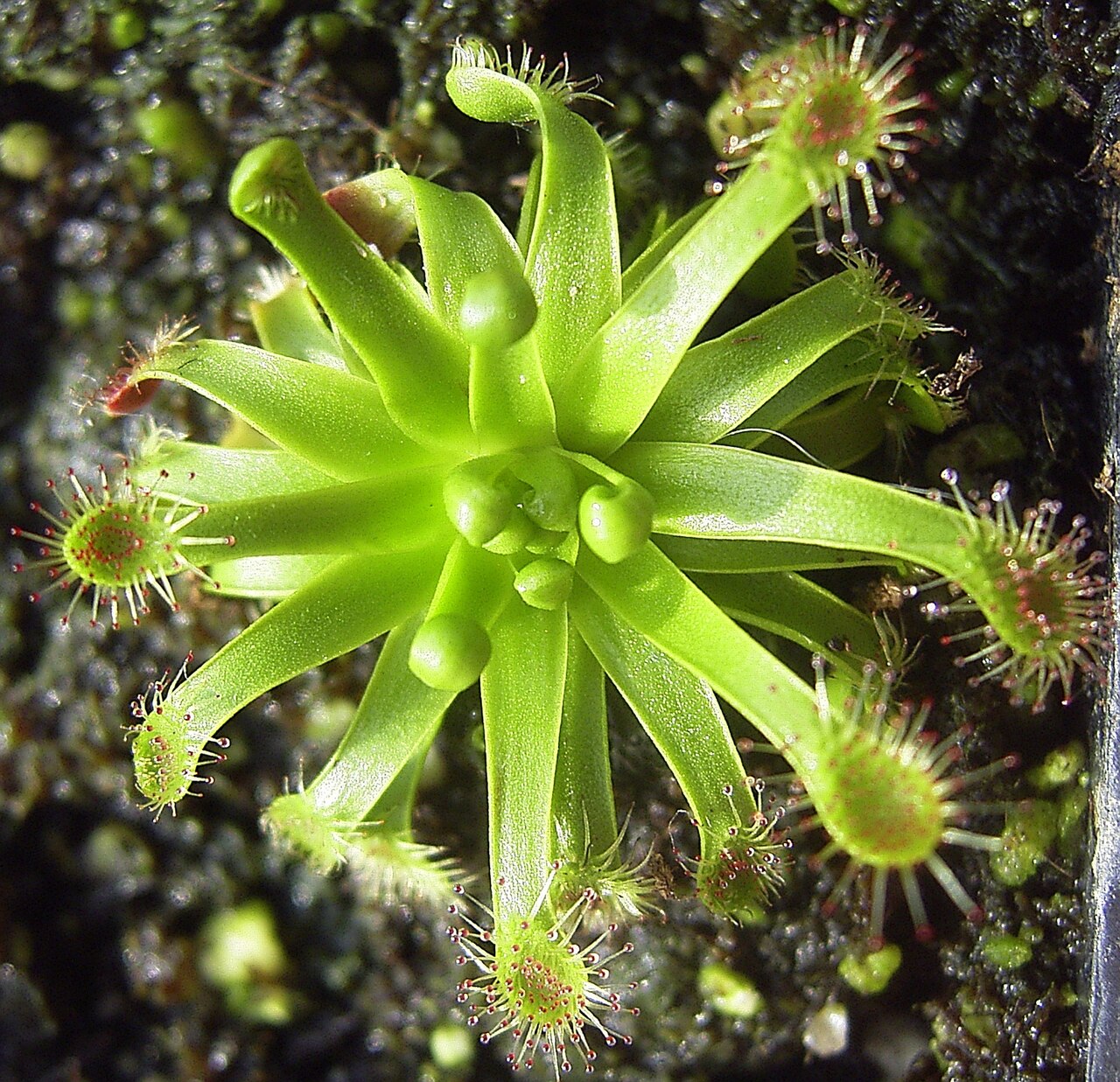
A rosette on a short stock clothed in the remains of old leaf bases. The leaves lack stipules; they consist of a glabrous petiole up to 5 cm and a narrow, spatulate blade up to 2 cm long and 5 mm wide, set with stalked glands. Each plant carries a single white flower on a glabrous stalk up to 20 cm. The calyx is five-lobed with rounded lobes about 3.5 mm long; the petals are cuneate to obovate and up to 1 cm long. There are three styles, each repeatedly divided. The capsule is about 7 mm long.
Similar species
The only real look-alike is Drosera arcturi, which grows in the same mountains and bogs. That has strap-shaped leaves with no clear division between stalk and blade, whereas D. stenopetala has a distinct, glabrous stalk and a clearly set-off spatulate blade. D. spatulata, which occurs in the New Zealand lowlands, has a flat rosette with short stalks and several small flowers per stem. D. auriculata has crescent-shaped, peltate leaves on an erect stem.
The trap and how it works
An active flypaper trap. The stalked glands on the narrow blade secrete a sticky mucilage in which small flies and gnats of the bog get stuck; the tentacles bend towards the prey and the glands digest it. In the cool, wet and extremely nutrient-poor bogs of the high mountains and subantarctic islands, that extra nitrogen is of great importance.
Habitat and ecology
Montane to subalpine Sphagnum bogs (W1), tarns and pools (W6) and the margins of slow-flowing streams (W4); in the south the species descends to sea level. It is an obligate wetland plant almost never found away from wet sites. The minute seeds are wind-dispersed.
Distribution and elevation
Endemic to New Zealand: the North Island (uncommon, in the central ranges and on the volcanic plateau and southwards), the South Island, Stewart Island/Rakiura and the subantarctic Auckland Islands and Campbell Island/Motu Ihupuku. The range description 'New Zealand and surrounding (subantarctic) islands' is correct. Exact altitudinal limits are not published in the sources consulted; the elevation field is left empty.
- Recorded (quarter-degree cells)
Forms and variation
No varieties are recognised. The species was described by Joseph Dalton Hooker. Subgenus Arcturia comprises three species of southern Australasia that differ from most other sundews; the relationship with D. arcturi shows in their shared habitat and their growth from a short stock.
Where and when to see it
Search in the New Zealand summer, December to February, in open Sphagnum bogs and around tarns in the subalpine zone of the South Island, for example along marked walking routes with boardwalks. The white flowers with their narrow petals stand on long stalks above the moss and are the first thing to catch the eye. Stay on the boardwalks: subalpine bogs recover extremely slowly from trampling. The species is difficult to grow and must not be collected from the wild.
Conservation status
On the IUCN Red List the species is Least Concern (LC); it is not listed in CITES. In New Zealand it is rated 'Not Threatened' in the 2023 assessment, a status unchanged since at least 2004. Many sites lie in remote mountains and on protected subantarctic islands. In the longer term climate change could affect the cold, wet bogs.
Scientific name
Drosera stenopetala | J.D. Hooker, 1853
Drosera stenopetala was described in 1852 by the British botanist Joseph Dalton Hooker, in The Botany of the Antarctic Voyage of H.M. Discovery Ships Erebus and Terror, vol. 1 (Flora Novae-Zelandiae), p. 19, tab. 9. The type material was collected in New Zealand by David Lyall, with the locality given as "Preservation" (likely Preservation Inlet, in the southwest of the South Island); the holotype (K000659200) is held at the Royal Botanic Gardens, Kew. An exact collection date could not be established with certainty. The epithet stenopetala is formed from Greek stenos ("narrow") and petalon ("petal"), meaning "narrow-petalled". Sources describe the name as somewhat misleading, since the petals of this species are in fact fairly broad.
World Checklist of Vascular Plants (WCVP), via Plants of the World Online (POWO), Royal Botanic Gardens, Kew.