All species › Caryophyllales › Sundew family › Drosera verrucata
Drosera verrucata
One of the youngest names in this series: Drosera verrucata was named in 2013 by Allen Lowrie and John Conran, in the period in which Lowrie's three-volume Carnivorous Plants of Australia Magnum Opus appeared. For recently described species like this the original description is virtually the only source, and it was not accessible for this guide. This text is therefore short and confines itself to what is established.
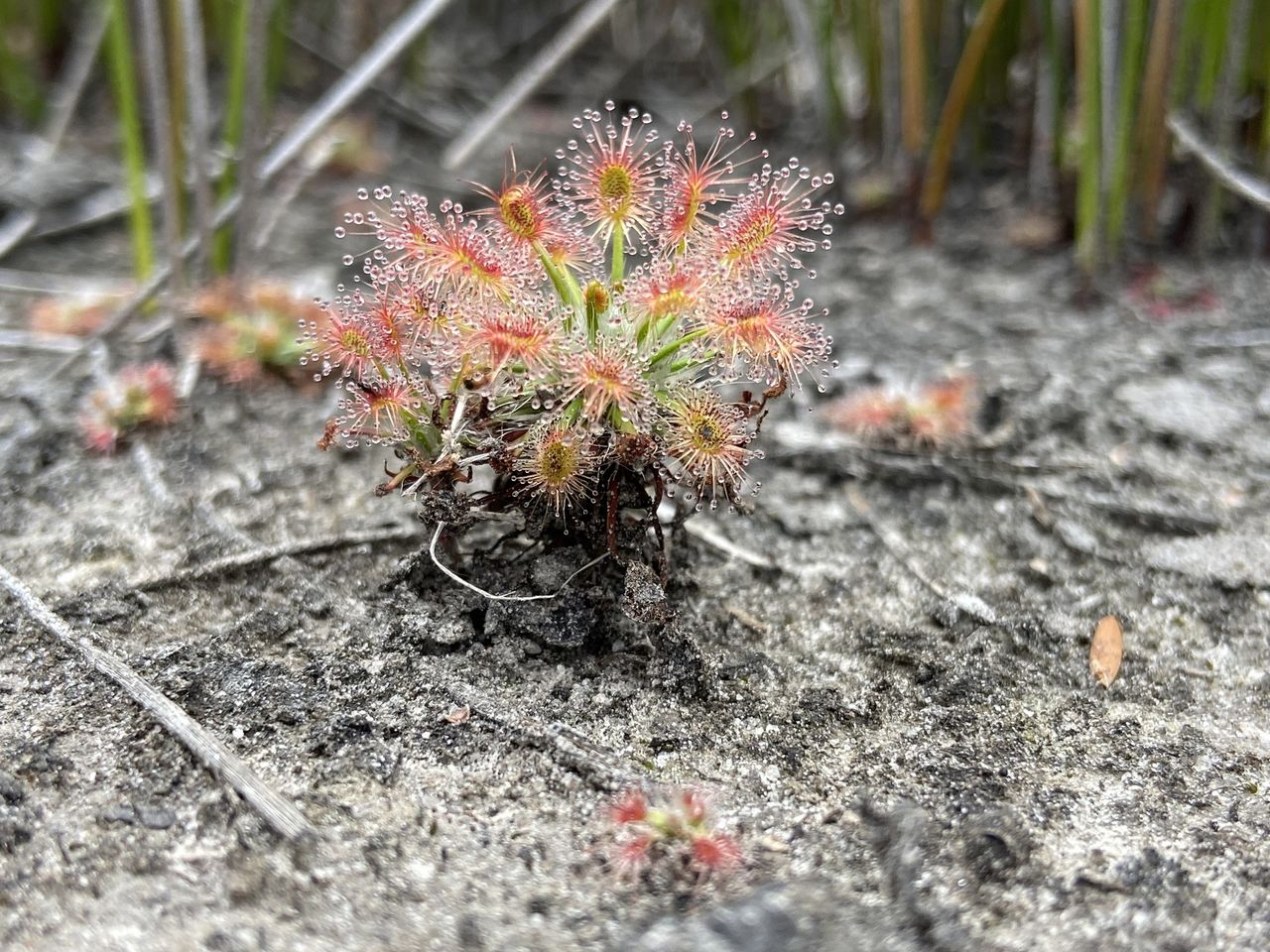
Identification
The epithet verrucata means 'warty' and refers to a part of the plant covered with small warts; which part that is, and further characters of habit, leaf, flower and flowering time, were not found in the sources consulted. All measurement fields are left empty. Even its placement within the genus — pygmy, tuberous species or otherwise — could not be established with certainty here.
Similar species
Without published characters, no reliable distinction from related species can be given. The original 2013 description is indispensable for identification.
The trap and how it works
An active flypaper trap, as in all sundews. The leaves carry stalked glands with a sticky droplet; an insect that touches them sticks fast, after which the tentacles bend towards the prey and the glands secrete digestive enzymes. The dissolved nitrogen, phosphorus and minerals are absorbed through the leaf — a supplement that makes the difference on the extremely poor soils of south-west Australia.
Habitat and ecology
Habitat details were not found in the sources consulted. The code D1 (sand) is a provisional placeholder based on the most common soil of south-west Australian sundews, not a published observation, and should be checked in a later round.
Distribution and elevation
South-west Australia according to this guide's working list. No closer delimitation was found in accessible sources. Altitudinal limits are not published.
- Recorded (one-degree cells)
Forms and variation
Described by Allen Lowrie and John Conran in 2013. No subspecies or varieties are known. As a newly described species, its circumscription may still change in later revisions.
Where and when to see it
Before a visit, consult FloraBase or a local plant society. For a species about which so little has been published, well-documented observations — dated photographs with a general location — are valuable, but share exact sites only with land managers.
Conservation status
Assessed as Least Concern (LC) on the IUCN Red List; not listed in CITES. Further data on populations and threats were not found in the sources consulted.
Scientific name
Drosera verrucata | Lowrie & Conran, 2013
Drosera verrucata was described in 2013 by Allen Lowrie and John G. Conran, published in Lowrie's Carnivorous Plants of Australia, volume 3, page 1272. The holotype (PERTH 8989125) was collected on 10 October 2000 by A. Lowrie at Parker Brook Road near Albany, in southwestern Australia. The name verrucata is Latin for "warty" (from "verruca", wart) and is likely a descriptive reference to wart-like or nodular structures on the plant (for example on the tuber or leaf stalks); this could not be confirmed against the original description.
World Checklist of Vascular Plants (WCVP), via Plants of the World Online (POWO), Royal Botanic Gardens, Kew.