All species › Caryophyllales › Sundew family › Drosera ultramafica
Drosera ultramafica
A sundew that grows only on ultramafic rock — the heavy soils rich in magnesium, iron and nickel that form where ancient ocean crust lies at the surface. Drosera ultramafica was described in 2011 by Andreas Fleischmann, Alastair Robinson and Stewart McPherson in the journal Blumea, based on plants from the mountains of Borneo and the Philippines. The species is a fine example of how the ultramafic islands of Malesia carry their own specialised flora, just like the pitcher plants on the same slopes.
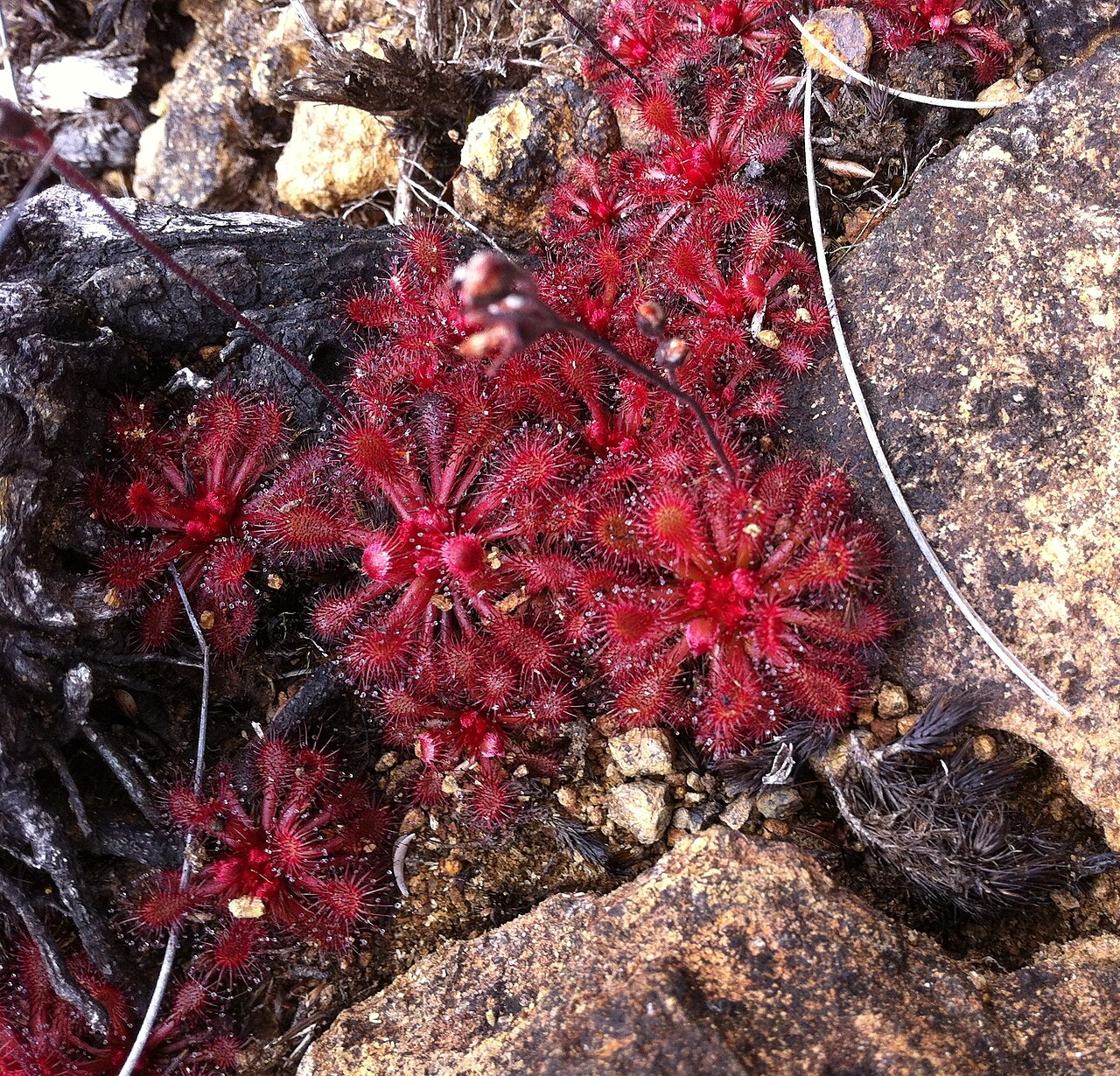
Identification
A perennial rosette from the relationship of Drosera spatulata, with spatulate leaves covered in red tentacles and scapes rising from the centre of the rosette. The authors separate the species from its closest relatives mainly on habit, its preference for ultramafic highland sites and some morphological details given in the original publication. That publication could not be consulted for this guide; measurements and flower colour have therefore not been filled in.
Similar species
According to the authors, the closest relatives are Drosera spatulata, D. neocaledonica and D. oblanceolata. From D. spatulata, widespread in the lowlands of the same region, D. ultramafica differs in habit and habitat; the other two are clearly different in structure and also occur in other areas (New Caledonia and southern China). Anyone finding a sundew on serpentine rock in the mountains of Malesia therefore has a good chance of this species, but certainty requires the details of the description.
The trap and how it works
An active flypaper trap. The red tentacles on the spatulate blade carry droplets of sticky mucilage; small insects that land on them stick fast, after which the tentacles bend towards the prey and the glands secrete digestive enzymes. On the open, nutrient-poor ultramafic slopes the extra nitrogen and phosphorus from prey are all the more valuable: the soil there is not only poor but also toxic to many plants because of its high nickel and magnesium content.
Habitat and ecology
Open, wet spots on ultramafic rock in the mountains: bare or sparsely vegetated serpentine soils (R4) and damp rocks and slopes with seeping water (R1), often within the open scrub and dwarf vegetation that replaces forest on these soils. The authors explicitly mention its preference for 'mafic, upland habitats'. A precise altitudinal zone could not be verified.
Distribution and elevation
Malesia in the broad sense: northern Borneo (Sabah), the Philippines (including Mindanao and Palawan), Sulawesi and Sumatra, everywhere on ultramafic rock. The species is thus not confined to a single mountain but follows an archipelago of separate serpentine areas. No published altitudinal range was found; the elevation field is left empty.
- Recorded (one-degree cells)
Forms and variation
No varieties are recognised. Because the species grows on separate, widely spaced serpentine massifs, populations on different islands may well differ from one another; as far as can be established, no genetic study of this has been published.
Where and when to see it
The sites lie in remote mountain country, often reachable only on foot and with a guide, and some are in national parks where a permit is needed. Search open, wet patches in the serpentine scrub, along trails crossing bare rock. The rosettes show up best in side light, when the droplets glow.
Conservation status
The species has not been assessed for the global IUCN Red List and is not in CITES. The ultramafic areas of Malesia are under pressure from nickel and chromium mining, and some of the mountains where the species grows have already been affected; at the same time important sites lie in protected areas. Because the species is so tied to this rock, it cannot move to other soils.
Scientific name
Drosera ultramafica | Fleischmann, Robinson & McPherson, 2011
Drosera ultramafica was described in 2011 by Andreas Fleischmann, Alastair S. Robinson and Stewart McPherson (together with V. Heinrich, E. Gironella and D.A. Madulid), published in Blumea, volume 56(1), pages 10–15. The species occurs in the highlands of Malesia (Philippines/Borneo region); a precise type locality with collector and date could not be established with certainty. The name ultramafica refers to the ultramafic (magnesium- and iron-rich) rock of the highland soils in Malesia where this species naturally grows — a descriptive name derived from the geological substrate of its habitat.
World Checklist of Vascular Plants (WCVP), via Plants of the World Online (POWO), Royal Botanic Gardens, Kew.