All species › Caryophyllales › Sundew family › Drosera viridis
Drosera viridis
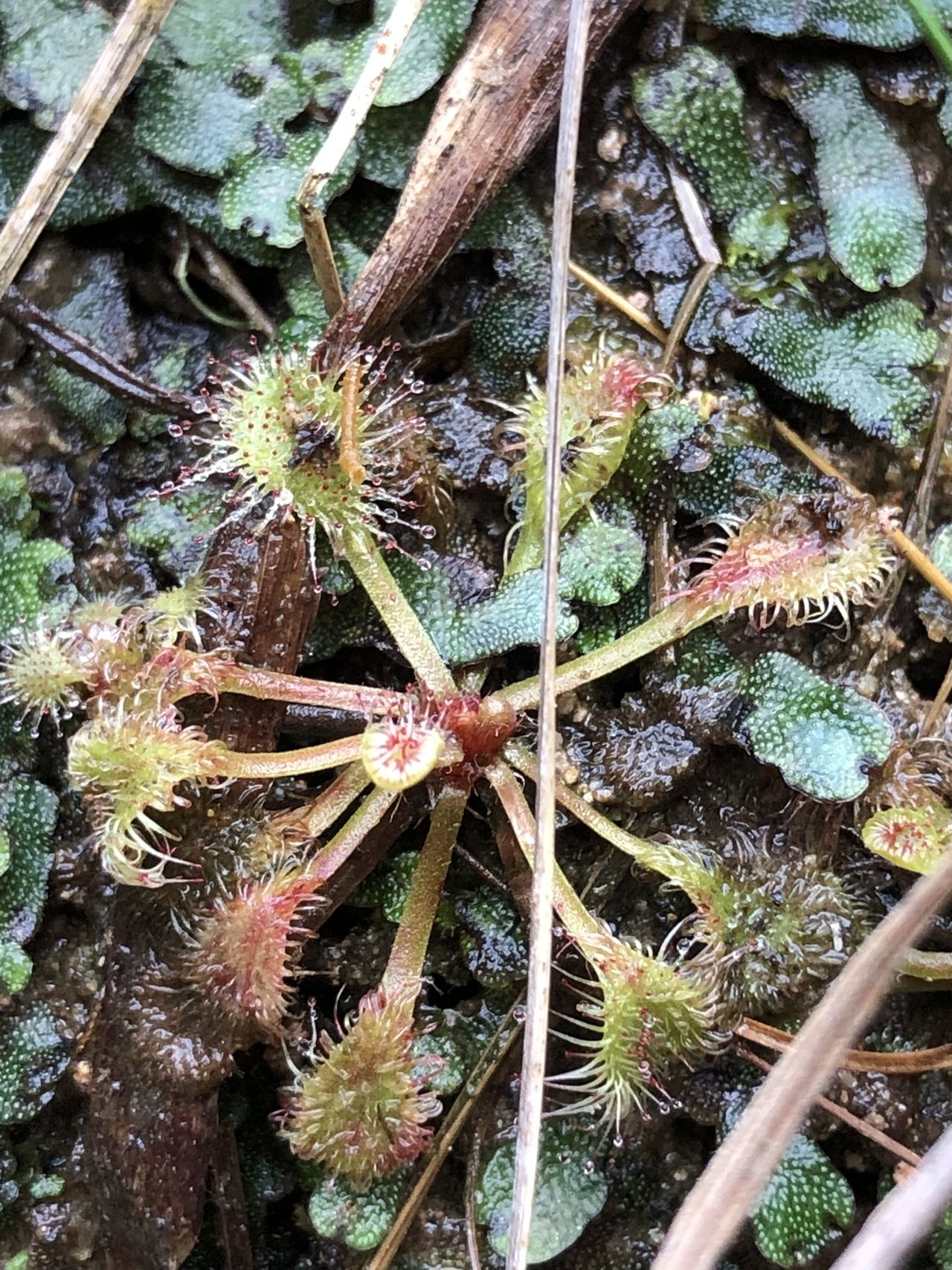
The green sundew, and that is no small matter. Almost all sundews turn red in full sun, through red pigments that protect leaf tissue and tentacles against strong light; Drosera viridis does not, remaining entirely green even in bright sun. The species was described in 2003 by Fernando Rivadavia from the highlands of southern Brazil, and is a close relative of the widespread Drosera communis.
Identification
A perennial, semi-erect rosette of spatulate leaves 5 to 28 mm long, entirely green, with green or at most faintly tinged tentacles. The inflorescences are 7.5 to 30 cm long and carry two to twelve light to dark lilac flowers. The chromosome number is 2n = 20. The green colour is the decisive field character: related species in similar sunny sites have red rosettes.
Similar species
Its closest relative is Drosera communis, which looks very similar but turns red in sun; where the two meet, rare hybrids have been found. Other sundews of southern Brazil, such as Drosera latifolia in the mountains and Drosera brevifolia in the lowlands, have a different leaf shape. Note that a shade form of another species can also be green; only plants in full sun are conclusive.
The trap and how it works
An active flypaper trap. The tentacles catch small insects attracted by the droplets; the surrounding tentacles then bend towards the prey. The lack of red colour has no noticeable effect on the catch: the glistening droplets themselves are the main lure.
Habitat and ecology
Boggy, waterlogged places among grasses, on white clay, red lateritic soil or humus-rich black-brown soils, at 550 to 1,100 m (W4, W7, B6). The plant is sometimes even submerged, with only the leaves above water. In Rio Grande do Sul it was found in subtropical highland grasslands adjoining the Atlantic rainforest.
Distribution and elevation
Southern Brazil: eastern Paraná, São Paulo, central Santa Catarina and, since the first records published in 2020, north-eastern Rio Grande do Sul. Occurrence in neighbouring Argentina, Paraguay or Uruguay is considered possible but unconfirmed.
- Recorded (one-degree cells)
Forms and variation
No varieties are recognised. The species is a fine example of how a single character, the lack of red pigment, can help recognise a closely related species; the 2022 Brazilian synopsis also maintains it as a separate species, although it sometimes hybridises where it grows with D. communis.
Where and when to see it
In the wet season, December to March, search boggy grasslands in the highlands of Paraná and Santa Catarina. Look in full sun for small, bright green rosettes among the grass; green rosettes in sun are the best sign. Wear boots: the plant grows where the water stands at ground level.
Conservation status
Not assessed for the global IUCN Red List and not listed in CITES. The authors of the 2020 study proposed treating the species as near threatened (NT), given its limited distribution and the pressure on its habitat. The wet highland grasslands of southern Brazil are threatened by conversion to pine and eucalyptus plantations, agriculture and drainage.
Scientific name
Drosera viridis | Rivadavia, 2003
Drosera viridis was described in 2003 by the Brazilian botanist Fernando Rivadavia, published in Carnivorous Plant Newsletter, volume 32(3), pages 79–92 (specifically page 87). The type material originates from Brazil (eastern Paraná and São Paulo, central Santa Catarina) and was collected on 2 February 1996 by Rivadavia and M.R.F. Cardoso. The name viridis is Latin for "green" and was chosen by Rivadavia because the plants retain their green colour even when growing in full sun — unlike related species that turn red under those conditions.
World Checklist of Vascular Plants (WCVP), via Plants of the World Online (POWO), Royal Botanic Gardens, Kew.