All species › Caryophyllales › Sundew family › Drosera xerophila
Drosera xerophila
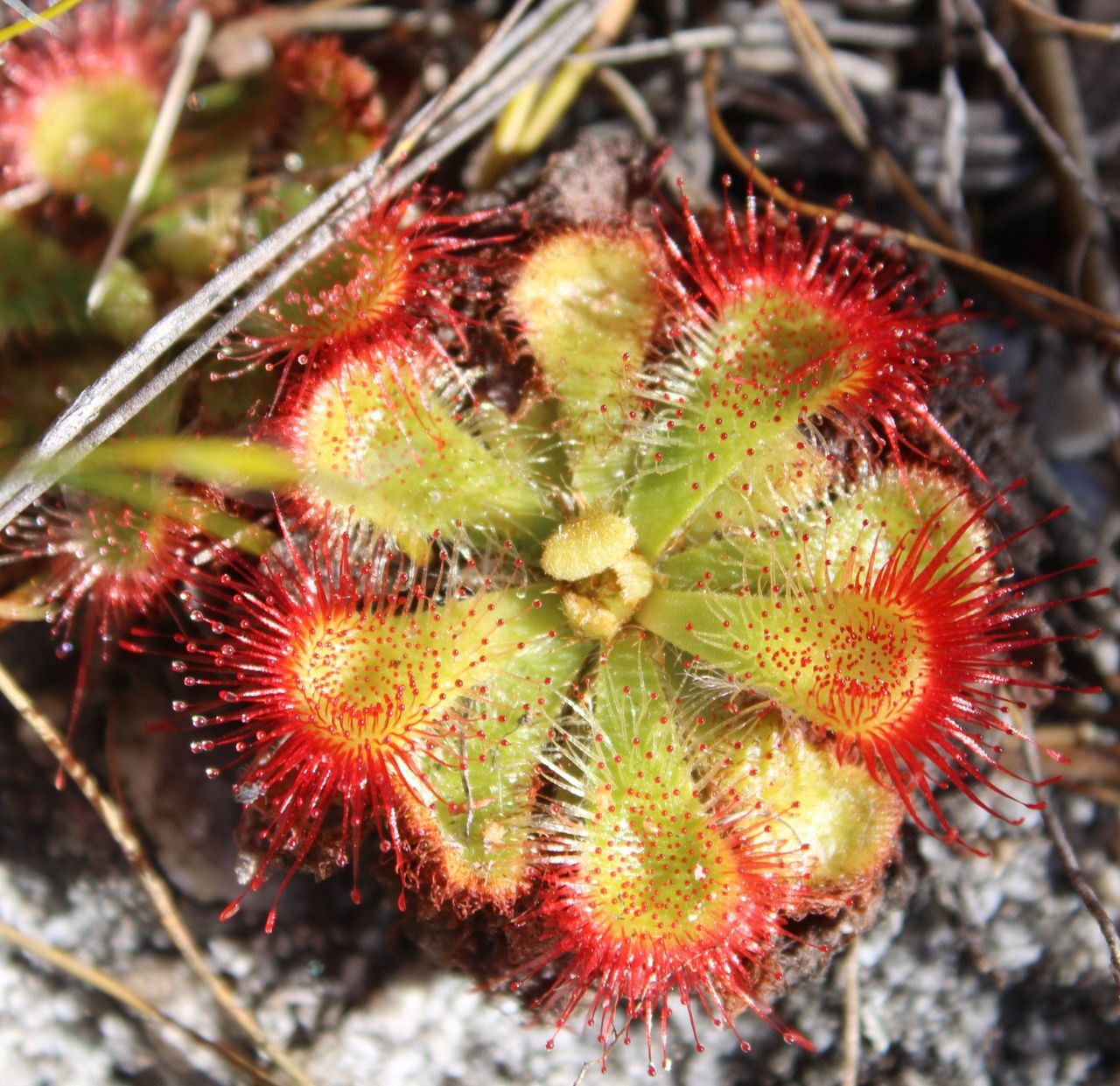
A sundew that bucks the rule by keeping dry. Drosera xerophila — 'drought-loving' — was described only in 2018 by Andreas Fleischmann, from the coastal mountains of the Overberg in the Western Cape. Where almost all Cape rosetted sundews grow in seeps, this one grows in sandstone cracks and on well-drained sand in the fynbos.
Identification
A small, flat rosette 20 to 50 mm across and up to 20 mm tall. The leaves are 7 to 15 mm long, 2 to 3.5 mm wide at the base and widening to 5 to 10 mm towards the tip; the petiole is 3 to 10 mm long and widens gradually. The tentacles are about 0.8 to 1 mm long, the stipules 5 to 6 mm. The scape reaches 100 to 200 mm and carries flowers about 20 mm across, with light pink to violet-pink petals 10 to 12 mm long. Sepals 3 to 4 mm, stamens about 4 mm, seeds 1 to 1.2 mm.
Similar species
Drosera esterhuyseniae often grows at the same sites but has narrower, more erect leaves. Drosera aliciae var. curviscapa ranges from olive green to red and lacks a clearly visible petiole. D. glabripes also often grows with D. xerophila, but forms elongated, ascending stems. The dry habitat itself is perhaps the best field character.
The trap and how it works
An active flypaper trap as in all sundews: stalked glands with sticky droplets hold small insects, after which tentacles bend towards the prey and digestive enzymes are secreted. Notably the plant maintains its droplets on a relatively dry site; it grows in the wet winter, when the sandstone cracks are moist too.
Habitat and ecology
Sunny places in sandstone fynbos: cracks in sandstone rock and well-drained, slightly moist sand (D2, R3, B5). The species grows in winter; by summer, when it flowers, the soil has already dried out.
Distribution and elevation
Endemic to the coastal mountains of the Overberg District in the Western Cape: from the Hottentots-Holland Mountains to the Kogelberg near Kleinmond, common in the Kleinrivier Mountains near Hermanus, and east into the Napier Mountains. No altitudinal limits are given in the source consulted.
- Recorded (one-degree cells)
Forms and variation
The species was described in 2018 in Willdenowia, together with an overview of all rosetted sundews of the Western Cape. Before that these plants were probably included in other species of the D. aliciae complex. No varieties are known.
Where and when to see it
Walk the Overberg mountains, for example around Hermanus, over rocky sandstone slopes and look in the rock crevices rather than the wet spots. Flowering falls in summer, from December to February.
Conservation status
Not assessed for the global IUCN Red List and not listed in CITES; the field above therefore reads NE. On the national Red List of South Africa (SANBI) the species is listed as Near Threatened. The range is small; overly frequent fires, invasion by alien trees and coastal development are possible threats.
Scientific name
Drosera xerophila | Fleischmann, 2018
Drosera xerophila was described in 2018 by Andreas Fleischmann, published in Willdenowia, volume 48(1), page 94. The species is native to South Africa; a precise type locality with collector and collection date could not be established with certainty. The name xerophila is compounded from the Greek "xēros" (dry) and "philos" (loving) and means "dry-loving" — a descriptive reference to this species' preference for drier habitats, consistent with its English common name "dryland sundew".
World Checklist of Vascular Plants (WCVP), via Plants of the World Online (POWO), Royal Botanic Gardens, Kew.