All species › Caryophyllales › Sundew family › Drosera whittakeri
Drosera whittakeri
Drosera whittakeri is a tuberous sundew of South Australia that lies on the ground as a flat, often brightly coloured rosette in winter and spring and survives underground in summer. Its flowers are scented, which earned it the English name 'scented sundew'. The epithet honours Joseph Whittaker, a Derbyshire botanist who collected some three hundred plant specimens around Adelaide in 1839 and 1840.

Identification
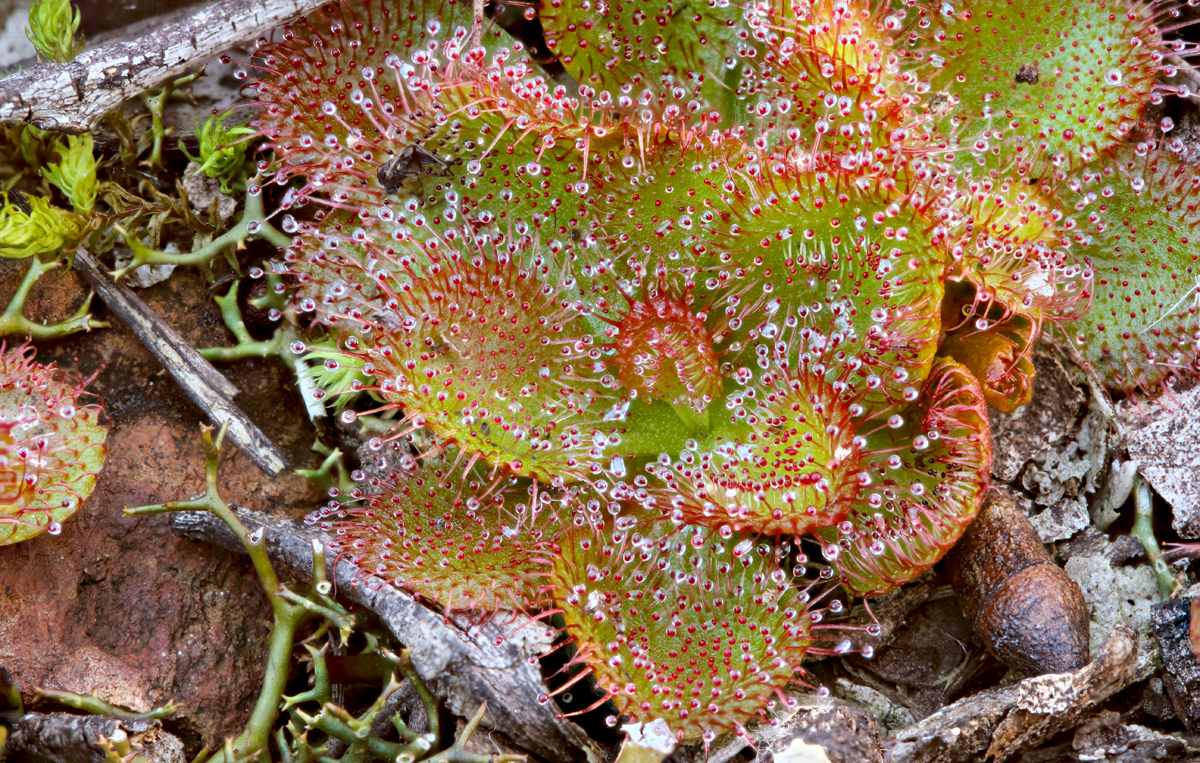
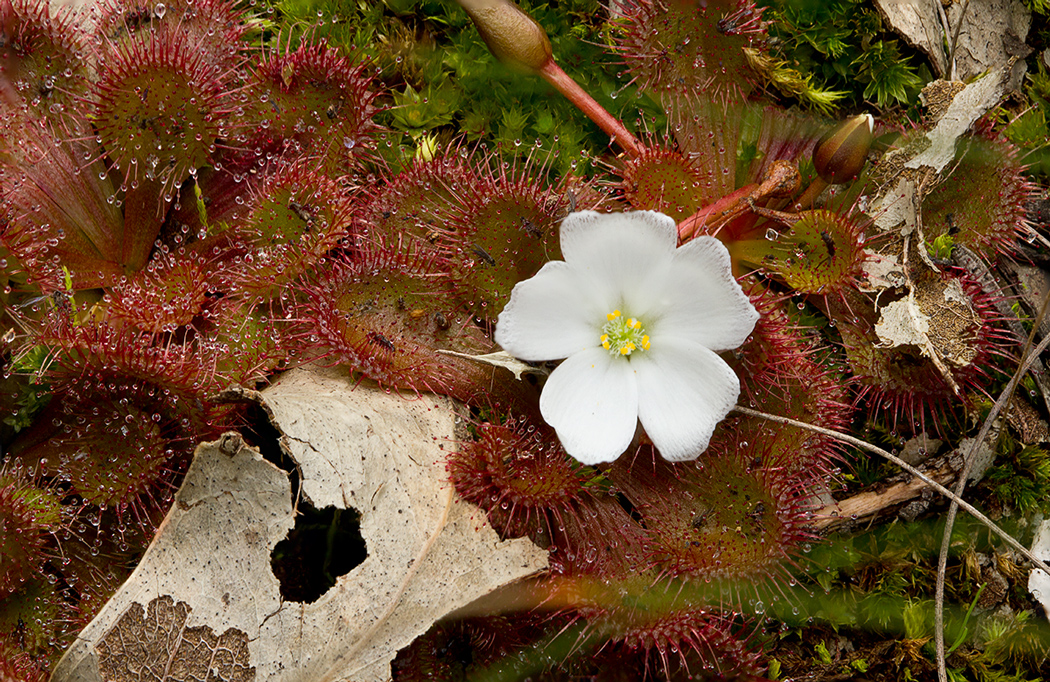
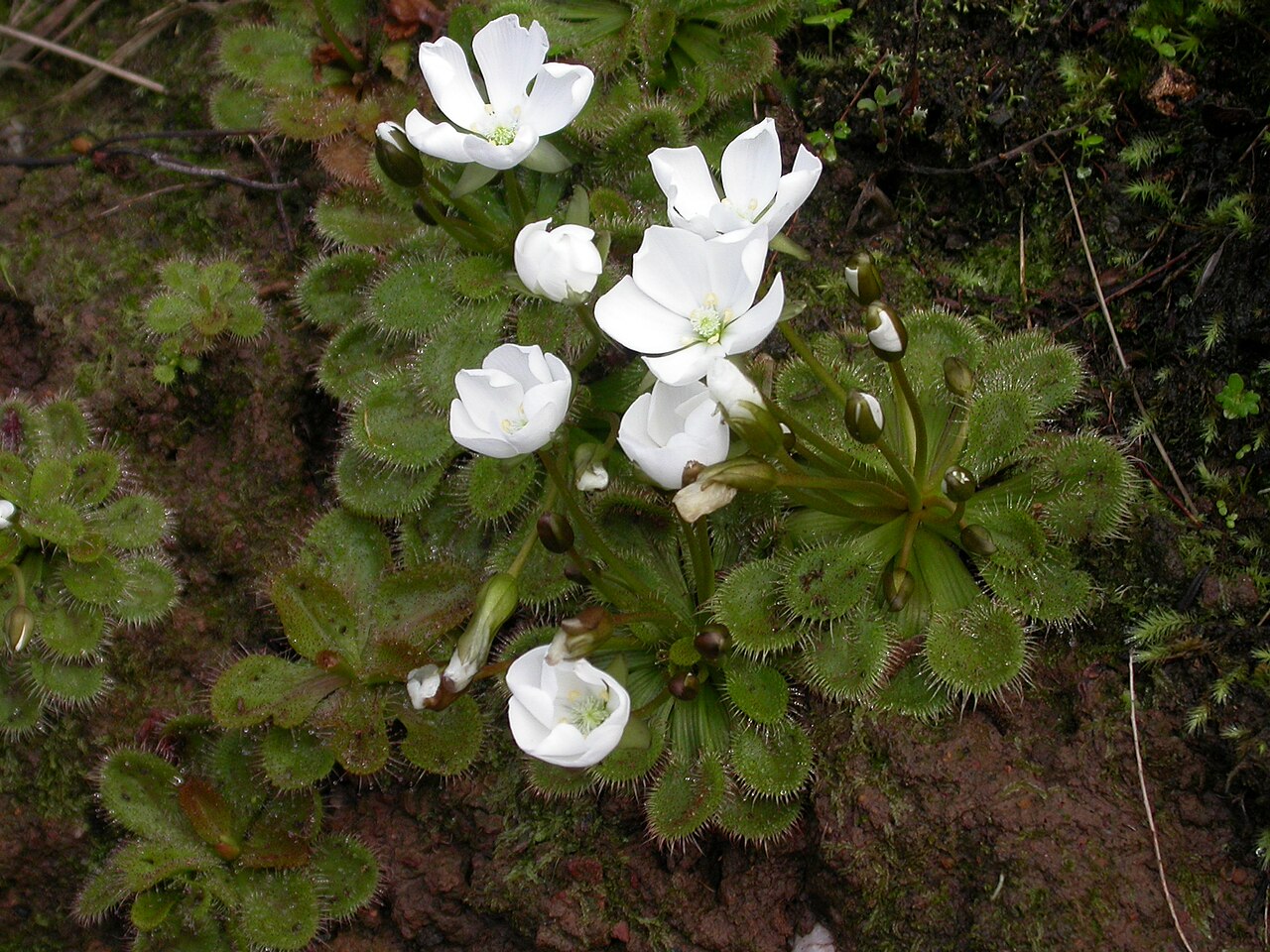
A flat rosette 4 to 8 cm across that grows from an underground tuber in the wet season. The leaves are broadly spatulate, 10 to 15 mm long and 9 to 13 mm wide, and green, orange-yellow or red depending on site and light. Short flowering stems rise from the centre with up to twenty white, scented flowers in all, several open at once. The plant forms no stolons: each rosette stands on its own.
Similar species
Its closest relative is Drosera aberrans, long regarded as a subspecies of D. whittakeri. The difference lies in growth habit and flowering: D. aberrans forms underground stolons and hence dense colonies, and has fewer flowers per plant; D. whittakeri has no stolons and more flowers. D. schmutzii of Kangaroo Island has very narrow, eglandular petioles, semi-erect leaves and a few whorled leaves separate from the rosette. D. spatulata has smaller, elongate spoon-shaped leaves and no tuber.
The trap and how it works
An active flypaper trap. The tentacles on the broad blades catch small insects crawling over the ground or flying low; the tentacles bend towards the prey and the blade can curl somewhat around the catch. Because the plant is above ground only in the cool, wet season, trapping takes place mainly in the Australian winter and spring.
Habitat and ecology
Open woodland and heath on sandy to clayey soil that is moist in winter and dries out in summer (B6, B5). The plant escapes the hot, dry summer by retreating into its tuber; in autumn, when the rains come, it sprouts again.
Distribution and elevation
Endemic to South Australia. Older sources also mention Victoria, but according to VicFlora those records refer to D. aberrans, and D. whittakeri in the strict sense occurs only in South Australia. The range description 'south-western and South Australia' is thus too broad: the species does not occur in south-western Australia (Western Australia). Altitudinal limits are not published in the sources consulted; the elevation field is left empty.
- Recorded (quarter-degree cells)
Forms and variation
Planchon described the species in 1848. For a long time two subspecies were recognised, but in 2008 Lowrie and Conran raised the former subspecies aberrans to the separate species D. aberrans. D. whittakeri in the strict sense has thus become a species with a smaller range. Older literature and herbarium labels often use the name in the broad sense.
Where and when to see it
Search from late autumn to spring, with flowering peaking from winter to early spring, in open woodland and heath in South Australia. The flat red or orange-yellow rosettes stand out well among leaf litter and moss. Kneel by a flowering plant and smell the flowers. Never dig plants up: the tuber lies deep and the plant cannot survive without it.
Conservation status
On the IUCN Red List the species is Least Concern (LC); it is not listed in CITES. That assessment may predate the separation of D. aberrans, so the smaller range of D. whittakeri in the strict sense has not necessarily been taken into account. The main threats are the loss of native vegetation to agriculture and building and the spread of invasive grasses.
Scientific name
Drosera whittakeri | Planchon, 1848
Drosera whittakeri was described in 1848 by the French botanist Jules Émile Planchon, published in Annales des Sciences Naturelles, Botanique, series 3, volume 9, page 302 (original spelling "Whittakerii"). The species occurs in South Australia, from Adelaide and the southern Mount Lofty Ranges to Encounter Bay; the type material almost certainly derives from the collecting work carried out in this area between 1839 and 1840 by the Derbyshire botanist Joseph Whittaker, though an exact type locality with collection date could not be established with certainty. The species is named after Joseph Whittaker, a botanist from Derbyshire, England, who collected some 300 plant specimens between Adelaide and the southern Mount Lofty Ranges to Encounter Bay during 1839–1840 — an eponym honouring this collector.
World Checklist of Vascular Plants (WCVP), via Plants of the World Online (POWO), Royal Botanic Gardens, Kew.