All species › Ericales › New World pitcher plant family › Heliamphora nutans
Heliamphora nutans | Sun pitcher
The first tepui pitcher plant science ever laid eyes on: the Schomburgk brothers found it on Mount Roraima in 1839, and Bentham described it the following year. It grows on the sandstone plateaus where Venezuela, Brazil and Guyana meet, between two thousand and two thousand seven hundred metres, in a landscape that lies in cloud almost every day. The nodding white flower it is named for stands well above the rosette.


Identification
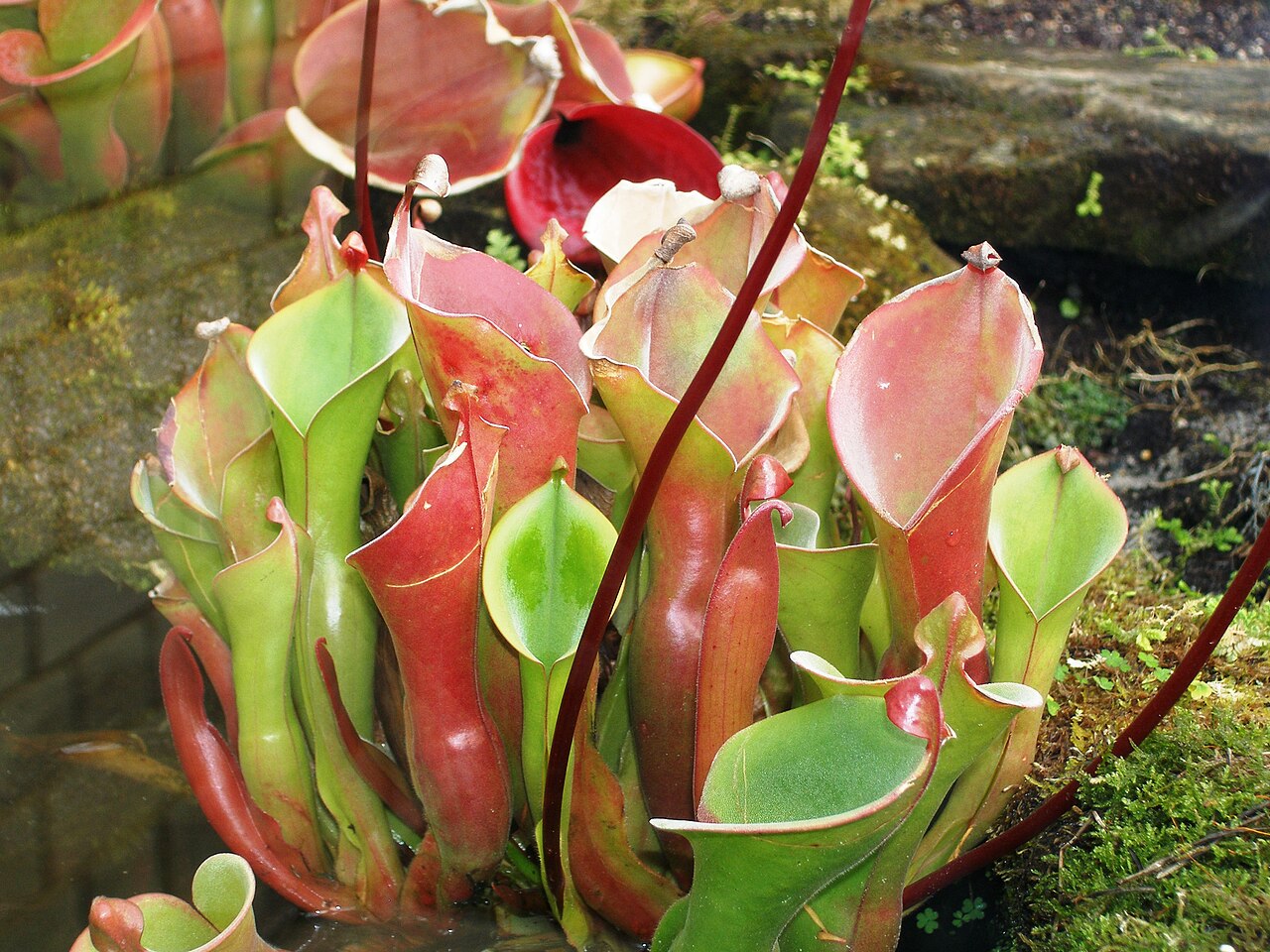
A rosette of funnel-shaped pitchers rising from an underground rhizome; narrow at the base, widening upwards, yellow-green to reddish brown. At the back of the rim sits a small spoon-shaped appendage — the nectar spoon — which separates the genus from every other pitcher plant. In the wall of the pitcher there is a slit or a hole at a fixed height: that is the drainage opening, and the level of the fluid inside never rises above it. The scape towers above the rosette and carries a few nodding flowers with white tepals that flush pink with age. On measurements a caveat applies here: reliable figures are to be found only in the 2011 monograph, which was not available when this page was written, so they have been left out.
Similar species
The genus is difficult in the field; the species differ in pitcher shape, in the hairiness of the inner wall and above all in the shape of the nectar spoon. On Roraima and the surrounding tepuis this species usually stands alone, which makes matters simpler than elsewhere in the highlands. Any Heliamphora can be told from Sarracenia at a glance by the drainage slit: a trumpet pitcher fills with rainwater and has a hood over the mouth, a tepui pitcher lets the surplus run out through the wall and has, instead of a hood, only that small spoon. From Darlingtonia everything separates it: that plant has a swollen dome with windows, a forked tongue and a downward-facing mouth.
The trap and how it works
A pitfall that works on slipperiness and water rather than on a lid. The nectar spoon on the back of the rim secretes sugar and draws insects to the edge. The upper half of the inner wall is lined with short, densely set, downward-pointing hairs; as soon as those are wet — and on a tepui they are wet nearly always — an insect aquaplanes over them like a car on a wet road. At the bottom stands a layer of fluid in which the prey drowns. The remarkable part is in the wall: at a fixed height there is a slit or hole through which surplus rainwater runs out. That is not a detail but the condition for living here, because these plateaus take so much rain that a closed pitcher would fill, topple and lose its catch. The slit keeps the fluid shallow and constant. Digestive enzymes of the plant's own have not been demonstrated in most species of the genus; the breaking down is largely done by bacteria and by the larvae living in the fluid.
Habitat and ecology
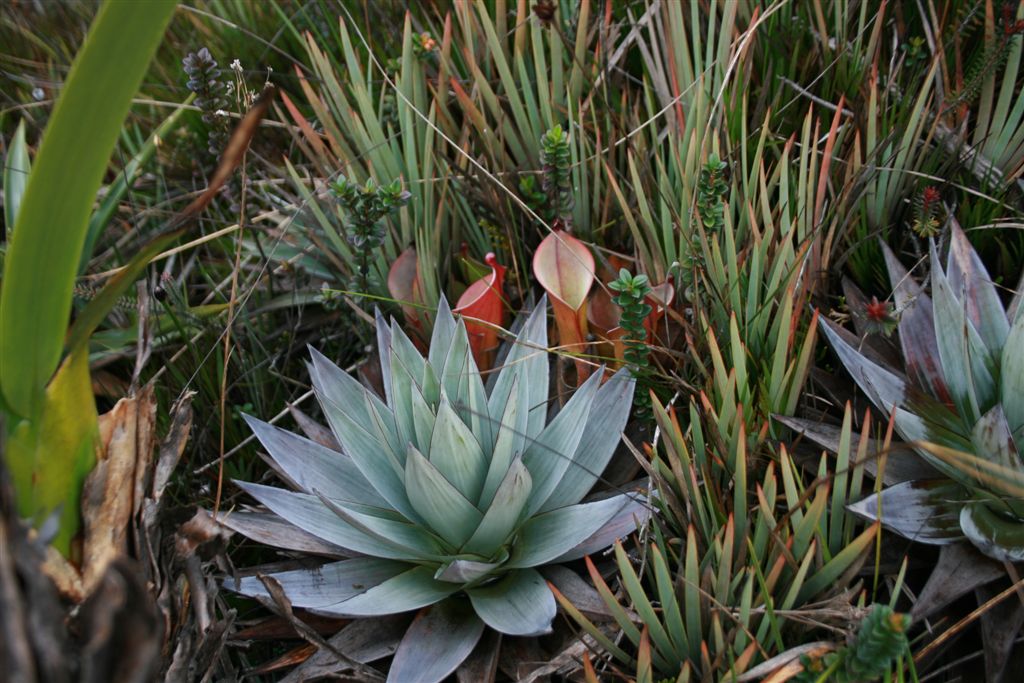
The summits and upper slopes of tepuis: open, permanently wet ground between the sandstone blocks, peat cushions, slopes where water seeps over the rock, and the margins of pools. The soil is exceptionally acid and extremely poor — weathered sandstone and quartzite hold almost no nutrients — and that is exactly why carnivorous plants have the upper hand here. The climate is cool and wet, with cloud on nearly every day, high humidity and strong ultraviolet radiation.
Distribution and elevation
The Roraima massif and the tepuis around it, on the border of Venezuela, Brazil and Guyana; among them Roraima itself, Kukenán, Yuruaní, Maringma and Wei-Assipu. The whole range lies above two thousand metres and covers no more than a handful of plateaus in all. Outside them the species does not occur.
- Recorded (one-degree cells)
Forms and variation
No varieties or forms have been described. What variation there is hangs on the mountain: plants from one tepui differ slightly from those on the next in the size and colour of the pitcher, but those differences grade into one another and have never been fixed as separate units. Natural crosses occur in the genus where two species share a mountain; on the Roraima massif that hardly arises, because this species is usually the only one there.
Where and when to see it
Roraima is the only tepui reachable on an ordinary multi-day trek, from the village of Paraitepui, and the plant stands along the paths in the wet places on the plateau. Look where water lies between the boulders and where the vegetation stays low; the nodding white flower above the rosette carries furthest. The whole plateau lies within national park and everything growing on it is protected; go with a permit and a guide, keep to the made paths and take nothing away.
Conservation status
Not evaluated by the IUCN: the Red List assigns this species no category. What is known: it occurs on a handful of tepuis, the most important of which lie in protected areas — Canaima National Park in Venezuela and the adjoining park around Roraima in Brazil — and the plateaus are hard to reach, so the sites are largely undamaged. Such pressure as there is comes from trekking to the summit, with trampling of the wet vegetation beside the paths, and from collecting for the enthusiast market. The genus is not listed in CITES.
Scientific name
Heliamphora nutans | Bentham, 1840
George Bentham described the species in 1840 in the Transactions of the Linnean Society of London, based on material collected by the German-British explorer Robert Hermann Schomburgk. The type locality lies on the tabletop mountain Mount Roraima, on the border of Guyana, Venezuela and Brazil. The genus name Heliamphora comes from the Greek helos ('marsh') and amphoreus ('jar, amphora') — literally 'marsh jar', despite the common misconception that the name derives from helios ('sun'). The species epithet nutans is Latin for 'nodding', referring to the drooping stance of the pitchers.
World Checklist of Vascular Plants (WCVP), via Plants of the World Online (POWO), Royal Botanic Gardens, Kew.