All species › Ericales › New World pitcher plant family › Heliamphora tatei
Heliamphora tatei
The exception in the genus: where every other tepui pitcher plant stays a flat rosette, this species builds a woody stem that over the years can reach several metres, and carries its pitchers in a tuft at the top of it. It grows on three massifs in the Venezuelan Amazonas — Cerro Duida, Cerro Huachamacari and Cerro Marahuaca — and nowhere else.
Identification
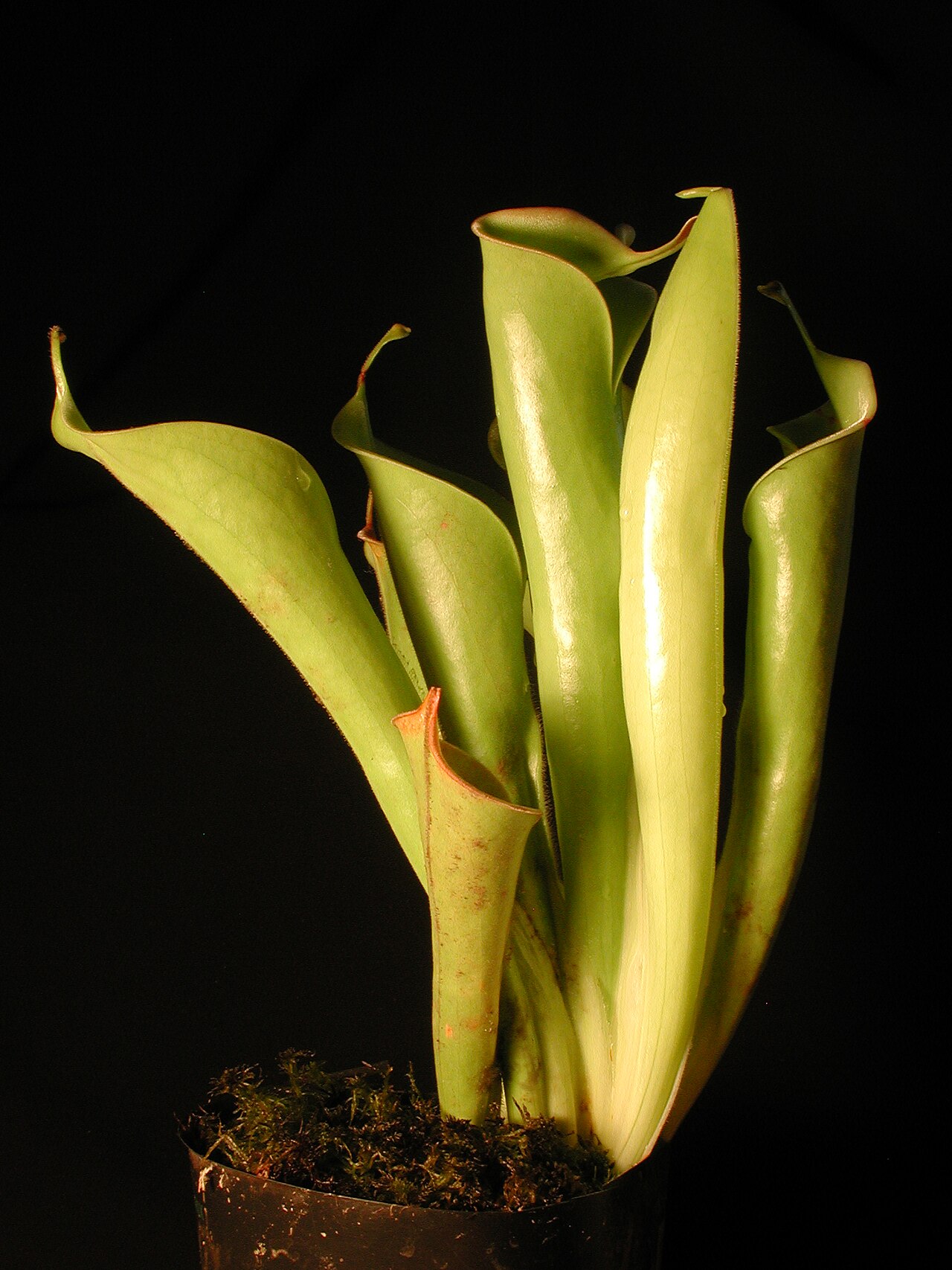
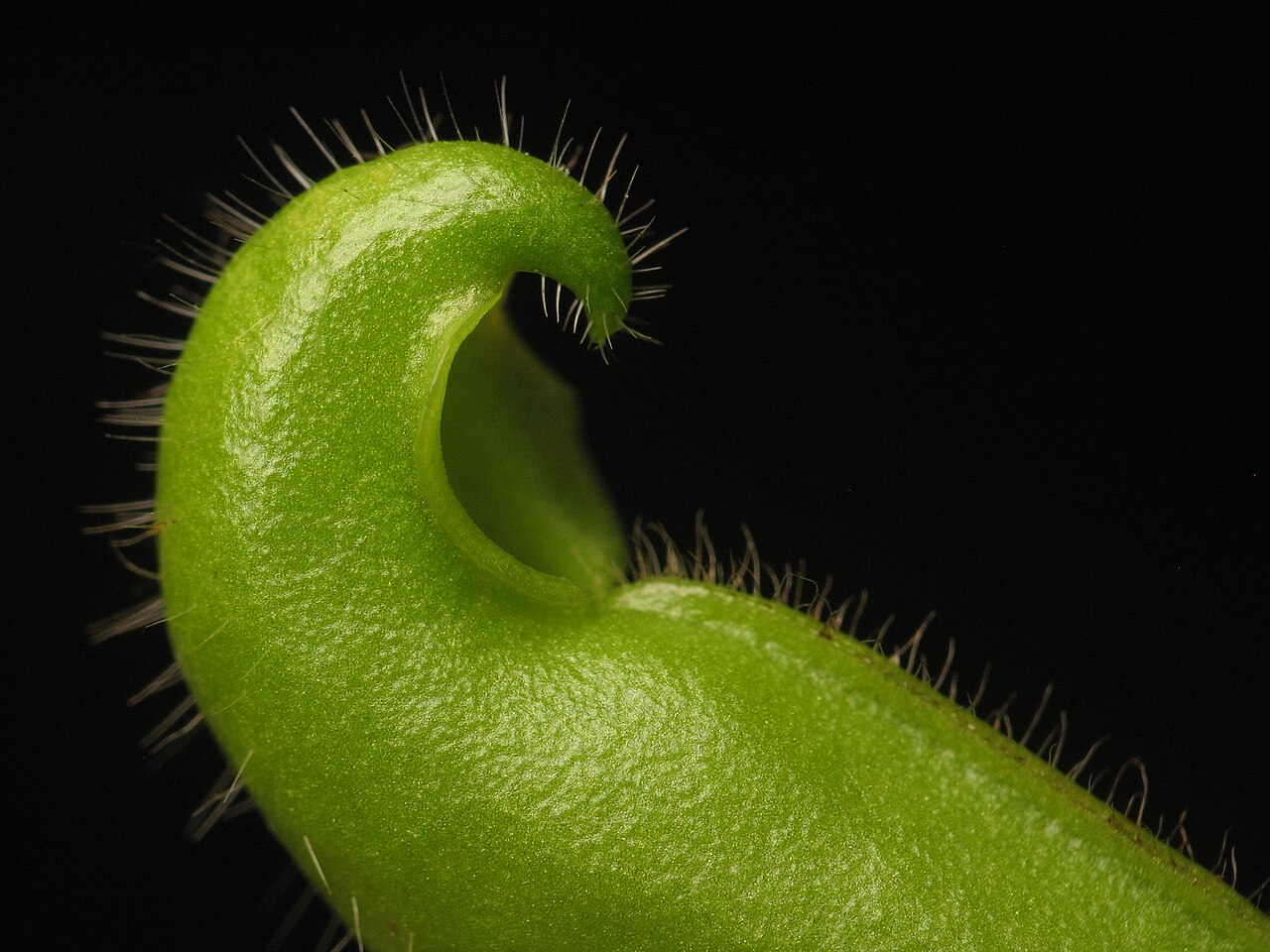
A plant with a true stem: woody, upright or leaning against shrubs, still clothed below in dead leaves, with the living pitchers gathered at the top. Young plants are still rosette-shaped and only betray their nature after years. The pitchers are funnel-shaped and carry at the back of the rim the small nectar spoon of the genus; in the wall sits the drainage slit that fixes the fluid level. The flowers nod, white to cream, on a scape rising above the tuft of leaves. Measurements have deliberately been left out here: the only reliable figures are in the 2011 monograph on the South American Sarraceniaceae, which could not be consulted while this page was written.
Similar species
The stem makes it unmistakable in the field: no other Heliamphora grows into a woody shrub. The difficulty lies with its relatives. H. neblinae, H. macdonaldae and H. parva also form a stem and were all three once treated as forms or varieties within H. tatei; they are now separate species and grow on other massifs. On the southern part of Cerro Duida putative natural crosses between H. macdonaldae and H. tatei have been recorded. From Sarracenia and Darlingtonia it is separated, as throughout the genus, by the drainage slit in the wall: a trumpet pitcher fills with rainwater, this one lets the surplus run out.
The trap and how it works
The same pitfall as in the rest of the genus, but offered high above the ground. The nectar spoon at the back of the rim draws insects in; the upper half of the inner wall bears short downward-pointing hairs over which an insect aquaplanes on the wet film; at the bottom stands a shallow layer of fluid. In the wall, at a fixed height, sits the slit through which rainwater runs out, so that in the persistent rain of the tepuis the pitcher neither fills nor topples. On one point this species departs from its relatives: H. tatei is the only member of the genus in which the plant has been shown to secrete a proteolytic enzyme of its own, where the others leave digestion almost entirely to bacteria and to the larvae in the fluid.
Habitat and ecology
Open, permanently wet ground on the summits and upper slopes of tepuis: peat cushions, boggy hollows between sandstone blocks and the margin of scrub on the plateaus. The soil is acid and extremely poor. The climate is cool and very wet, with cloud and rain on most days; it is precisely that constant wetness that makes the drainage slit necessary. That a plant here builds a woody stem is remarkable: it keeps its pitchers above the encroaching scrub.
Distribution and elevation
Endemic to Venezuela, and within it confined to three massifs in the state of Amazonas: Cerro Duida, Cerro Huachamacari and Cerro Marahuaca. That is one of the smallest ranges in this guide. The three mountains lie close together but are separated by lowland where the species cannot grow, so each mountain carries its own population.
- Recorded (one-degree cells)
Forms and variation
Variation within the species has never been fixed in varieties, but the history of the name shows how unclear the boundaries are: H. neblinae, H. macdonaldae and H. parva were long treated as forms or varieties of this species and now count as species in their own right. This guide follows POWO on what counts as a species. Between the three massifs there are differences in pitcher size and colour and in the height the stem reaches; these have not been named. Putative natural crosses with H. macdonaldae have been described on Cerro Duida.
Where and when to see it
This is the hardest plant in the whole guide to reach. The three massifs lie in protected country in the Venezuelan Amazonas, without walking trails, and are visited almost only by scientific expeditions with a permit; there is no trek such as the one to Roraima. Anyone who does get there will know it at once: look for the tuft of pitchers on top of a woody stem, at the edge of open peat. For everyone who does not go, the plate and the description remain; with this species that is not a shortcoming but the ordinary state of affairs.
Conservation status
Not evaluated by the IUCN — no category has been set for this species. What is known: the range covers three massifs within a single state, the areas lie in protected country, and they are so remote and so hard to reach that in practice there is almost no human pressure on the sites. The risks that exist are the collecting of plants for the specialist trade and, in the longer term, climate change, which pushes the cool wet zone on tepuis upwards from below and so threatens precisely the highest sites. The genus is not listed in CITES.
Scientific name
Heliamphora tatei | Gleason, 1931
Described by Henry Allan Gleason in 1931, in “Botanical results of the Tyler-Duida Expedition”, Bulletin of the Torrey Botanical Club 58(6): 345–404. The species is endemic to three mountains in Venezuela: Cerro Duida, Cerro Huachamacari and Cerro Marahuaca. The species name tatei honours George Henry Hamilton Tate, the American zoologist and explorer who co-led the Tyler-Duida Expedition on which the type material was collected.
World Checklist of Vascular Plants (WCVP), via Plants of the World Online (POWO), Royal Botanic Gardens, Kew.