All species › Ericales › New World pitcher plant family › Heliamphora minor
Heliamphora minor
Auyán-tepui, at over seven hundred square kilometres, is the largest of the Venezuelan table mountains, and Heliamphora minor is the only member of the Sarraceniaceae that grows on it. The plant lives on an island with no sea around it: a plateau standing hundreds of metres above the rainforest, with its own climate, its own substrate and a flora much of which occurs nowhere else.
Identification
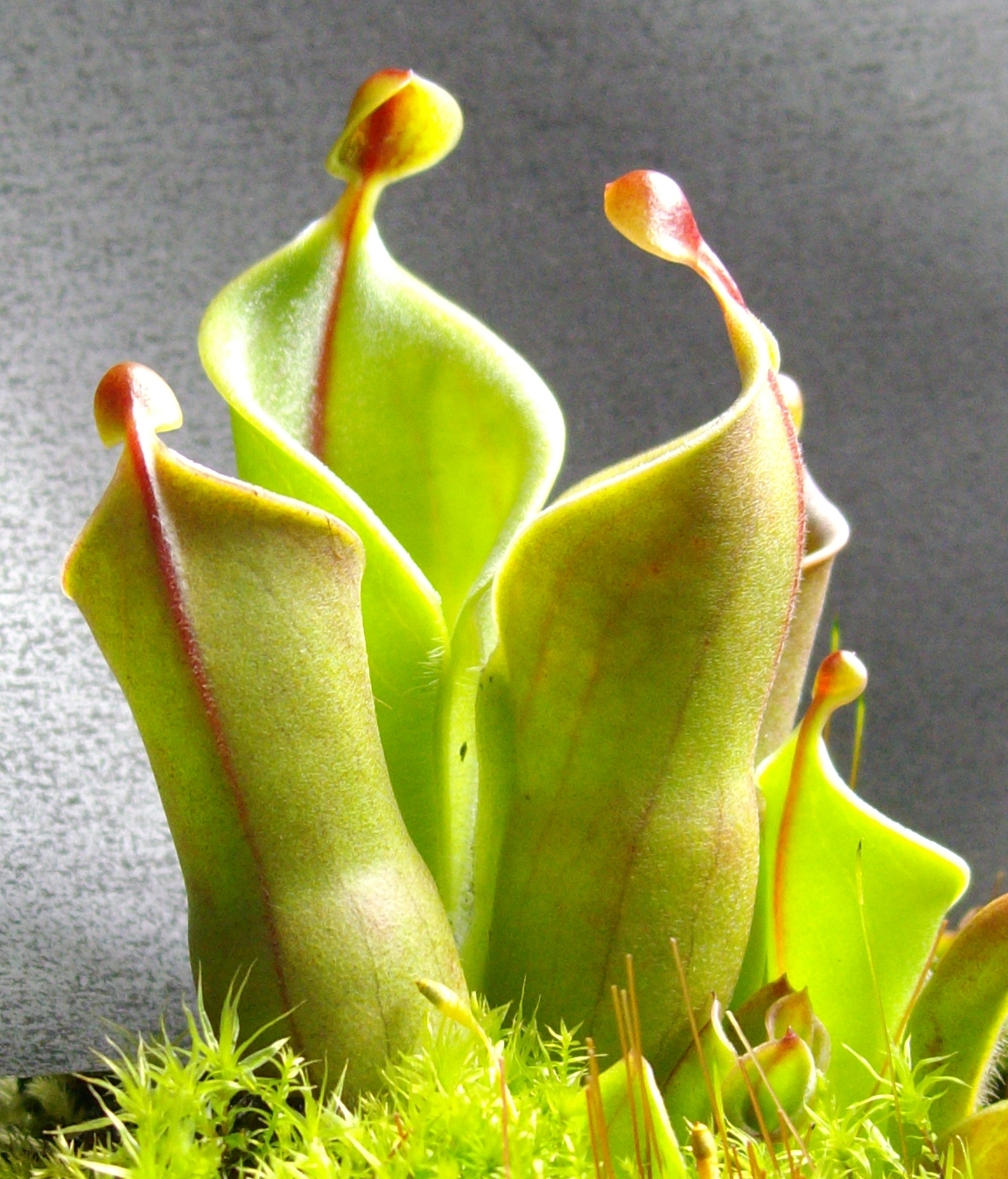
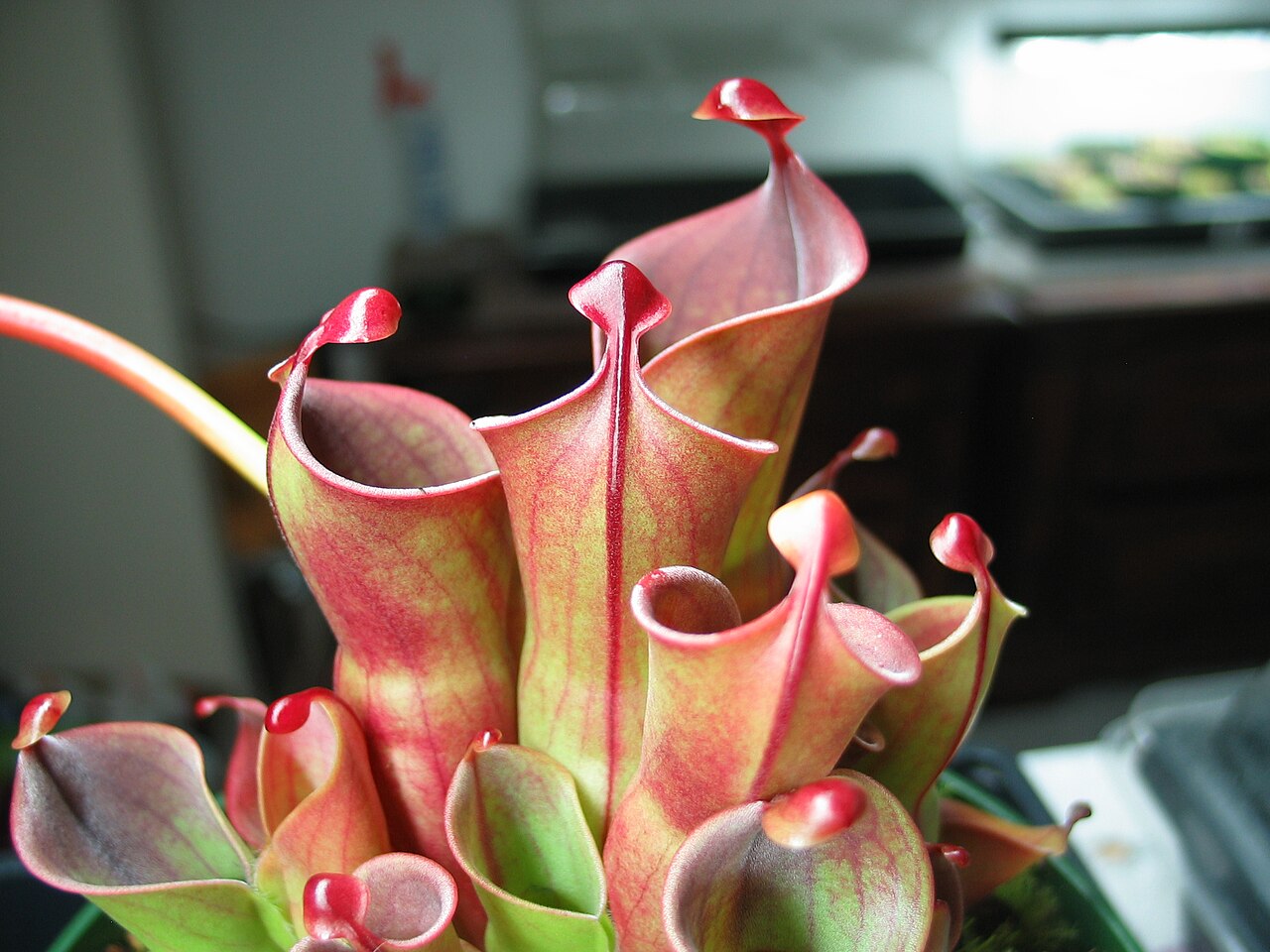
A rosette of erect pitchers, each formed from a single leaf grown shut into a funnel with a seam down the front. The pitcher is slightly bellied about halfway and widens strongly towards the top, and has no drainage pore through the wall — a character that varies from species to species in this genus. Colour runs from yellow-green in shaded plants to deep red in plants in full light. On the back rim stands the so-called nectar spoon: a small, hooded, red organ on a slender stalk up to 5 mm long, glabrous or with short white hairs that soon fall. The inflorescence is a one-sided raceme on a red scape about 30 cm long and some 5 mm thick at the base. The flowers have four, rarely five, white or faintly pink-tinged tepals up to 4 cm long and 1.0 to 1.5 cm wide, which change colour and stiffen as flowering proceeds.
Similar species
On Auyán-tepui itself there is nothing to confuse it with: this is the only species of the family on the mountain, so a find on the plateau is identified by that fact alone. Beyond it matters get harder. Heliamphora pulchella, of the Chimantá massif, looks much like it but has a nectar spoon attached broadly to the pitcher instead of sitting on a slender stalk, and its pitcher interior is densely hairy. Heliamphora nutans of the Roraima group is clearly larger and has a drainage pore. Confusion with Sarracenia is ruled out geographically, and structurally too: Heliamphora has no broad hood, only that minute spoon in its place.
The trap and how it works
A pitfall trap notable for what it lacks. The plant produces few or no digestive enzymes of its own; breaking the prey down is left largely to bacteria in the pitcher fluid, after which the plant takes up the released nutrients. The nectar spoon on the back rim is the lure: nectar is secreted there, and insects coming to it stand directly over the opening. The upper part of the inner wall is lined with downward-pointing hairs, so every attempt to walk back up fails, and below that the wall is smooth.
Habitat and ecology
The summit plateau of the table mountain: a virtually soil-less landscape of bare sandstone, fissures and hollows in which acid peat and bog moss collect (W6). Two microhabitats are typical. On the northern part of the summit the plant grows in open, waterlogged bogs among the rocks; on the southern part it grows rather in cavities and crevices in the rock where some organic matter has accumulated (R1). In both, the substrate is extremely poor in nitrogen and phosphorus, rain continually washes what little there is away, and the climate is cool and all but permanently wet, with cloud covering the plateau for much of the day. Under those conditions a trap that turns insects into nitrogen is not a luxury but the only way to stand here at all.
Distribution and elevation
Endemic to Auyán-tepui in Bolívar state, Venezuela, and found nowhere else. Known sites lie between about 1650 and 2500 m, spread over the northern and southern parts of the plateau; the northern plants grow at around 1800 m. The genus as a whole is confined to the table mountains of the Guiana Shield — Venezuela, western Guyana and the far north of Brazil — and is one of the clearest illustrations of how that landscape drives speciation mountain by mountain: for a bog plant the plateaus are as unreachable from one another as islands at sea.
- Recorded (one-degree cells)
Forms and variation
Two varieties are recognised, both wild. Heliamphora minor var. minor is the plant of the southern plateau, with a glabrous or nearly glabrous pitcher, growing mainly in rock cavities. Heliamphora minor var. pilosa, described in 2011, comes from the northern part and is recognised by conspicuous hairs on the outside of the pitcher; those plants grow in waterlogged bogs at around 1800 m. Beyond that there is colour variation without a taxonomic name: plants in full light turn deep red, plants in shelter stay yellow-green. No natural hybrids are known from this mountain, which follows from there being no second species of the genus on it.
Where and when to see it
The plateau is reachable only by helicopter or on a multi-day trek, and lies within a national park; in practice every visit is made with a permit and a guide. Once on top you need not search long: on the wet ground the species forms extensive mats and is among the most conspicuous plants of the plateau. Watch the light rather than the season — the pitchers only glow when the cloud briefly opens, and that is the moment you see the difference between the red plants in the sun and the green ones in the crevices. The flowering period of the species is not established in the literature; plants in flower are seen on the plateau throughout the year.
Conservation status
The species has not been assessed for the IUCN Red List, and there is no CITES listing either: Heliamphora appears in no appendix. What can be said is that the known distribution is confined to a single mountain, which makes any species vulnerable by definition to whatever befalls that one plateau. Against that, the habitat lies within Canaima, a national park and World Heritage site, the plateau cannot be entered without a permit, and the populations on the wet ground are large. Collection for trade is the risk usually named for the genus, but plants in cultivation now come almost entirely from seed and tissue culture. The absence of a formal assessment here therefore signals a gap in the record rather than a known decline.
Scientific name
Heliamphora minor | Gleason, 1939
Described by Henry Allan Gleason in 1939, in "The flora of Mount Auyan-Tepui, Venezuela" (Gleason & Killip), published in Brittonia 3(2): 141–204. The type area lies on Auyán-tepui in Venezuela. The species name minor is Latin for "smaller" and refers to this species' smaller dimensions compared to related Heliamphora species.
World Checklist of Vascular Plants (WCVP), via Plants of the World Online (POWO), Royal Botanic Gardens, Kew.