All species › Ericales › New World pitcher plant family › Heliamphora heterodoxa
Heliamphora heterodoxa
Most species in this genus grow on a plateau you can reach only by helicopter or on a trek of several days. Heliamphora heterodoxa is the exception: it grows in the open, swampy savannas of the Gran Sabana and on the wooded slopes of the Sierra de Lema, at elevations where roads still run. Anyone who has seen a Guiana Shield pitcher plant in Venezuela without climbing for it has almost certainly seen this species.
Identification
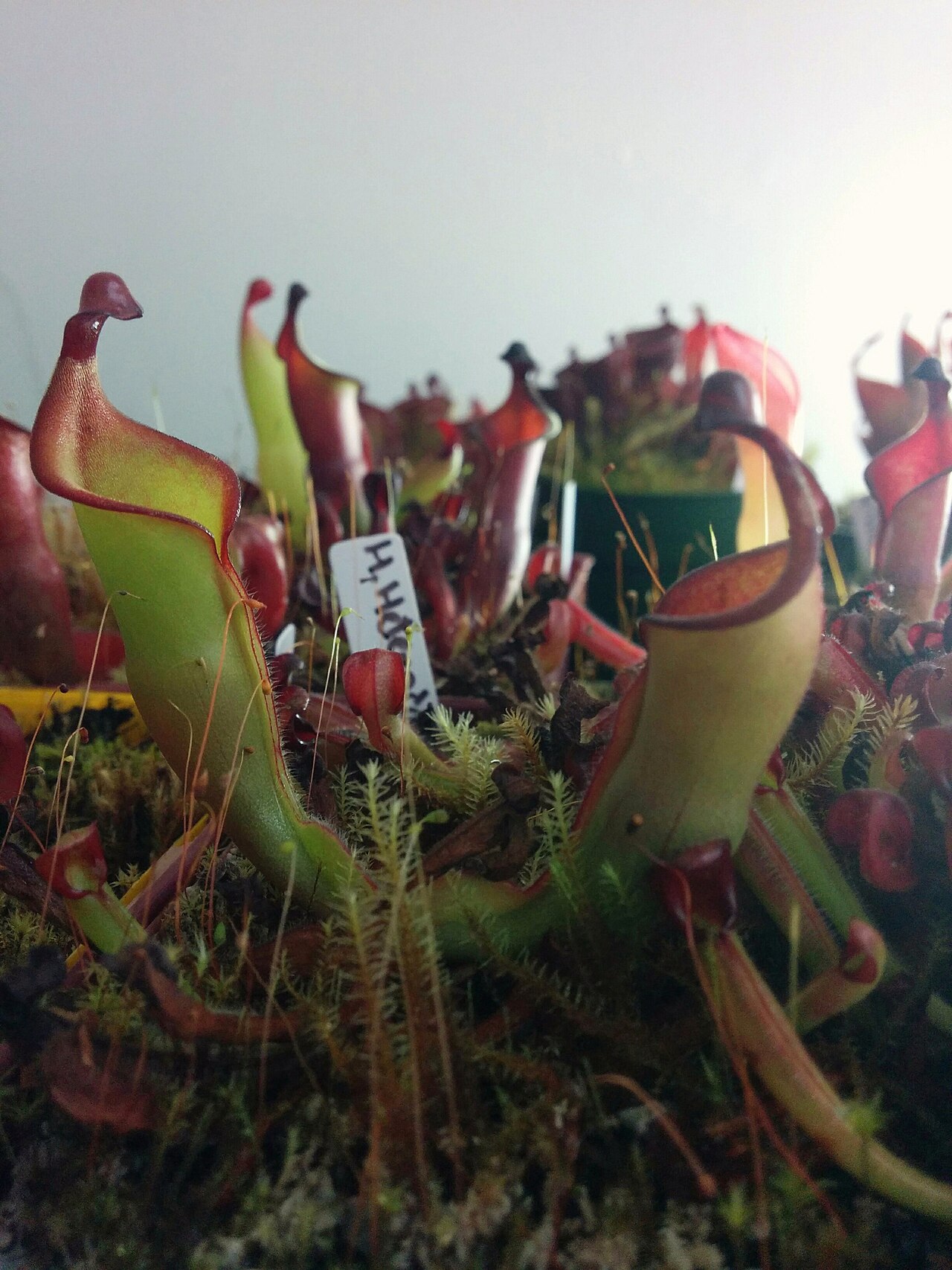
A rosette of erect pitchers, each formed from a single leaf grown shut into a funnel with a seam down the front. The pitcher is infundibular below, slightly bellied about halfway and widens again towards the mouth; a drainage slit in the wall carries off excess rainwater so the pitcher does not fill up. The inner surface is lined with downward-pointing hairs right up to the rim — a character that is absent or interrupted in the species it can be confused with. On the back rim stands the nectar spoon, in this species large and distinctly overhanging, often more deeply coloured than the rest of the leaf. Pitcher colour runs from plain green in shade to green with red veins, or almost wholly red in plants in full light. The inflorescence is a one-sided raceme on a long, glabrous scape held well above the rosette, with nodding white flowers that change colour as flowering proceeds.
Similar species
Of the species sharing this landscape, Heliamphora sarracenioides of Ptari-tepui is the easiest to rule out: it has a conspicuously broad, triangular lid and a glabrous zone beneath the rim, whereas here the pitcher is hairy to the very top and the mouth more funnel-shaped. Heliamphora glabra and Heliamphora exappendiculata were once treated as varieties of this species and now stand as species in their own right; the first is larger and smoother, the second has a nectar spoon reduced to almost nothing. The Sierra de Lema also holds Heliamphora electrum, which looks much the same but has two kinds of retentive hair instead of one and a differently built spoon. On Ptari-tepui itself grow Heliamphora collina and Heliamphora purpurascens, with hybrids between them.
The trap and how it works
A classic pitfall. The plant makes few or no digestive enzymes of its own; prey — mostly ants — is broken down by bacteria in the pitcher fluid, after which the plant takes up the released nitrogen and phosphorus. The nectar spoon on the back rim is the lure: a sugary fluid is secreted there, and an insect coming to it stands directly over the opening. The downward-pointing hairs on the inner wall make climbing back out impossible. The drainage slit keeps the fluid at a working level in a landscape where rain falls almost daily: without it the pitcher would overflow and lose its catch.
Habitat and ecology
Swampy savanna and wet clearings in forest (W6): hollows where rainwater stands, with an acid, peaty substrate and a low cover of grasses, Xyris, bromeliads of the genus Brocchinia and sundews. The species also grows on the damp, peat-covered margins of the uplands themselves (R4). In both cases the substrate is extremely poor in nitrogen and phosphorus and is continually leached by the high rainfall. The species grows lower than most of its relatives and so tolerates slightly warmer conditions, but the site is permanently wet and the air humid.
Distribution and elevation
The Gran Sabana and the Sierra de Lema in Bolívar state, Venezuela, with records between about 1200 and 2200 m; most known sites lie in the lower half of that range. Whether the species also occurs in adjacent Guyana has not been settled. The genus as a whole is confined to the table mountains of the Guiana Shield and their foreland — Venezuela, western Guyana and the far north of Brazil — and within it Heliamphora heterodoxa is one of the few species not locked onto a single mountain.
- Recorded (one-degree cells)
Forms and variation
The name has an untidy history, and for a field observer that is not a side issue. Steyermark described the species in 1951 from material on the slopes of Ptari-tepui; that type material is now understood to be a natural hybrid between Heliamphora collina and Heliamphora purpurascens, while in practice the name is used for the plants of the Gran Sabana. A proposal to replace the type narrowly failed to carry in 2019, so the question remains formally open. Two former varieties have meanwhile been raised to species: Heliamphora glabra and Heliamphora exappendiculata. What remains as variation within the species is mainly colour, from wholly green to shot through with red, depending on exposure.
Where and when to see it
This is the species to look for when a tepui summit is out of reach. Search the wet hollows of the savanna and the margins of woodland patches, not the dry ridges; the plants often stand among sundews and Brocchinia. Watch for the outline of the flowering scape — it rises well above the grass and betrays a group of plants you would otherwise walk past. Leave the digging to nobody: the species is widely available in cultivation from seed, and wild plants rarely survive being moved. The flowering period is not established in the literature.
Conservation status
The species has not been assessed for the IUCN Red List and appears in no CITES appendix; that holds for the whole genus. What can be said is that by Heliamphora standards this is a widespread plant, known from a series of sites across two landscapes rather than one plateau, and part of its range falls within Canaima National Park. Against that, the very accessibility of the low savanna sites is a risk: fire, road works and collecting reach them far more easily than they reach a closed summit. The absence of a formal assessment therefore marks a gap rather than a known decline — and in a species with this naming history it is not even settled which populations an assessment ought to cover.
Scientific name
Heliamphora heterodoxa | Steyermark, 1951
Described by Julian Alfred Steyermark in 1951, in "Contributions to the flora of Venezuela...", published in Fieldiana: Botany 28(1): 239–242. The type area lies on the slopes connecting the tepuis Ptari-tepui and Sororopán-tepui, on the border of Venezuela and Guyana, discovered in 1944. The species name heterodoxa derives from the Greek heteros ("different, deviating") and doxa ("opinion, view") and roughly means "variable"; Steyermark chose this name because of the considerable variation he observed within the species.
World Checklist of Vascular Plants (WCVP), via Plants of the World Online (POWO), Royal Botanic Gardens, Kew.