All species › Caryophyllales › Tropical pitcher plant family › Nepenthes adnata
Nepenthes adnata
A small, little-known pitcher plant of the sandstone cliffs in the hills and mountains of West Sumatra, and a species with a complicated naming history. Willem Meijer collected the type material on 24 August 1957, but it was sterile and incomplete. Mitsuru Hotta and Rusjdi Tamin described the species in 1986 without the Latin diagnosis then required, so the name was invalid; Jan Schlauer supplied that diagnosis in 1994 in Blumea, and since then the species has been called Nepenthes adnata Tamin & M.Hotta ex Schlauer. The name refers to the leaf base, which is fused to the stem.
Identification
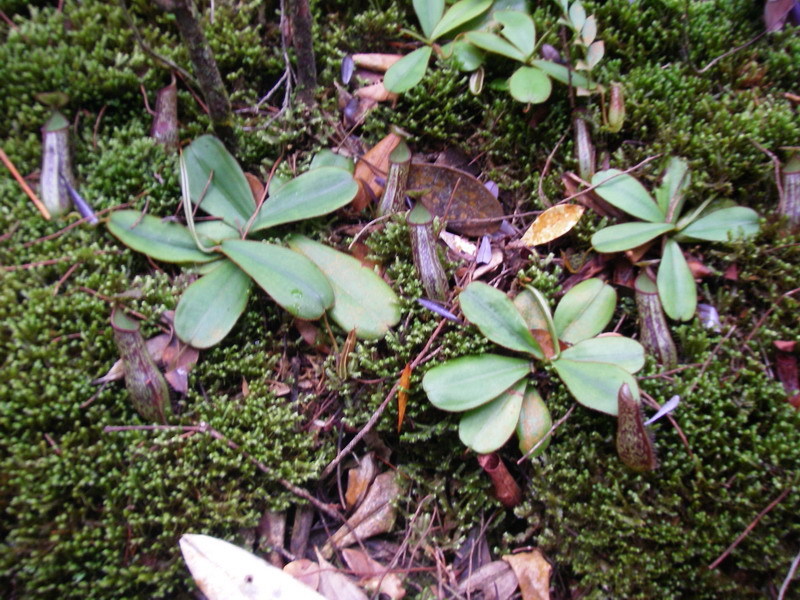
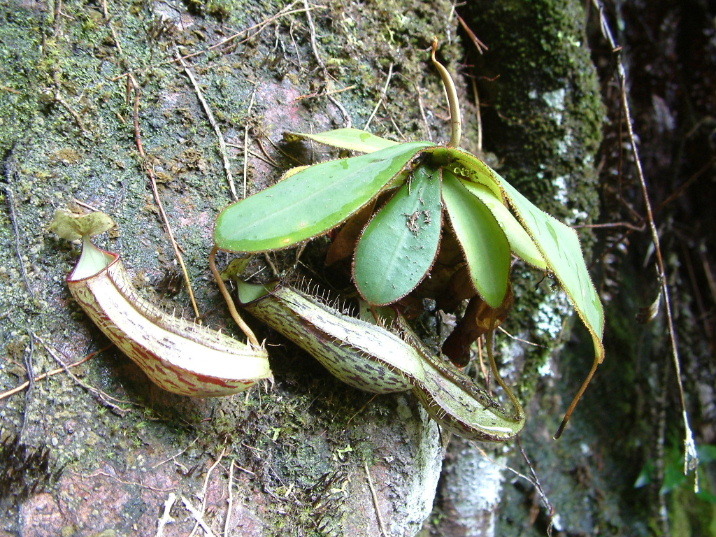
A slender climber, rarely longer than 2 to 3 m, with round stems of 2 to 2.5 mm and internodes of 3 to 10 cm. The leaves are narrowly oblanceolate, usually 9 to 11 cm long and 2.5 to 3.1 cm wide, with a rounded, sometimes slightly emarginate tip and a base that narrows gradually and is fused to the stem; three or four (sometimes five) longitudinal veins run on each side. Lower and intermediate pitchers are slightly ventricose below and tubular above, 6.8 to 7.5 cm tall and 1.7 to 2.3 cm wide, with fringed wings of 1 (to 2) mm and a rounded peristome of 0.6 to 1.2 mm with distinct ribs and small teeth on the inside. The lid is broadly ovate to almost round, 1.8 to 2.1 by 1.5 to 1.9 cm, with scattered crater-like glands; the spur is thread-like, 7 to 9 mm, and forked. The pitchers are white, about three-quarters overlaid with red stripes and blotches, with dark violet veins; the peristome is dark purple. Upper pitchers have not been described.
Similar species
Its place within the genus is disputed. Nepenthes tentaculata, N. gracillima and N. gracilis have been proposed as relatives, but Clarke (2001) sees closer affinity with Sumatran species such as N. gymnamphora, N. longifolia and N. albomarginata. Seedlings resemble those of N. longifolia, but adult plants differ clearly. N. tobaica has a similar build but differs in stem and blade, and grows in the north of the island.
The trap and how it works
A small tubular trap. The pitchers hang among the moss and vegetation on the rock face and catch what walks and flies there: ants and other small arthropods, and small flies. The peristome is narrow but distinctly ribbed and toothed on the inside, so that it turns slippery when wet and an insect that has fallen in can hardly climb back. The crater-like glands on the lid secrete nectar.
Habitat and ecology
Mossy sandstone faces and rocky ridges (R1) in moist hill and mountain forest, between about 600 and 1200 m. The plants grow among dense vegetation on the rock, in filtered sunlight, where seepage and rain keep the moss layer permanently damp. It is an unusual habitat for Nepenthes: a steep, poor but wet rock face.
Distribution and elevation
Endemic to Sumatra, in the mountains of West Sumatra. The species is known only from a small area. Because it is endangered, this guide gives no locality more precise than the province's mountains. Jebb & Cheek (1997) give 700 to 1000 m; Clarke (2001) 600 to 1200 m. The world checklist gives Sumatra as its only area.
- Recorded (one-degree cells)
Forms and variation
No varieties or forms have been described. No natural hybrids are known, even though the species grows together with N. tenuis. That is remarkable in a genus in which crosses between species growing together are the rule rather than the exception, and may indicate that the two species flower at different times or are genetically far apart.
Where and when to see it
This threatened species grows on fragile, mossy rock faces, and a known, accessible population is already being plundered by collectors. Do not seek it out; anyone who, during fieldwork in the hills of West Sumatra, nevertheless sees a slender pitcher plant with white-and-red, dark-veined pitchers on a sandstone face should photograph without climbing the rock and share no location data. A moss layer torn from a rock face takes years to recover.
Conservation status
Assessed on the Red List as Endangered. The range is very small, and the easily reached population is severely threatened by collectors and by fires set to clear land for agriculture. As a member of the genus it is listed in CITES Appendix II. The lack of herbarium material with flowers and upper pitchers shows how little is still known of the species.
Scientific name
Nepenthes adnata | Tamin & Hotta ex Schlauer, 1994
First described in 1986 by Mitsuru Hotta and Rusjdi Tamin, but this description was invalid because it lacked a Latin diagnosis. Jan Schlauer supplied that eight years later; the valid description appeared as Schlauer & Nerz 1994, in Blumea 39: 139–142, based on a holotype (Meijer 6941) collected on 24 August 1957. The type locality lies near the river Tjampo, east of Payakumbuh, Taram, West Sumatra, at 1000 metres altitude. The name "adnata" is Latin for "broadly attached" and refers to the way the leaf blade is attached to the stem.
World Checklist of Vascular Plants (WCVP), via Plants of the World Online (POWO), Royal Botanic Gardens, Kew.