All species › Caryophyllales › Tropical pitcher plant family › Nepenthes deaniana
Nepenthes deaniana
A large pitcher plant from the summit of Thumb Peak, a small ultramafic mountain near Puerto Princesa on Palawan. Nepenthes deaniana was described in 1908 by John Muirhead Macfarlane and named after Dean C. Worcester, American zoologist and administrator in the Philippines. The holotype, a collection by Curran from the mountain then called Mount Pulgar, was lost when the Manila herbarium was destroyed in 1945, and no duplicates have ever been found. The botanist A. D. E. Elmer noted in 1912 that he had seen a large sterile species there with pitchers 'a foot long and six inches thick'.
Identification
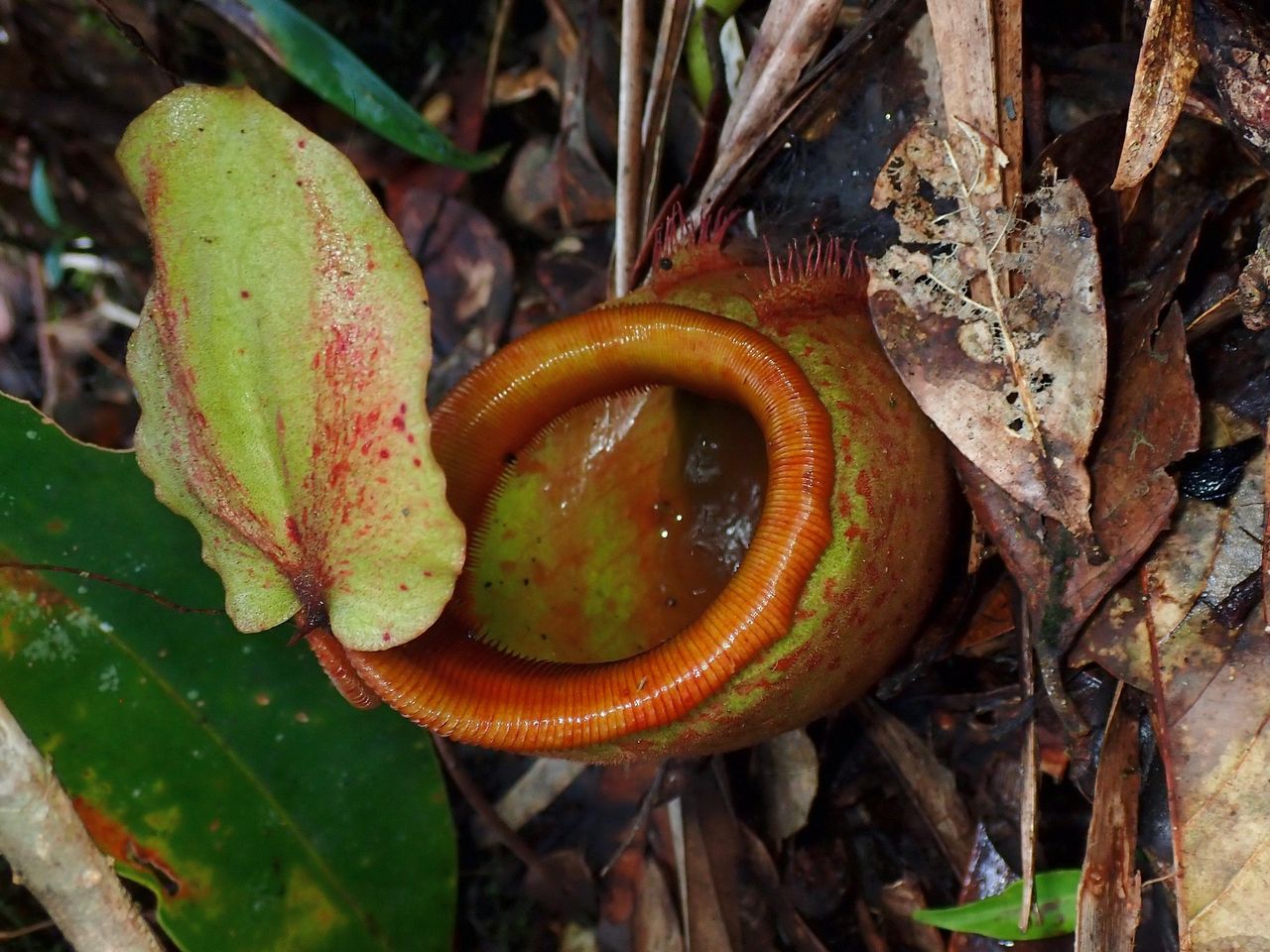
Most plants form a compact rosette or a short, rigid, upright stem up to a metre tall; climbing stems up to six metres, bearing upper pitchers, are rarer. The leaves are oblong, up to 40 cm long and 18 cm wide, with a rounded or obtuse tip and a base that abruptly narrows into a clasping petiole. The blade is green, the stem, midrib and tendril yellow. Lower pitchers are large and variable in shape, from ovate and globose to amphora-shaped or cylindrical, up to 30 cm tall and 20 cm wide, with fringed wings nearly two centimetres broad. The peristome is up to 2.5 cm wide, its ribs ending on the inner edge in needle-like teeth of 4 mm. The lid is broadly elliptic to ovate, up to 8 cm long, without appendages. Lower pitchers are orange to reddish brown with a yellowish-orange interior; the rare upper pitchers are funnel-shaped and predominantly yellow.
Similar species
The species belongs to a group of related giant species from Palawan and its surroundings, which also includes Nepenthes attenboroughii, Nepenthes mantalingajanensis and Nepenthes mira. Opinions differ on the boundaries within this group: the taxonomist Jan Schlauer regards Nepenthes gantungensis, Nepenthes leonardoi and Nepenthes mira as synonyms of Nepenthes deaniana, whereas other authors recognise them as separate species from other mountains. On Thumb Peak itself confusion is unlikely: the combination of large, bulbous lower pitchers with needle-like teeth on the peristome, yellow stems and large, rounded leaves is characteristic.
The trap and how it works
A large ground trap. Lower pitchers sit in the rosette or close to the foot of the plant, sometimes half in moss, and can hold a litre or more. The broad fringed wings guide crawling animals to the mouth, and the broad peristome with needle-like teeth on the inner edge makes it very hard for fallen prey to climb back out. The lid carries nectar glands that lure insects to the rim. Upper pitchers are rarely produced, only on climbing stems, and are funnel-shaped with a narrower peristome. No targeted prey study of this species was found in the sources consulted.
Habitat and ecology
Terrestrial in mossy upper montane forest and scrub and in small clearings, at about 1180 to 1300 m, in the summit zone of an ultramafic mountain (B1, R3). The ultramafic rock yields a nutrient-poor soil rich in heavy metals, and the summit vegetation is low and open. The climate is cool and damp, with much fog. Because the mountain is small, the amount of suitable habitat is very limited.
Distribution and elevation
Endemic to Palawan, Philippines, and known there only from the summit zone of Thumb Peak, a relatively small ultramafic mountain in the Puerto Princesa area. Our own species list gives 'Palawan, Philippines', which matches the literature. Anyone following Schlauer's broad concept would include plants from several other mountains of Palawan and its surroundings; in the concept followed here the species remains confined to that one mountain.
- Recorded (one-degree cells)
Forms and variation
No varieties or forms have been described and no natural hybrids are known. Lower pitchers vary greatly in shape, from ovate and globose to amphora-shaped, urn-shaped or cylindrical, and in colour, from orange to reddish brown. Upper pitchers are predominantly yellow, with orange accents on wings, peristome and lid. The debate over synonyms means that plants from other mountains are sometimes discussed under this name in the literature.
Where and when to see it
Thumb Peak lies within reach of Puerto Princesa, but the climb to the summit zone is steep and requires a local guide and permission from the relevant authorities. The pitchers stand mostly low, in rosettes among moss and shrubs, so look at the ground in clearings of the mossy summit forest. The orange to reddish-brown lower pitchers with their toothed peristome are unmistakable at close range. Stay on existing trails: the population is small and the summit vegetation fragile.
Conservation status
Assessed on the Red List as Near Threatened. The species is known from one small mountain, but the summit zone is hard to reach, which offers protection. As a member of Nepenthes it is listed in CITES Appendix II, so international trade in wild plants requires a permit. So restricted a habitat makes the species vulnerable to any disturbance, such as collecting, fire and climate change; no specific threats are named in the sources consulted.
Scientific name
Nepenthes deaniana | Macfarlane, 1908
Nepenthes deaniana was described in 1908 by John Muirhead Macfarlane, in the monograph "Nepenthaceae" (Das Pflanzenreich IV, III, Heft 36: 1-91). The summit region of Thumb Peak (formerly Mount Pulgar), an ultramafic mountain in Puerto Princesa Province, Palawan, Philippines, at 1,180-1,296 m elevation. The specific epithet honours Dean C. Worcester.
World Checklist of Vascular Plants (WCVP), via Plants of the World Online (POWO), Royal Botanic Gardens, Kew.