All species › Caryophyllales › Tropical pitcher plant family › Nepenthes petiolata
Nepenthes petiolata
A poorly known montane species of Mindanao, named after its distinctly stalked leaves. Nepenthes petiolata was described in 1928 by B. H. Danser in his monograph The Nepenthaceae of the Netherlands Indies, based on a collection by the American botanist A. D. E. Elmer. Up to the 2001 Flora Malesiana there were only three incomplete herbarium sheets, without flowers or fruit, so the affinities of the species remained unclear. It has been suggested that the plant is of hybrid origin, but this has not been demonstrated.
Identification
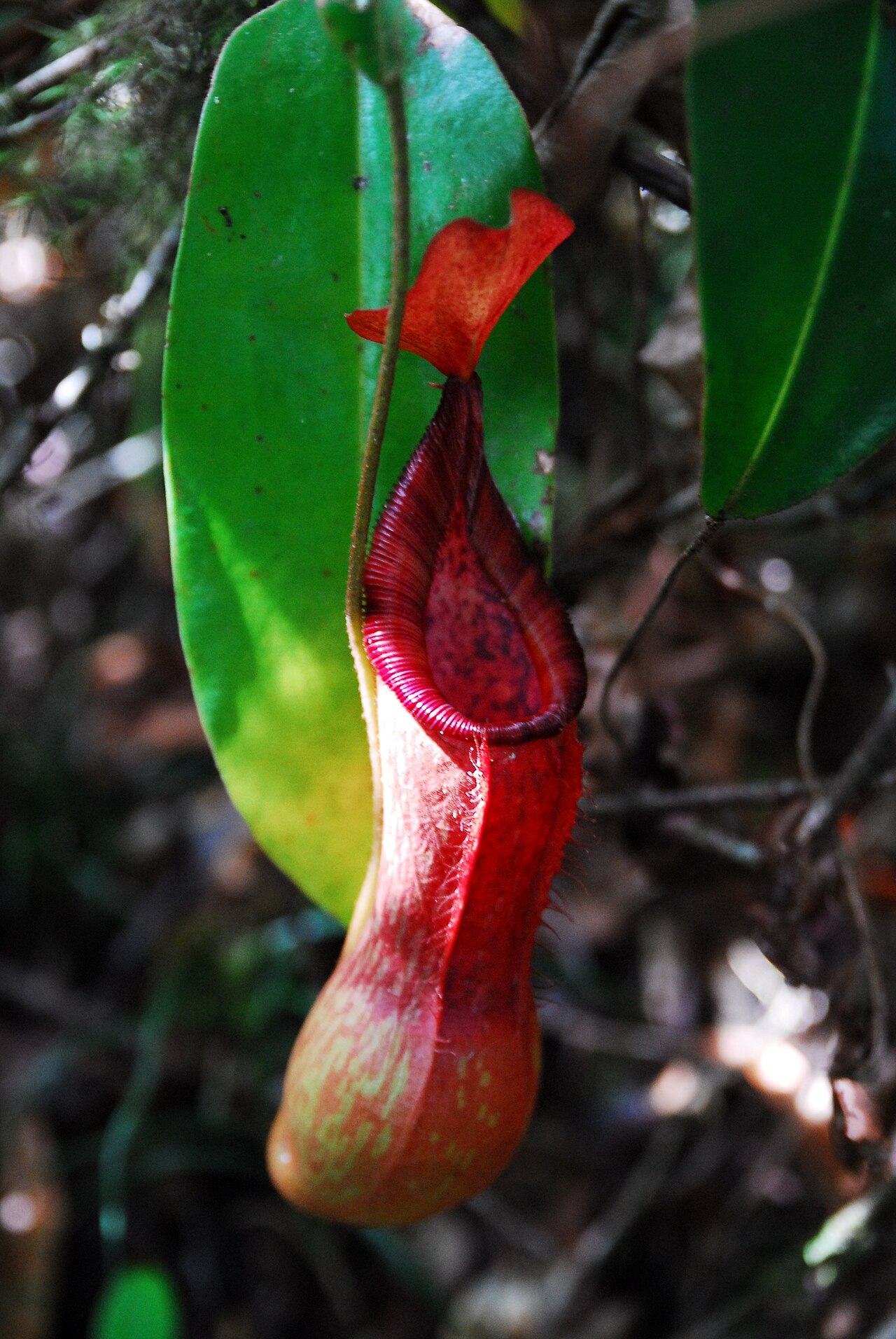
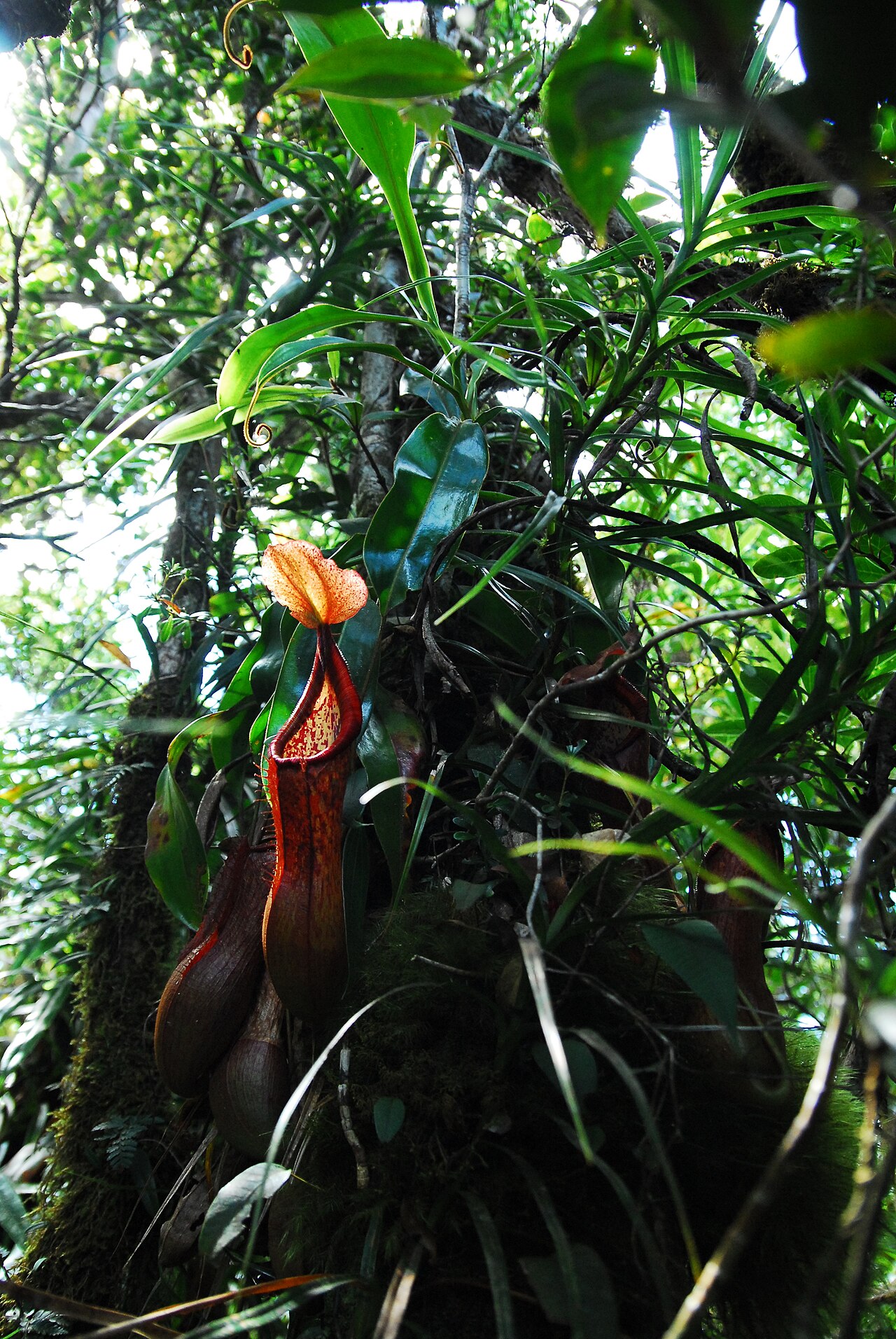
A climber of at least one metre, with hairy stems and leaf margins. The leaves are thin in texture and distinctly stalked, elliptic to oblong, 10 to 15 cm long and 3 to 5 cm wide. The known pitchers are intermediate pitchers: almost cylindrical, slightly dilated in the lower half, 7 to 13 cm tall and 2 to 4 cm wide, with fringed wings in the upper two-thirds. The mouth is ovate with an acuminate back, concave and oblique. The peristome is flattened and broad, 9 to 15 mm, with high ribs and an inner edge bearing long teeth. The lid is broadly ovate to broadly elliptic, about three and a half by three centimetres, with no appendages on its underside. The pitchers are olive to maroon, with a crimson peristome.
Similar species
According to Flora Malesiana, with its slender pitchers lacking appendages under the lid, the species is unlikely to be confused with any other species of Mindanao. The broad, flattened, long-toothed peristome on a narrow pitcher is a good character. It has been suggested that the species could be a cross between a plant of the Nepenthes alata group and Nepenthes truncata; a natural cross between Nepenthes petiolata and Nepenthes truncata is also suspected. Without flowering material and genetic study the species' place in the genus remains uncertain.
The trap and how it works
Little is known about capture, as the species is described mainly from herbarium material. The known pitchers are slender and winged, with a broad, flattened peristome and an inner edge bearing long teeth: a construction that makes it hard for a fallen insect to climb back out. The fringed wings may guide crawling animals to the mouth. As throughout the genus, nectar glands lie under the lid and digestive fluid stands at the bottom. Clearly distinct lower and upper pitchers are not described in the sources consulted.
Habitat and ecology
Montane and submontane forest with Agathis and oak, among others, at about 1500 m according to Flora Malesiana, possibly on ultramafic soil; other overviews give an altitude of 1450 to 1900 m (B1, R3). This is cool, damp cloud forest with a thick moss layer, through which the plant climbs. Little has been published on soil and light conditions at its sites.
Distribution and elevation
Endemic to Mindanao in the Philippines; Flora Malesiana gives the uplands of the provinces of Agusan and Surigao in the north-east of the island. Our own species list places the species on Palawan, but that is incorrect: all the literature consulted gives Mindanao only. The species may have been confused in our list with one of the montane species of Palawan. Its true range is poorly known owing to the small number of collections.
- Recorded (one-degree cells)
Forms and variation
No varieties or forms have been described, and with so few collections almost nothing can be said about variation within the species. A natural hybrid with Nepenthes truncata is suspected, and crosses with plants of the Nepenthes alata group are also mentioned in the literature. The colour of the known pitchers ranges from olive to maroon, with a crimson peristome. Inflorescences, fruit and seeds are still unknown.
Where and when to see it
The uplands of north-eastern Mindanao are remote, and the security situation in parts of them varies. Anyone visiting the cloud forest there with local guidance and the necessary permits can watch for slender, olive to maroon pitchers with a strikingly broad, crimson, long-toothed peristome, on plants with distinctly stalked leaves. Good photographs and, with the proper permit, herbarium material with flowers would be a valuable contribution to knowledge of this species.
Conservation status
Listed on the Red List as Vulnerable. The species is known from few sites in uplands under pressure from deforestation and mining. As a member of Nepenthes it is listed in CITES Appendix II, so international trade in wild plants requires a permit. Because so little is known about its distribution, the true state of its populations is uncertain; further fieldwork is needed.
Scientific name
Nepenthes petiolata | Danser, 1928
Nepenthes petiolata was described in 1928 by Benedictus Hubertus Danser, in "The Nepenthaceae of the Netherlands Indies" (Bulletin du Jardin Botanique de Buitenzorg, series III, 9(3-4): 249-438). The holotype is the specimen Elmer 13705. Highland regions on Mindanao island, Philippines, at 1,450-1,900 m elevation. The specific epithet derives from the Latin "petiolatus" ("petiolate"), referring to the plant's leaf attachment.
World Checklist of Vascular Plants (WCVP), via Plants of the World Online (POWO), Royal Botanic Gardens, Kew.