All species › Caryophyllales › Tropical pitcher plant family › Nepenthes mindanaoensis
Nepenthes mindanaoensis
A colourful climber of the Nepenthes alata group, from the lowlands and lower mountain slopes of Mindanao and Dinagat. Nepenthes mindanaoensis was described in 2001 by the Japanese pitcher plant specialist Shigeo Kurata and is named after the island of Mindanao. Its naming has a complicated history: plants of this group were long placed under Nepenthes alata, and a variety described by Macfarlane in 1908, Nepenthes alata var. ecristata, has been linked in turn to this species and to others of the group. The revision of the group by Cheek and Jebb in 2013 clarified the boundaries.

Identification
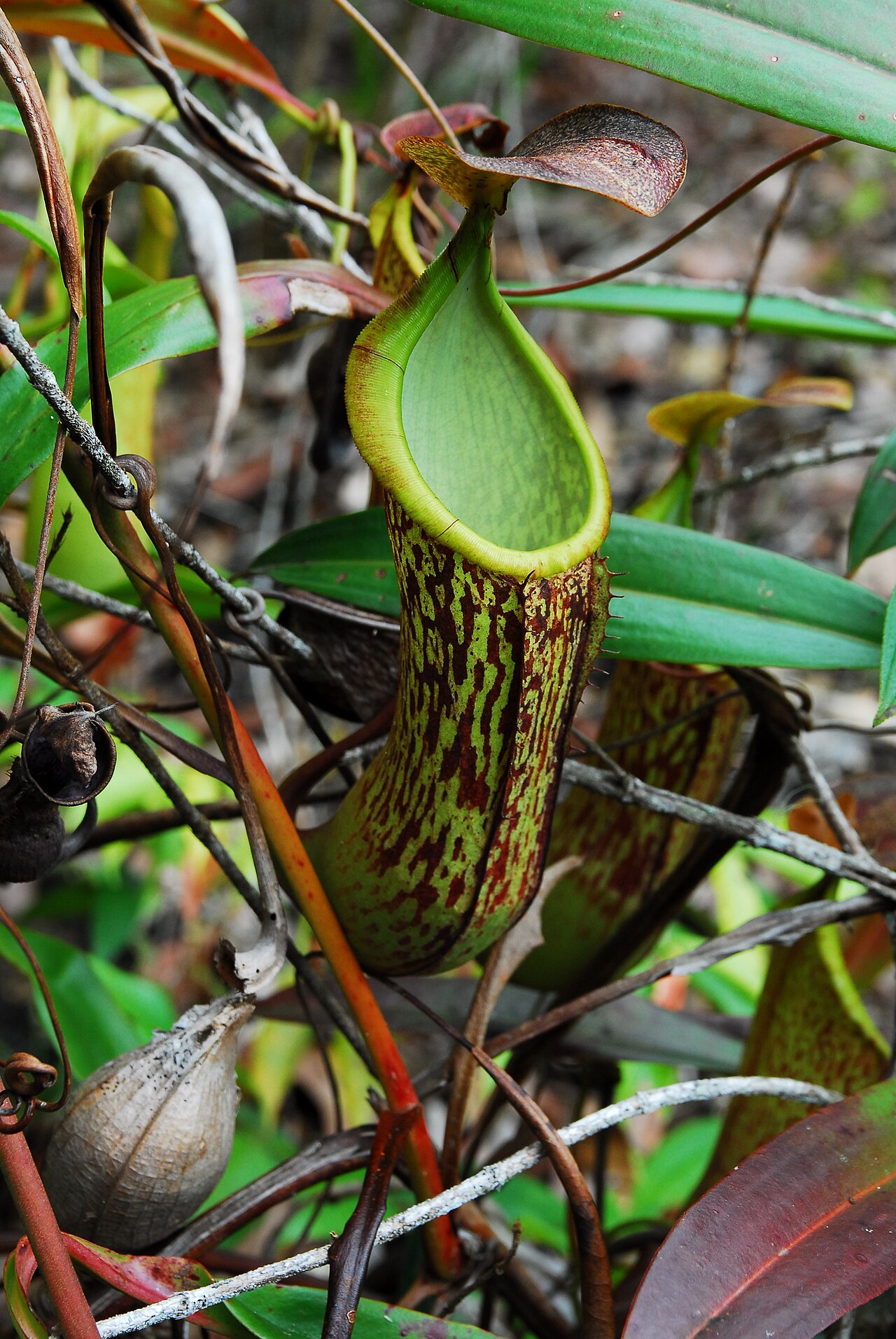
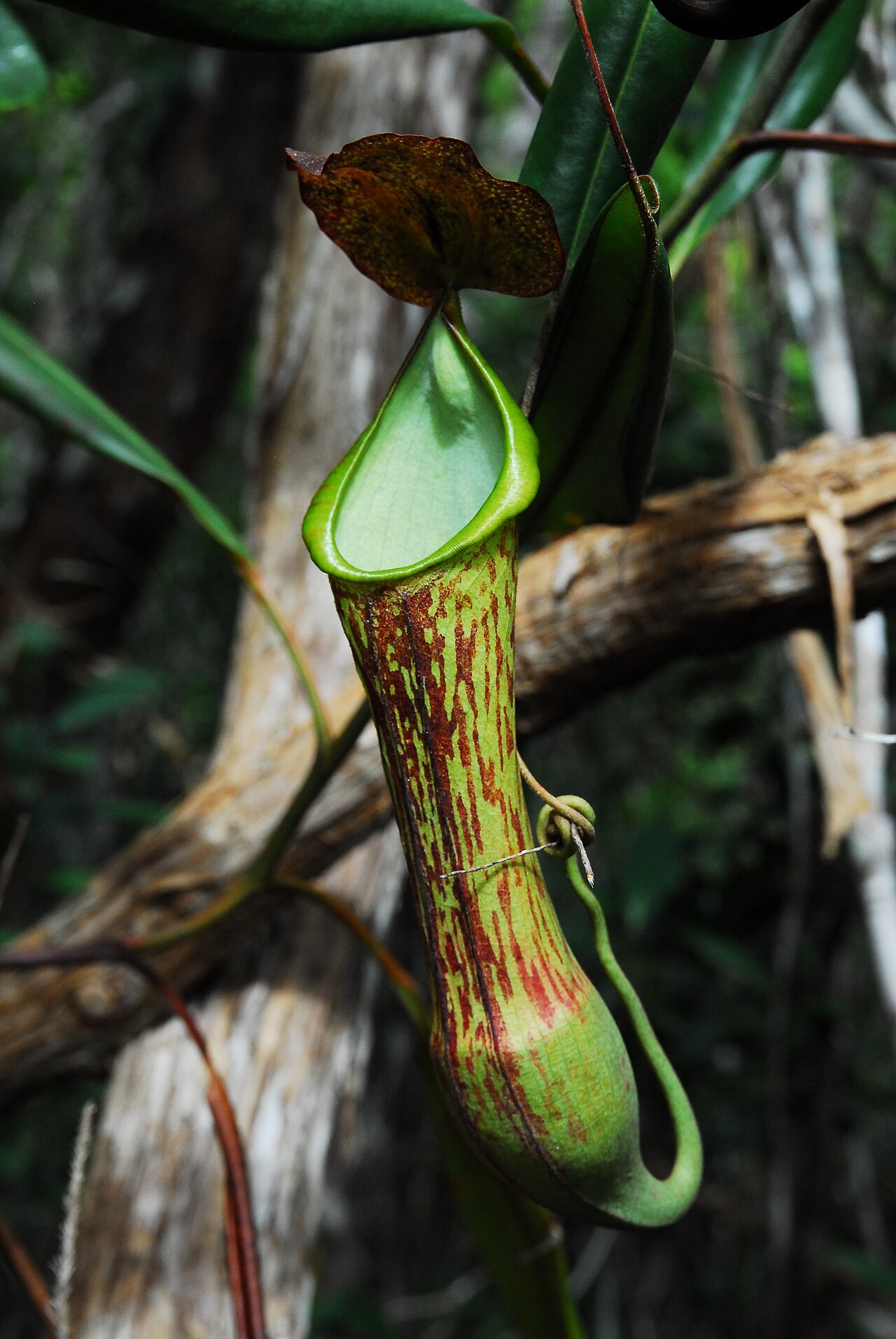
A plant with climbing, strangling or trailing branched stems up to six metres. The blade is elliptic or lanceolate, up to 25 cm long and 6 cm wide, often bright green, and borne on a strikingly long, tubular to channelled petiole up to 10 cm: one of the main differences from related species. Stem and tendrils may be yellow, green, orange or bright red. Tendrils and pitchers bear short orange-brown hairs, the leaf margins soft brown hairs up to half a centimetre, and the midrib is densely and finely white stellate-hairy. Lower pitchers, formed only briefly by young plants, are up to 15 cm tall, ovate or globose below, with fringed wings and a peristome of 3 to 10 mm. Upper pitchers reach 26 cm tall and 6 cm wide, with wings reduced to ridges or absent. The lid has a deeply heart-shaped base.
Similar species
The species belongs to the Nepenthes alata group, species with winged petioles, a basal ridge or appendage under the lid and upper pitchers usually broadest near the base. Nepenthes alata in the strict sense occurs only on Luzon and has densely grey-hairy pitchers. On Mount Hamiguitan grow Nepenthes hamiguitanensis, with stout upper pitchers and an obtuse leaf tip against the acute tip of Nepenthes mindanaoensis, and Nepenthes justinae, previously identified as Nepenthes mindanaoensis. The long petiole, the fine white stellate hairs on the midrib and the peristome with a lobed outer edge help distinguish it.
The trap and how it works
A pitfall trap in two clearly different forms. Young plants briefly produce lower pitchers: bulbous below, with fringed wings that guide crawling animals to the mouth. Mature plants make almost only upper pitchers, which hang high in the surrounding vegetation and mainly catch flying insects. The peristome has fine ribs less than a millimetre apart; once wet, insects slip on it. Nectar glands lie under the lid, which bears an unbranched spur up to 12 mm. The striking colour patterns of the upper pitchers, with dark blotches or stripes on a pale ground, presumably serve as a lure, but this has not been specifically studied.
Habitat and ecology
Lowland heath forest, degraded or recovering secondary vegetation, exposed cliffs and landslides, clearings in lowland dipterocarp forest and lower montane forest, mostly between sea level and 800 m and occasionally up to 1400 m (B3, B5, R3). Cheek and Jebb mention open scrub on ultramafic substrate. The species also grows epiphytically. It is clearly light-loving and holds its own well on disturbed, open ground, such as road verges and recovering clearings.
Distribution and elevation
Endemic to the Philippines: Mindanao and the island of Dinagat. In their circumscription Cheek and Jebb give mainly Surigao province in north-eastern Mindanao; later overviews also report plants from Mount Masay and Mount Hamiguitan, although the Hamiguitan plants have partly been identified otherwise. Our own species list gives 'Mindanao, Philippines', which is correct; Dinagat belongs to the range too.
- Recorded (one-degree cells)
Forms and variation
No wild varieties or forms have been described, but colour is exceptionally variable. The outside of the upper pitchers may be creamy white, yellow, green, orange, pink, red or purple, blotched or striped with dark red, dark purple or black; the inside is creamy white or pale yellow. Natural hybrids have been reported with Nepenthes bellii, Nepenthes merrilliana, Nepenthes truncata and plants that fell under the old, broad name Nepenthes alata; on Hamiguitan some plants may be crosses with species of that mountain.
Where and when to see it
On Dinagat and in the Surigao provinces the species is locally common, often on open, disturbed ground along roads and on slopes. Look up for the colourful, blotched upper pitchers in the scrub; lower pitchers are seen mainly on young plants at ground level. Where it grows with Nepenthes merrilliana and Nepenthes bellii, it is the middle one in pitcher size. Check the security situation in parts of Mindanao beforehand.
Conservation status
Assessed on the Red List as Least Concern. The species is widespread in north-eastern Mindanao and on Dinagat and tolerates disturbed vegetation well. Much lowland habitat in this region is, however, being lost to deforestation and mining on ultramafic rock. As a member of Nepenthes it is listed in CITES Appendix II, so international trade in wild plants requires a permit.
Scientific name
Nepenthes mindanaoensis | Kurata, 2001
Nepenthes mindanaoensis was described in 2001 by Shigeo Kurata, in "Two new species of Nepenthes from Sumatra (Indonesia) and Mindanao (Philippines)" (Journal of Insectivorous Plant Society 52(2): 30-34). The islands of Mindanao and Dinagat, Philippines; the precise type locality could not be established more precisely. The specific epithet means "from Mindanao", referencing the Philippine island where this pitcher plant originates.
World Checklist of Vascular Plants (WCVP), via Plants of the World Online (POWO), Royal Botanic Gardens, Kew.