All species › Caryophyllales › Tropical pitcher plant family › Nepenthes benstonei
Nepenthes benstonei
A pitcher plant that received a name only in 1999, although Henry Ridley must already have collected it on Gunung Tahan in 1911. Nepenthes benstonei was described by Charles Clarke, author of the standard work on the pitcher plants of Sumatra and the Malay Peninsula, and named after the botanist Benjamin Stone, one of the first to collect the plant. Clarke called it 'unremarkable', and perhaps it is: medium-sized, green-yellow to brick-red pitchers on a plant with bluish, waxy leaves. But it has peculiarities that make it an interesting species, and Clarke saw in it a possible link between the pitcher plants of Indochina and those of the peninsula.
Identification
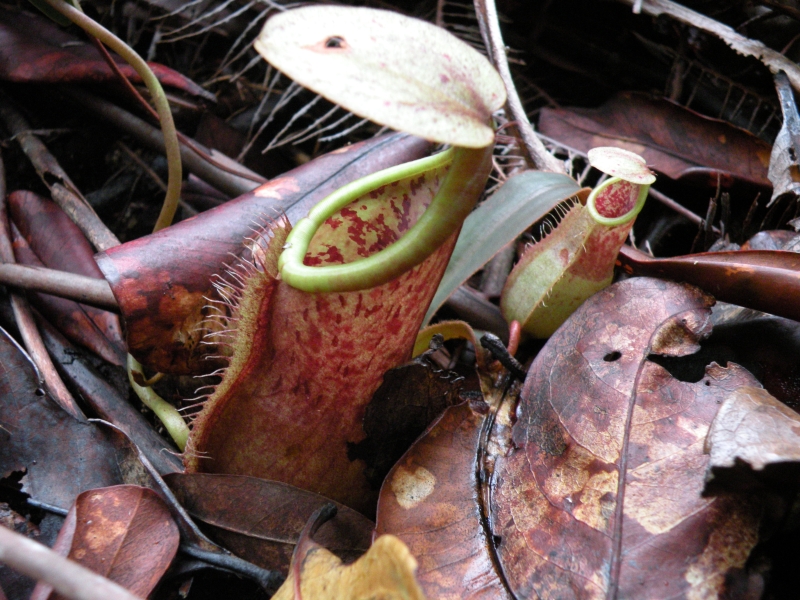
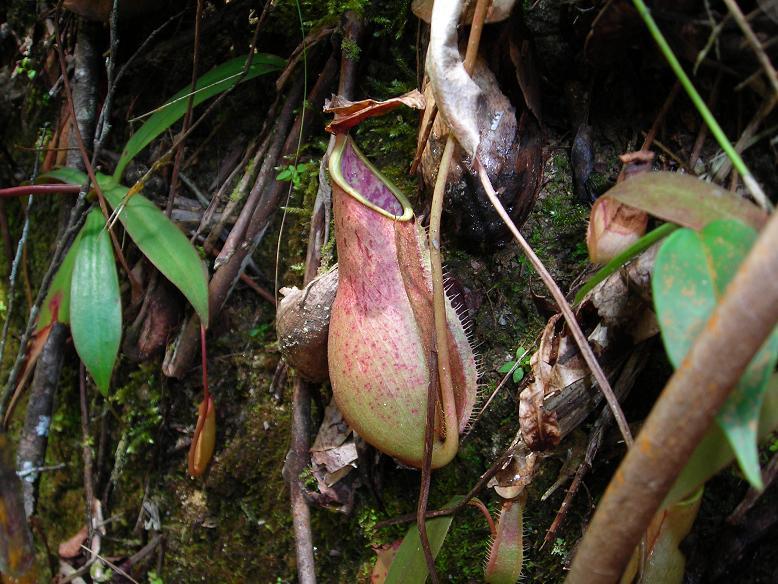
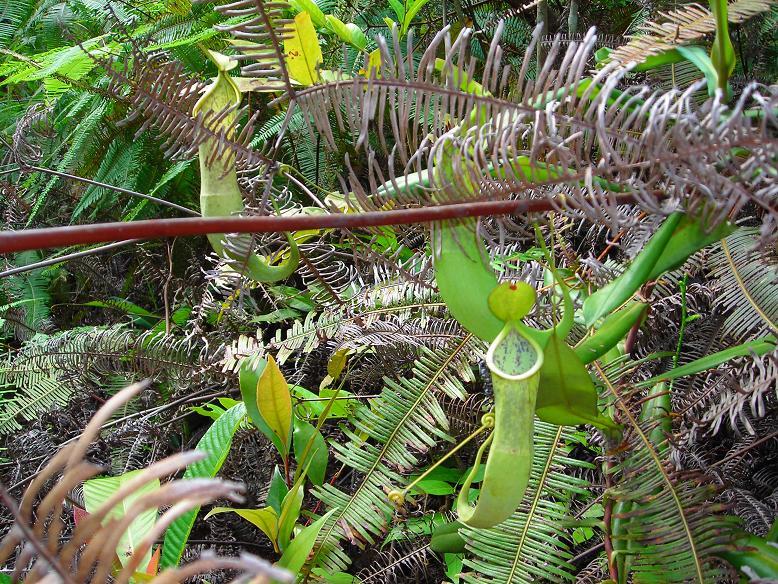
A robust climber, up to ten metres long, with terete stems four to eight millimetres thick and long internodes. The leaves are broadly linear-lanceolate, usually 25 to 30 cm but sometimes up to 60 cm long, with three to five longitudinal veins on each side; they are sessile to shortly stalked and clasp the stem with a broad sheath. Stem and leaves have a thick waxy cuticle that gives them a whitish-blue sheen. Lower pitchers have a pronounced 'hip': ovoid below, abruptly narrowed and cylindrical above, to 15 or 20 cm tall, with fringed wings up to four millimetres and a cylindrical peristome of three to six millimetres with small teeth on the inner margin. Upper pitchers are narrower, to 15 or 20 cm tall and 3 cm wide, funnel-shaped at the base, then narrowly ovoid and cylindrical above; their peristome lacks teeth. Colour ranges from green and yellow to brick red.
Similar species
The species most resembles Nepenthes sanguinea, from the same peninsula, but that has an angular stem, smaller sessile leaves, and grows higher. Clarke further cites Nepenthes smilesii from Indochina, whose pitchers look very like those of benstonei, and Nepenthes macrovulgaris of Borneo, which has only one inflorescence at a time with exclusively two-flowered partial peduncles. Nepenthes albomarginata has a white band below the peristome, and the upper pitchers of Nepenthes mirabilis can look similar, though the rest of that plant has little in common with this species. A good character of benstonei is that a stem often carries two or three inflorescences at once, which is rare in the genus.
The trap and how it works
A pitfall trap with two clearly different pitcher forms. Lower pitchers, with their swollen base and narrowed 'hip', hold much fluid and catch crawling animals guided by the fringed wings; the teeth on the inner edge of the peristome hinder escape. Upper pitchers lack those teeth and hang higher, catching flying insects. The outside of the pitchers bears a sparse covering of short, branched red hairs. No specific prey study for this species was found in the sources consulted.
Habitat and ecology
Open secondary vegetation in full sun, such as road embankments, landslips and other disturbed sites (B5, H1); it also grows in dense forest (B1), but produces few pitchers there. At the type locality it is locally very abundant on embankments beside a paved road. The sources give different altitudes: Cheek and Jebb (2001) cite 450 to 600 m, Clarke a total range of 150 to 1350 m, with plants on Gunung Tahan between 800 and 1350 m. Given these differing statements the elevation field is left empty.
Distribution and elevation
Endemic to the Malay Peninsula: known from the low hills of Kelantan and northern Terengganu, and from Gunung Tahan in Taman Negara National Park in Pahang. The type locality is the hilltop of Bukit Bakar near Machang in Kelantan, where Clarke collected the species in July 1998. Our own list gives the peninsula in general, which is correct.
- Recorded (one-degree cells)
Forms and variation
No varieties have been described. Pitcher colour ranges from green and yellow to brick red. Until 2025 one natural hybrid was known, Nepenthes benstonei × Nepenthes mirabilis, found as a single plant on Bukit Bakar; in 2025 a cross with Nepenthes rafflesiana was reported. According to Clarke, herbarium material of this species dries lighter than that of sanguinea, a useful point for anyone searching old collections.
Where and when to see it
Bukit Bakar, a recreational forest near Machang in Kelantan, is the classic site: the plants grow on the embankments along the road to the top and can be seen without searching. Look for climbing stems with bluish-bloomed leaves and pitchers with a distinct hip. On Gunung Tahan the species grows along the western trail; that requires a multi-day guided trek. The wet monsoon on the east coast falls from November to January.
Conservation status
The species has not (yet) been assessed for the Red List. Clarke considered its future in the wild secure: the type locality lies in a protected area, the species thrives in disturbed vegetation, and its unremarkable appearance means collection is no serious threat. As a member of Nepenthes it is listed in CITES Appendix II, so international trade in wild plants requires a permit.
Scientific name
Nepenthes benstonei | Clarke, 1999
Nepenthes benstonei was described in 1999 by Charles Clarke, in "Nepenthes benstonei (Nepenthaceae), a new pitcher plant from Peninsular Malaysia" (Sandakania 13: 79-87). The holotype was collected by Clarke himself on 24 July 1998 at Bukit Bakar, Kelantan, at 450-550 m elevation, and is held at the Forest Research Institute of Malaysia (Kepong); isotypes are held at Kew, Leiden and Singapore among others. Bukit Bakar, Kelantan, Peninsular Malaysia, at 450-550 m elevation. The specific epithet honours botanist Benjamin Clemens Stone, one of the first to collect the species.
World Checklist of Vascular Plants (WCVP), via Plants of the World Online (POWO), Royal Botanic Gardens, Kew.