All species › Caryophyllales › Tropical pitcher plant family › Nepenthes macfarlanei
Nepenthes macfarlanei
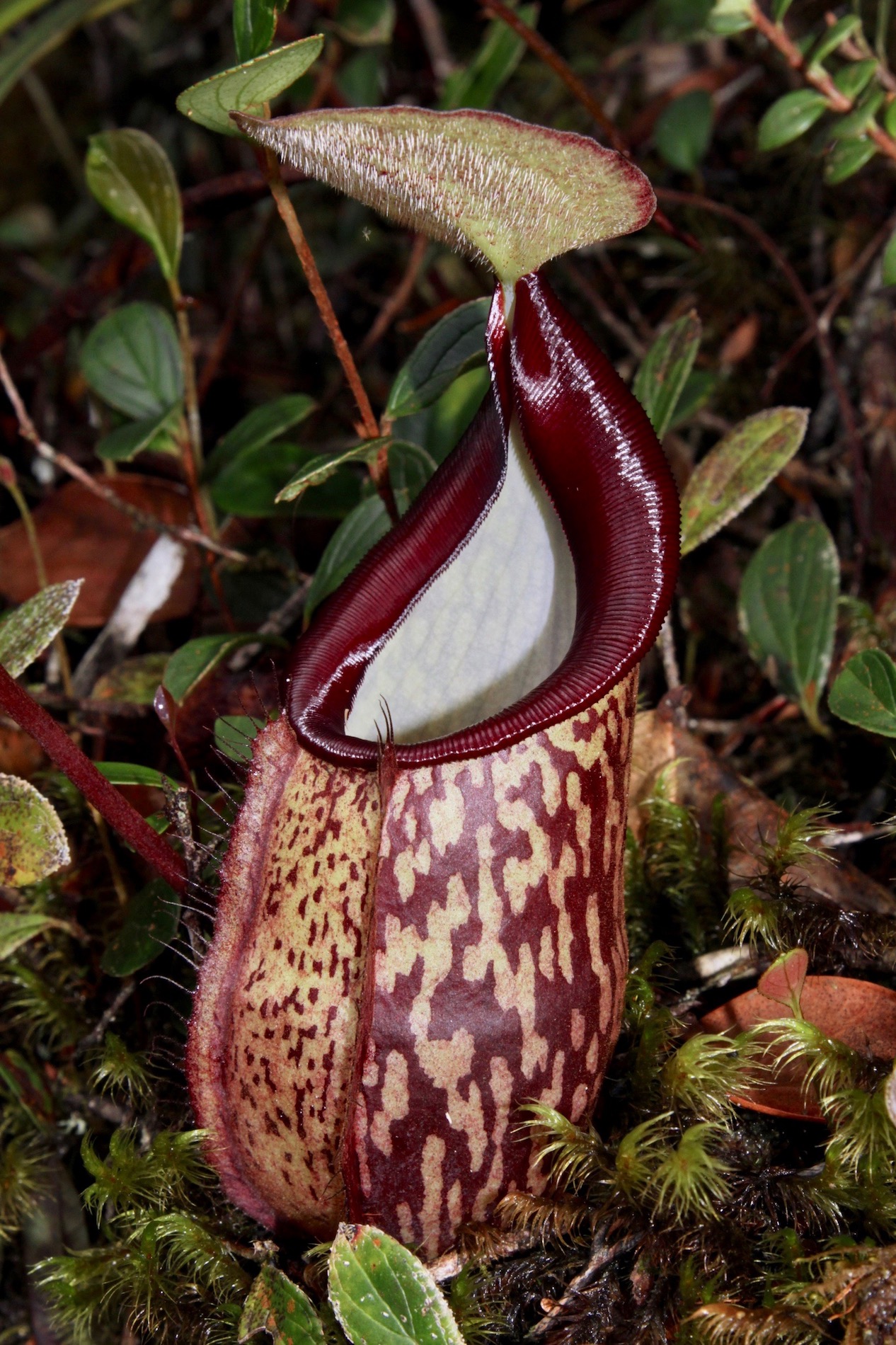
The pitcher plant with the hairy lid. Where in almost every species of the genus the underside of the lid is bare apart from the nectar glands, in Nepenthes macfarlanei it is densely covered with short white hairs, like a layer of felt. What they are for, nobody knows. The species was described in 1905 by the British botanist William Hemsley and named after John Muirhead Macfarlane, the Scottish-American botanist who a few years later wrote the first major monograph of the genus. It is a plant of the high, cool montane forests of the Malay Peninsula, and one of the best-known pitcher plants of the Malaysian hill stations.
Identification
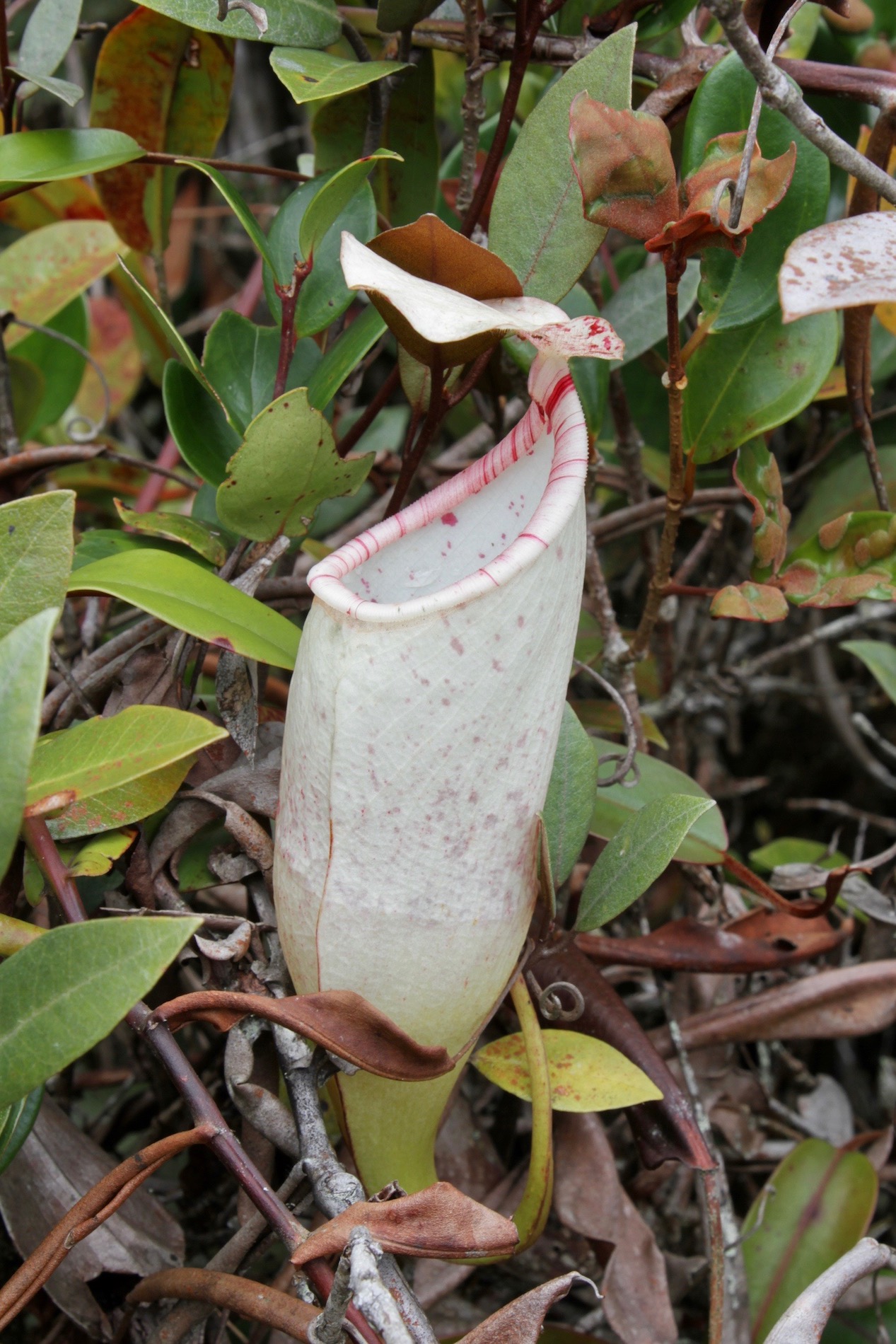
Lower pitchers are robust and pot-bellied, up to 25 cm tall, ovoid or funnel-shaped in the lower half and globose or cylindrical above, with two fringed wings down the front. They are speckled red on a paler ground, often in striking shades. Upper pitchers are paler in colour, and their wings are reduced to ribs. The best character, and a unique one on the peninsula, is the underside of the lid: it is densely covered with short white hairs, so that the lid looks white or silvery from below. Precise measurements of leaves and stem were not available to this guide from a verifiable source, so the plant size field is left empty.
Similar species
The same uplands hold Nepenthes sanguinea, Nepenthes ramispina and Nepenthes gracillima, and where they meet, hybrids arise. Nepenthes sanguinea often has even more robust, plain red or green pitchers, but a bare lid underside. Nepenthes ramispina and Nepenthes gracillima have much slimmer, cylindrical pitchers with a narrow peristome. In doubt, look under the lid: the white hair covering is decisive for macfarlanei, although hybrids may partly inherit it. It is also notable that the species crosses with two very different species in the same uplands, which may suggest that the pollinators of these pitcher plants, mainly small flies and other insects, are not very choosy between species.
The trap and how it works
A pitfall trap with a riddle. Lower pitchers stand on the ground or in moss and are pot-bellied and roomy, with plenty of fluid; the fringed wings guide crawling animals to the mouth. Upper pitchers hang higher. The white hairs under the lid are the intriguing part: in other species that area holds a zone of nectar glands that lures insects, and it is unclear whether the hairs enhance luring, protect the glands, or do something else entirely. The digestive fluid of this species was studied for enzymes as early as 1974, and there have been studies of its flowering, floral biology and pollination; these are among the earliest ecological studies of a pitcher plant of the peninsula.
Habitat and ecology
High mossy montane forest on the mountains of the peninsula (B1): a cool, permanently humid setting with much moss, ferns and mist. The plants grow there in the moss on the forest floor and along ridges and forest edges, where enough light penetrates. No reliable altitudinal range was taken from a verifiable source for this guide, so the elevation field is left empty; the species in any case belongs to the higher montane zones.
Distribution and elevation
Endemic to the Malay Peninsula. The species is known from several mountains, including Gunung Tahan and the mountains around the Genting Highlands on the Main Range. Within those uplands it is not rare at suitable altitudes. Our own list gives the peninsula, which agrees with the literature. The hill stations of the peninsula, such as the Genting Highlands and the Cameron Highlands, were laid out in colonial times as cool retreats, and the roads to them opened up the mossy montane forest to botanists and visitors. Much of what is known about the pitcher plants of the peninsula comes from these accessible areas.
- Recorded (one-degree cells)
Forms and variation
No varieties are recognised. The colour of the lower pitchers ranges from greenish yellow to deeply red-speckled. In the wild, hybrids are known with Nepenthes ramispina and with Nepenthes sanguinea; where several species grow intermixed, intermediates can complicate identification. Plants with trade names do not belong in this account.
Where and when to see it
The hill stations of the Main Range, with built trails through mossy montane forest, are the place to see this species. Look low, in the moss along the trail: the red-speckled, pot-bellied lower pitchers often lie half hidden. When you find a pitcher, bend down carefully to view the lid from below without touching it; the white felt is clearly visible to the naked eye. Come early in the day, before the afternoon cloud wraps the forest in mist.
Conservation status
The Red List assesses the species as Least Concern. It is present on several mountains of the peninsula, partly in protected areas. The highest montane zones of the peninsula are, however, small and under pressure from the expansion of hill stations and agriculture, and in the long run from climate change. As a member of Nepenthes it is listed in CITES Appendix II, so international trade in wild plants requires a permit.
Scientific name
Nepenthes macfarlanei | Hemsley, 1905
Nepenthes macfarlanei was described in 1905 by William Botting Hemsley. The precise type locality could not be established with certainty; the species is endemic to Peninsular Malaysia. The species is named after the botanist John Muirhead Macfarlane, who himself later (1908) described several other Nepenthes species, including N. hemsleyana, N. deaniana and N. insignis.
World Checklist of Vascular Plants (WCVP), via Plants of the World Online (POWO), Royal Botanic Gardens, Kew.