All species › Caryophyllales › Tropical pitcher plant family › Nepenthes armin
Nepenthes armin
A pitcher plant whose name recalls a political killing. Nepenthes armin is named for Armin Rios Marin, a municipal councillor on Sibuyan and former WWF staff member, who on 3 October 2007 was shot dead by a mining company official while leading a protest against forest clearance for a mine. Martin Cheek and Matthew Jebb described the species in 2014 from a collection that George Argent and Reynoso had made on Sibuyan as early as 1989.
Identification
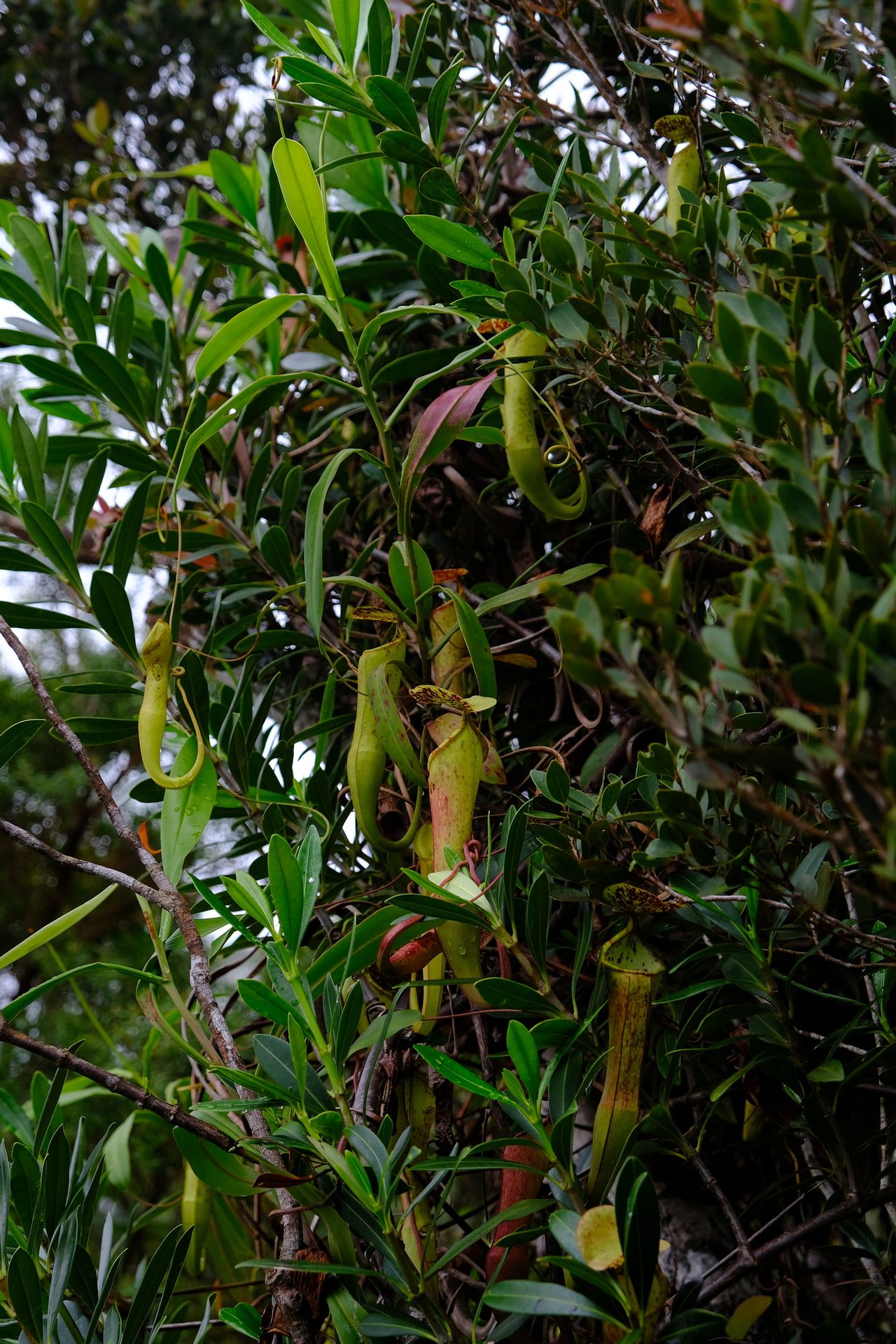
A climber to about five metres, with a rounded-quadrangular stem three to five and a half millimetres thick; the leaf axils hold dense brown hairs. The leaves are thinly leathery, narrowly oblong-elliptic to almost linear, 10 to 17.5 cm long and 1.4 to 3.7 cm wide, with a gradually decurrent base and two pairs of longitudinal nerves in the outer third of the blade; they carry scattered erect pale brown hairs. Only upper pitchers are known: narrowly cylindrical, 10 to 16 cm tall and 2 to 3 cm wide, green with faint purple mottling. The lower half is narrowly ellipsoid, after which the pitcher gradually narrows to 1.3 to 2.2 cm at the middle and widens again below the peristome. The wings are reduced to inconspicuous ridges, and the pitcher carries branched hairs. The peristome is cylindrical and thin, one to two millimetres. The lid is orbicular, two to three centimetres, bright purplish red mottled beneath, with a low ridge at the base. The male inflorescence is 25 to 28 cm long with 70 to 95 one-flowered side branches; the flowers are green on opening and later turn red.
Similar species
Sibuyan also holds Nepenthes graciliflora, whose type collection in fact comes from Guiting-Guiting; it is the common, widespread species of the same group. The combination of very narrow, mid-constricted upper pitchers without fringed wings, hairy leaf axils and a lid underside mottled bright purplish red and densely set with small nectar glands with raised rims distinguishes Nepenthes armin. The other Sibuyan species, Nepenthes sibuyanensis and Nepenthes argentii, grow much higher and have entirely different, squat pitchers. Later phylogenetic work placed the species in the small section Alatae, together with Nepenthes alata and a few species from Luzon.
The trap and how it works
A slender pitfall of the type common in the alata group: a narrow, hanging pitcher with a thin, round peristome with fine ribs a quarter of a millimetre apart. The lid carries dense, round nectar glands a fifth of a millimetre across beneath, each surrounded by a raised membranous rim; four to ten per square millimetre. The purplish-red colour of the lid underside coincides with the location of the nectar. Without fringed wings the upper pitchers offer no obvious walkway for crawling animals; flying insects and those climbing the stem are the likely prey. Studies of prey are lacking.
Habitat and ecology
The only known habitat is forest on the ridge above Magdiwang, towards Mayos Peak, at about 750 m (B1). That makes it the lowest-growing pitcher plant of the Guiting-Guiting massif, below the zone of Nepenthes graciliflora. The description says little more about soil or vegetation. The area lies on the north side of the island, where the slopes of the massif descend to Magdiwang.
Distribution and elevation
Endemic to Sibuyan, in Romblon province, and known only from the ridge above Magdiwang at about 750 m. The label 'Sibuyan' in our species list is correct and can be narrowed to the northern slope of the Guiting-Guiting massif.
- Recorded (one-degree cells)
Forms and variation
No varieties have been described. Upper pitchers vary considerably in size, from ten to sixteen centimetres, and the lid from round to, rarely, notched at the tip. Lower pitchers, intermediate pitchers and fruits are still unknown. No natural hybrids have been reported.
Where and when to see it
The site lies on the route that climbs the ridge from Magdiwang towards Mount Guiting-Guiting, the usual access to the natural park. At about 750 m, well below the open ridges, look in the forest for a slender climber with narrow, green, waisted pitchers. Carefully turn the lid to look underneath: the bright purplish-red underside is the best field character. A trek in the park requires a permit and a local guide.
Conservation status
The Red List assesses the species as Least Concern. The authors came to a very different verdict in 2014, Critically Endangered, with an estimated fewer than fifty mature plants. How that difference arose cannot be told from the sources available for this guide; above all it shows how little is known about the population. The name remains a reminder of the tension between mining and nature on Sibuyan. Like all Nepenthes it is listed in CITES Appendix II.
Scientific name
Nepenthes armin | Jebb & Cheek, 2014
Nepenthes armin was described in 2014 by Matthew Jebb and Martin Cheek, in "Expansion of the Nepenthes alata group (Nepenthaceae), Philippines, and descriptions of three new species" (Blumea 59(2): 144-154). The type material was collected in 1989 on Sibuyan Island, Philippines, in gallery forest on ultramafic rock at approximately 750 m elevation. The specific epithet honours Armin Rios Marin, a former local councillor and World Wide Fund for Nature official, who was murdered in 2007 during a protest against forest clearance for a mining project on Sibuyan.
World Checklist of Vascular Plants (WCVP), via Plants of the World Online (POWO), Royal Botanic Gardens, Kew.