All species › Caryophyllales › Tropical pitcher plant family › Nepenthes campanulata
Nepenthes campanulata
A dwarf among pitcher plants, with bell-shaped pitchers of about ten centimetres, and a species with a dramatic history. Nepenthes campanulata was collected by Kostermans in East Kalimantan in 1957 and described by Kurata in 1973 from a single herbarium specimen. The known populations in Kalimantan were later lost to forest fires, and the species was thought possibly extinct until it was found again in 1997 on limestone walls in Gunung Mulu National Park, Sarawak, more than 400 km from the original site.
Identification
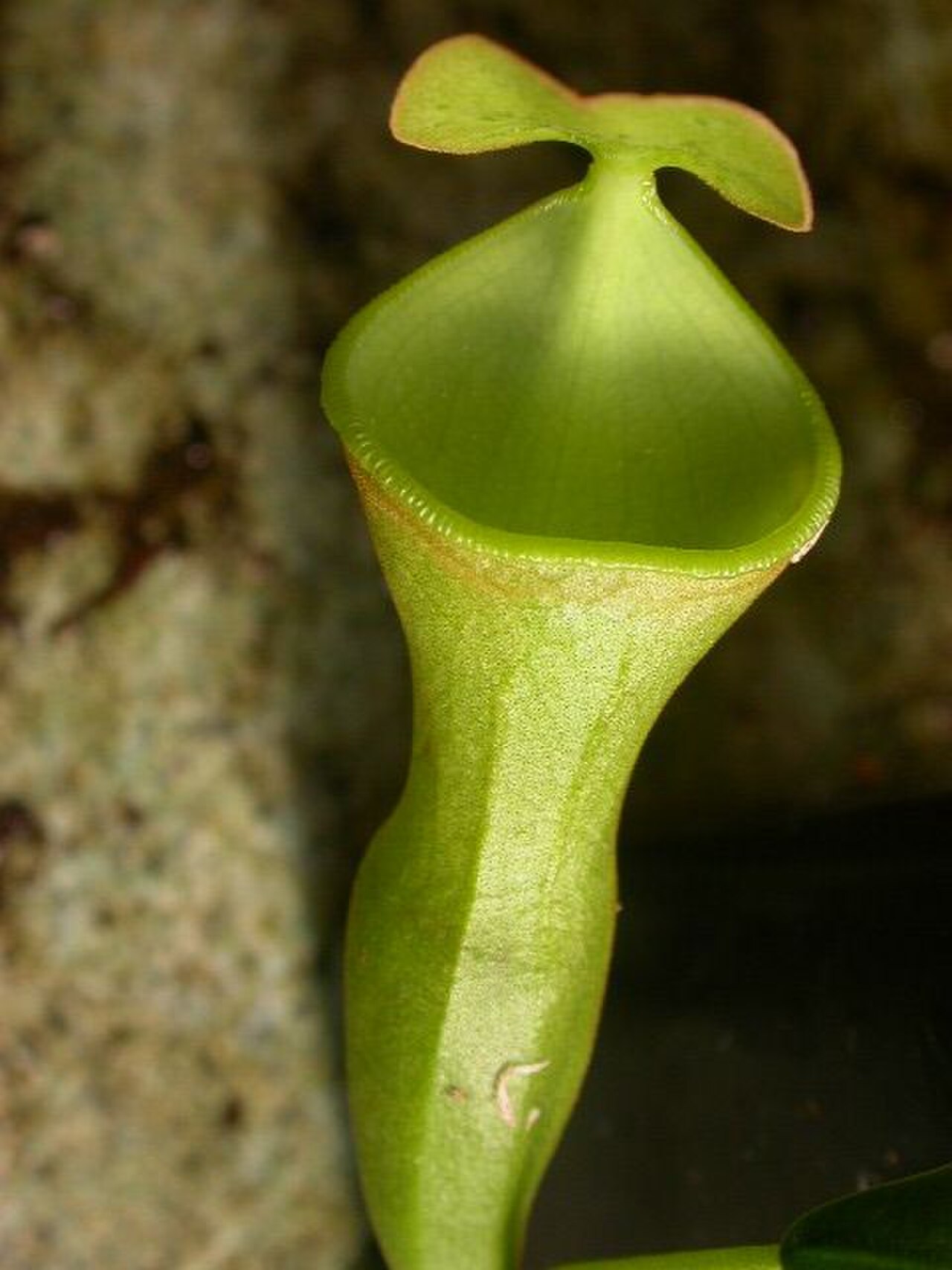
A small rock plant with short, cylindrical stems 20 to 50 cm tall and up to 4 mm thick, spreading by underground runners and forming large clumps with many growing points. The leaves are leathery and stalkless, spathulate to lanceolate, to 12 cm long and 2 cm wide, with a rounded, slightly peltate tip and a clasping base. The tendrils are very short and stiff, rarely over 4 cm. The plant produces only one type of pitcher: bell-shaped, yellow-green, to 10 cm tall and 5.5 cm wide, usually without fringed wings but with two ribs on the front. The mouth is round and horizontal, the peristome greatly reduced with a row of tiny teeth, and the lid elliptic to oblong, without appendages. The plant is wholly hairless.
Similar species
No Bornean species really resembles it: the combination of small, bell-shaped yellow-green pitchers on very short tendrils, a barely visible peristome and a clumping habit on limestone walls is unique. Morphologically the species is compared with Nepenthes inermis of Sumatra, which also has a reduced peristome, but that is an epiphyte of 1500 to 2600 m and grows far away; a close relationship has not been shown. No natural hybrids are known.
The trap and how it works
A trap that relies on its shape, not its peristome. The rim is so reduced that there is hardly a slippery platform; the mouth is horizontal and the bell widens upwards, so an insect landing on the rim and slipping readily falls in. The digestive glands lie only in the lowest quarter of the inner wall. The tendrils are so short that the pitchers hang close to the leaves against the rock. Nothing has been published on the prey.
Habitat and ecology
Damp, mossy places on limestone walls (R2, R1), in the lowlands at 100 to 300 m. The plant grows as a lithophyte directly on the rock, in shaded to half-shaded situations where moss and seepage keep the face moist. With its underground runners it forms dense cushions on ledges and in crevices. It is thus one of the few Bornean lowland species that grow only on limestone.
Distribution and elevation
Endemic to Borneo. The original site lay in East Kalimantan; the only populations known with certainty now grow on limestone in Gunung Mulu National Park, Sarawak, Malaysia. A find from Palawan in the Philippines was reported in 2013 and has not yet been confirmed. Altitude: 100 to 300 m. The area in our species list (Borneo) is correct.
- Recorded (one-degree cells)
Forms and variation
No varieties or forms have been described and no natural hybrids are known. The pitchers are fairly uniformly yellow-green. Because the plant makes only one type of pitcher, there is no usual contrast between lower and upper pitchers. Flowers and fruit were unknown until the 1997 rediscovery; Kurata's type material had no inflorescence.
Where and when to see it
In Gunung Mulu National Park in Sarawak the species grows on lowland limestone walls; the park has a network of trails and boardwalks, and park guides know the pitcher plants. Look on shaded, mossy limestone faces for dense cushions of small, narrow leaves with yellow-green bells. The plants are often out of reach; binoculars suffice. Climbing on the limestone is not allowed in the park, and the rock is sharp.
Conservation status
The Red List assesses the species as Vulnerable (2014 assessment). The original Kalimantan populations vanished in forest fires, and drought with fire, as in El Niño years, remains the greatest threat to lowland limestone flora. The Gunung Mulu populations lie in a strictly protected national park and World Heritage Site, which gives the species a secure base for now. It is listed in CITES Appendix II.
Scientific name
Nepenthes campanulata | Kurata, 1973
Nepenthes campanulata was described in 1973 by Shigeo Kurata, based on a single specimen (Kostermans 13764) collected on 9 September 1957 on Mount Ilas Bungaan (northeastern Borneo), at 300 m elevation amid sand and limestone walls; the material is held at the herbarium of the Singapore Botanic Gardens. The species was later presumed extinct after forest fires destroyed this population, but was rediscovered in 1997 at Gunung Mulu National Park, Sarawak — over 400 km from the original type locality. Mount Ilas Bungaan, northeastern Borneo, at 300 m elevation. The name derives from Late Latin "campānulātus" ("bell-shaped"), referring to the pitcher's characteristic shape.
World Checklist of Vascular Plants (WCVP), via Plants of the World Online (POWO), Royal Botanic Gardens, Kew.