All species › Caryophyllales › Tropical pitcher plant family › Nepenthes clipeata
Nepenthes clipeata
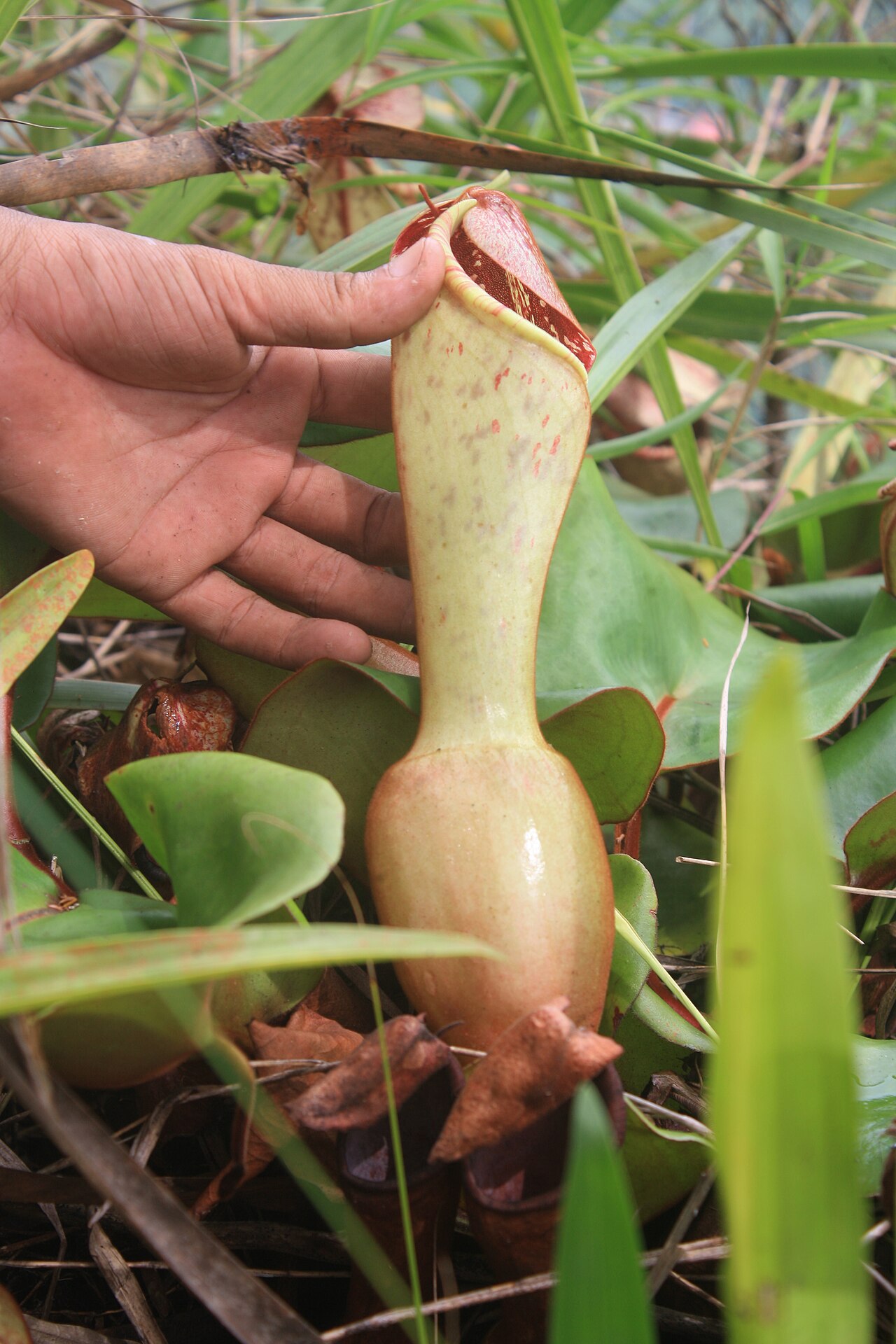
Perhaps the most endangered pitcher plant in the world. Nepenthes clipeata is known from a single granite mountain in West Kalimantan, where it grows on near-vertical rock faces. The name means 'shield-shaped' and refers to the round leaves, whose tendril is attached not at the tip but on the underside of the blade, like the handle of a shield. Shortly after its discovery in 1894 it was still plentiful there; collecting and fire have reduced the wild population over a century to a handful of plants, and the survival of the species now largely depends on plants in cultivation.
Identification
A non-climbing plant with a short, sturdy stem of at most 2 m. The leaves are almost round and peltate: the tendril is attached on the underside of the blade, some way before the tip, which makes the species unique on Borneo. The plant produces only one type of pitcher: globose below and slightly funnel-shaped above, to 30 cm tall according to the literature, without wings, with a strongly vaulted lid. The whole plant is densely covered in long brown hairs. The inflorescence is small, rarely more than 25 cm; most flowering plants seen in the wild were male.
Similar species
No other Bornean species has peltate, round leaves with the tendril beneath the blade, so on its mountain it is unmistakable. The only species with a comparably aberrant leaf form is Nepenthes truncata of the Philippines, which has much larger, truncate leaves and much larger pitchers and need not be related. Lowland species such as N. albomarginata, N. rafflesiana and N. reinwardtiana grow nearby, and hybrids with all three are known; these have intermediate leaves, usually without full peltate attachment.
The trap and how it works
A wingless pitfall, borne by a plant that does not climb and so has no lower and upper pitchers in the usual sense. The pitchers hang from the tendril beneath the round leaves against the rock face. They are globose below, so they hold much fluid, and widen slightly towards the mouth. The strongly vaulted lid keeps most rain out. Little is known of the prey; given the habitat on a bare rock face, ants and other animals walking over the rock probably make up a large share, but published data are lacking.
Habitat and ecology
Near-vertical granite faces (R1), at 600 to 800 m according to Clarke and up to about 875 m according to a later survey. The plant roots in crevices and on narrow ledges where some humus has collected, and stands in full light. Faces like these dry out strongly in the dry season, and the surrounding vegetation is fire-prone. The very inaccessibility of the faces is why any plants remain.
Distribution and elevation
Endemic to Borneo, and known from a single granite mountain in the Kapuas basin in the province of West Kalimantan, Indonesia. Because the species is critically endangered, this guide does not name the mountain and gives no further directions. Our species list names Kapuas Hulu regency; according to the literature the mountain lies further downstream, outside that regency, so only West Kalimantan is given here.
- Recorded (one-degree cells)
Forms and variation
No subspecies or varieties have been described. Natural hybrids are known with N. albomarginata, N. rafflesiana and N. reinwardtiana. In cultivation only three or four genetically distinct lines of legally grown plants exist, which makes the genetic base of the species outside its mountain very narrow. Documenting the genetic variation in the wild is therefore a priority of the conservation projects.
Where and when to see it
Do not visit the site and do not search for the species. Every step on the faces, every broken plant and every collected seed weighs heavily on a wild population of a few plants to a few hundred. Anyone who wants to see the species can do so in botanic gardens and research collections taking part in a rescue programme. Anyone wishing to do research in West Kalimantan must work through the Indonesian authorities and the ongoing conservation projects.
Conservation status
The Red List assesses the species as Critically Endangered. Estimates of the wild population vary widely: about fifteen plants in 1995, two to six according to Clarke in 2001, 260 plants at 45 points in a 2010 survey, and seven plants, four of them mature, in 2016. The causes are collecting by enthusiasts from the 1980s, harvesting by local people, and the El Niño drought and forest fires of 1997 and 1998. Conservation projects in the wild and in cultivation have been running since 2011. The species is listed in CITES Appendix II.
Scientific name
Nepenthes clipeata | Danser, 1928
Nepenthes clipeata was described in 1928 by Benedictus Hubertus Danser in his monograph "The Nepenthaceae of the Netherlands Indies", based on material that Johannes Gottfried Hallier had already collected in 1894. The near-vertical granite cliff faces of Mount Kelam, West Kalimantan, Indonesia, at 600-800 m elevation — the species is known from nowhere else. The name derives from the Latin "clipeus" ("round shield") and refers to the leaf shape: the leaves are shield-shaped (peltate), with the tendril joining the underside of the lamina before the apex.
World Checklist of Vascular Plants (WCVP), via Plants of the World Online (POWO), Royal Botanic Gardens, Kew.