All species › Caryophyllales › Tropical pitcher plant family › Nepenthes mikei
Nepenthes mikei
A small, dark pitcher plant of the ridges of North Sumatra, discovered in the late 1980s, when amateur researchers began systematically searching the mountains around Lake Toba. Those searches brought several new species to light within a short time. Bruce Salmon, Mike Hopkins and Ricky Maulder found it in September 1989 on Gunung Pangulubao; Salmon and Maulder described Nepenthes mikei in 1995 in Carnivorous Plant Newsletter and named it after Hopkins. It is a slender plant with almost black pitchers, growing on open, windy ridges where the cloud forest gives way to low scrub.

Identification
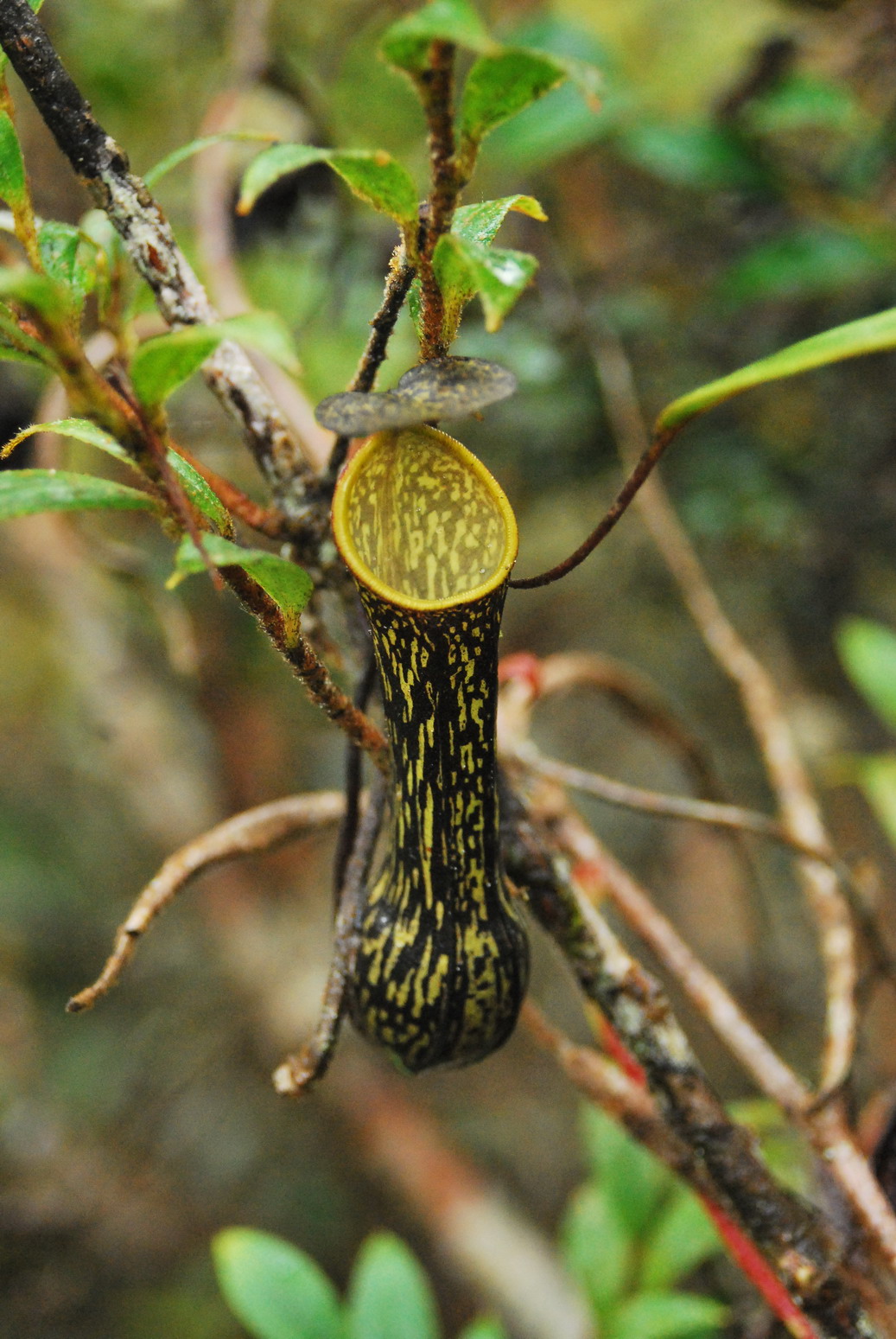
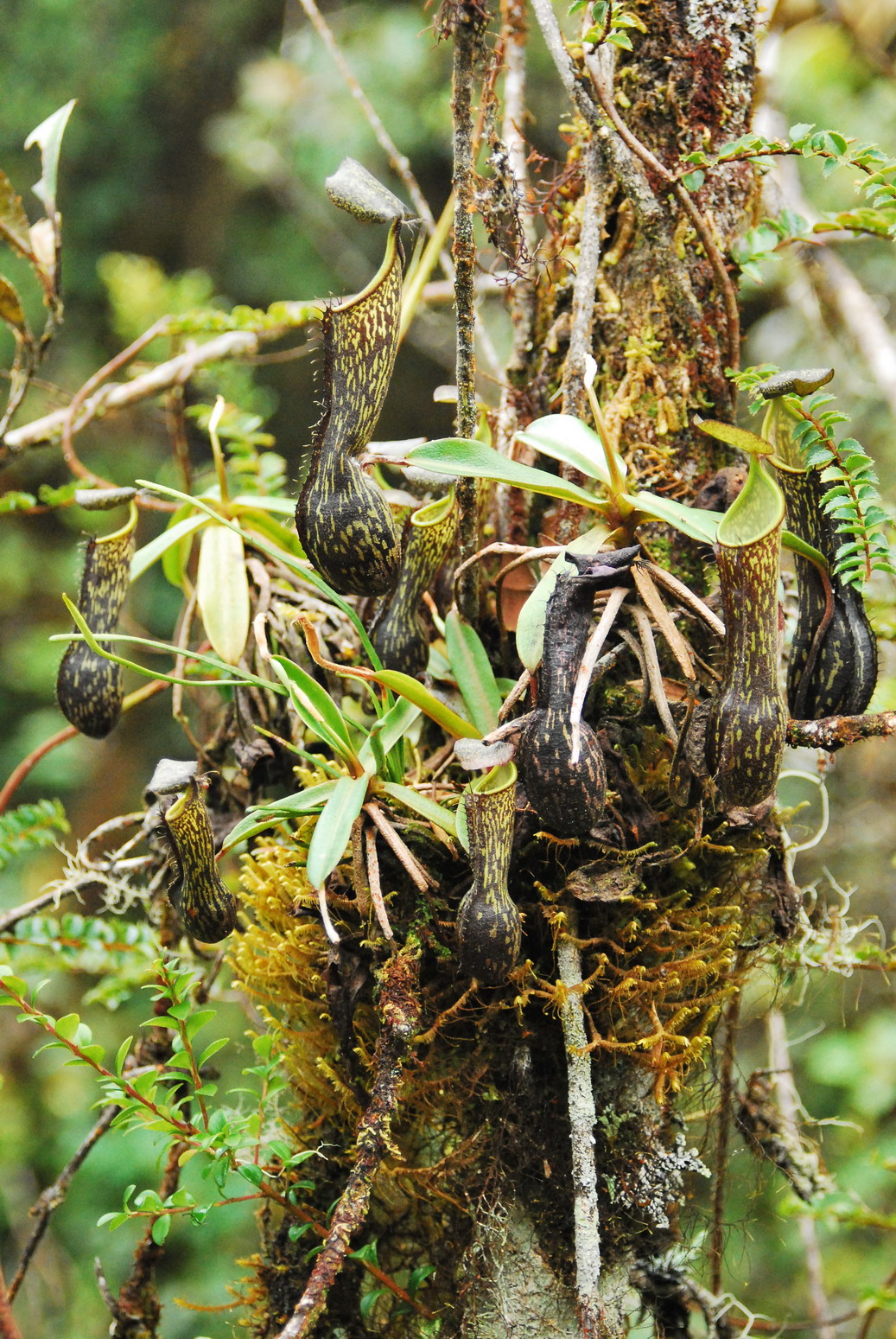
A lanky climber to about 3 m, exceptionally to 9 m, with a thin, slightly zigzag stem of 2 to 3 mm and internodes of 3 to 5 cm. Rosette leaves are narrow, 3 to 7 cm long; leaves of the climbing stem narrowly oblanceolate, 3.5 to 15 cm long and to 2.5 cm wide, with a wing-like base. The stem is glabrous apart from a tuft of white hairs around the axillary bud. Lower pitchers are ovoid below and cylindrical above, 3.5 to 11.5 cm tall and at most 2 cm wide, with two narrow fringed wings, a thin, rounded peristome of barely 1 mm and an elliptic lid to 2 cm. The spur under the lid is characteristic: split into two to six (by other accounts up to twelve) threads, 4 to 6 mm long. Upper pitchers are more constricted at the middle, 3.5 to 13 cm tall, without wings. In life stem and pitchers are purplish black, with scattered cream splashes.
Similar species
The closest relatives are Nepenthes angasanensis and N. tobaica. N. tobaica is lighter in colour (green to yellowish green with red), has broader blades, a longer inflorescence with two-flowered pedicels, and an undivided or at most two- or three-pointed spur. N. angasanensis closely resembles N. mikei and is merged with it by some authors; it forms underground runners, has slightly longer peristome teeth, a higher density of digestive glands and also grows epiphytically in shady forest. N. gymnamphora has broad wings and a distinctly ribbed peristome.
The trap and how it works
A narrow tubular trap with a very narrow peristome. With such a thin, rounded peristome, the slippery rim plays a smaller role than in species with a broad peristome; the nectar glands under the lid and on the rim mainly attract small insects, which slide over the wet rim into the pitcher. The lower pitchers, sunk in moss and litter, mainly receive ants and other walking animals. The inner wall carries digestive glands 0.2 to 0.3 mm across at a density of 150 to 180 per square centimetre.
Habitat and ecology
Open ridges with low scrub and mossy mountain forest (B1, R5), between 1100 and 2500 m (other sources to 2800 m). The species always grows on the ground, preferably at exposed spots on the ridge where the vegetation is low and open and the plant gets plenty of light. It is windy there too, and the soil is a thin layer of humus, moss and litter over the bedrock. In closed forest it is much less often found.
Distribution and elevation
Endemic to Sumatra, in the provinces of Aceh and North Sumatra: according to Cheek & Jebb (2001) from Puncak Angasan in Aceh south to around Lake Toba. Known localities include Gunung Pangulubao near Lake Toba, where it was discovered, and Gunung Bandahara in Aceh. The world checklist gives Sumatra as its only area.
- Recorded (one-degree cells)
Forms and variation
No varieties or forms have been described. Natural hybrids are reported with N. diatas (common on Gunung Bandahara between 2300 and 2700 m), N. gymnamphora (informally named N. × pangulubauensis), N. ovata and N. spectabilis. On Pangulubao, where five or more species grow together, these hybrids make up a real share of the pitcher plants in the field. The relationship with N. angasanensis is unresolved: Cheek & Jebb (2001) do not treat that name as a separate species, whereas later Indonesian authors do recognise it.
Where and when to see it
Gunung Pangulubao near Lake Toba is the classic place, and one of the richest pitcher-plant mountains of North Sumatra; N. ovata, N. spectabilis, N. rhombicaulis and N. gymnamphora grow there too. Look for N. mikei on the open, windy parts of the ridge, not in dense forest. The pitchers are small and almost black and hard to spot in the moss: watch for the thin, zigzag stems climbing through the scrub, and follow the tendrils down.
Conservation status
Assessed on the Red List as Vulnerable (assessment from 2000), on the basis of its limited range and the threats named: habitat loss, disturbance and over-collection. Clarke (2001) pointed out that large populations lie within protected areas and that a lower category could be defended. As a member of the genus the species is listed in CITES Appendix II.
Scientific name
Nepenthes mikei | Salmon & Maulder, 1995
Nepenthes mikei was described in 1995 by Bruce Salmon and Ricky Maulder, in Carnivorous Plant Newsletter 24(3): 77-85. The type material was originally collected in September 1989 during a Nepenthes expedition, on a very steep ridge in wet mossy forest near the summit of Mount Pangulubao, North Sumatra, at 2,000 m elevation; the herbarium specimen (B. Salmon & R. Maulder 221719) was, however, only pressed on 17 February 1995, from cultivated plant material in New Zealand, and is held at the Auckland Institute and Museum. A very steep ridge near the summit of Mount Pangulubao, North Sumatra, Indonesia, at 2,000 m elevation. The specific epithet honours Mike Hopkins, who co-discovered the species with the describing authors.
World Checklist of Vascular Plants (WCVP), via Plants of the World Online (POWO), Royal Botanic Gardens, Kew.