All species › Caryophyllales › Tropical pitcher plant family › Nepenthes inermis
Nepenthes inermis
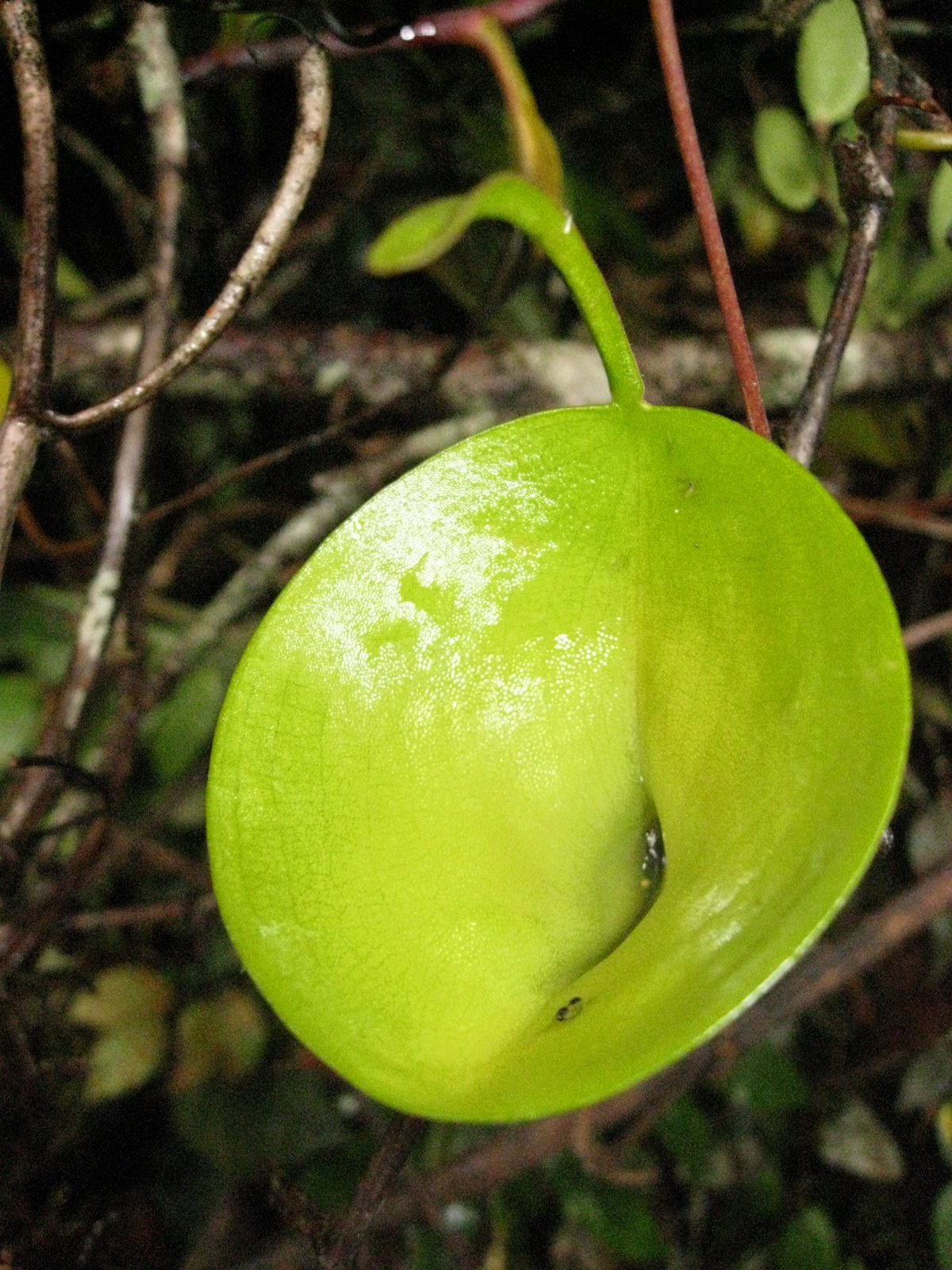
A pitcher plant without a peristome. Where almost every Nepenthes carries a ribbed, glossy rim around the pitcher mouth, the upper pitchers of this species have no more than a barely visible line a few tenths of a millimetre wide. That 'unarmed' mouth gave it its name: inermis, Latin for unarmed. H.A.B. Bünnemeijer collected the first plants on 7 September 1918 on Gunung Talang in West Sumatra, at 2590 m; B.H. Danser described the species in 1928. It catches not so much with a slippery rim as with an exceptionally syrupy fluid.

Identification
A climber to about 7 m, with a round to rounded-triangular stem of 3 to 5 mm; stem, tendrils and inflorescence are purplish red. The leaves are thinly leathery, sessile, oblanceolate to spathulate or oblong, usually 6.5 to 8 cm long (to 12 cm) and 1 to 2.5 cm wide. The upper pitchers are the key feature: about 5.5 cm tall (to 9 cm), narrowly cylindrical in the lower half to two thirds, around 1 cm wide, then abruptly flaring into a wide funnel nearly 5 cm across at the mouth. A peristome is virtually absent: the rim is at most 0.2 mm wide, with no ribs or teeth. The lid is narrowly linear, 4.5 to 5 cm long and barely half a centimetre wide; the spur is undivided and reflexed. The lower pitchers, not described in the flora, are according to Clarke (2001) funnel-shaped, around 8 cm tall, with a narrow, rounded peristome with indistinct teeth. The pitchers are yellowish green.
Similar species
The closest relative is Nepenthes dubia, which has the same funnel-shaped upper pitchers with a compressed lower part, but does have a distinct peristome, more glands on the lid, a lid reflexed well beyond the vertical, and is usually yellow to orange rather than green. N. × pyriformis, the cross with N. talangensis on Gunung Talang, has a narrow but present peristome and a broader lid. N. campanulata from Borneo has comparable bell-shaped pitchers but grows on limestone cliffs in another part of Southeast Asia. N. jacquelineae and N. flava, by contrast, have a very broad peristome.
The trap and how it works
One of the strangest traps in the genus. Lacking the slippery peristome rim, this species catches in another way: the pitcher holds an extremely thick, mucilaginous fluid that, when a pitcher is tipped over, runs down as an unbroken thread sometimes metres long. The fluid works as both pitfall and flypaper: insects that land in the wide funnel get stuck on the inner wall or in the fluid. The prey consists mainly of flies and gnats. Strikingly, almost no infauna lives in the pitchers, unlike those of many other species; the sticky fluid evidently makes the pitcher uninhabitable for mosquito larvae and other aquatic life.
Habitat and ecology
Mossy montane cloud forest (B1), where the species mostly grows epiphytically on mossy trunks and branches; above about 2000 m also on the ground in low, stunted mountain scrub (R5). Clarke (2001) gives an altitudinal range of 1500 to 2600 m; Cheek & Jebb (2001), who saw only herbarium material from Kerinci, give 2300 to 2590 m. The climate is cool and almost permanently damp.
Distribution and elevation
Endemic to Sumatra, in the Barisan Mountains of West Sumatra and Jambi provinces. Known mountains are Gunung Talang, source of the type collection, Gunung Gadut, Gunung Belirang and Gunung Gadang; Cheek & Jebb (2001) also mention Kerinci. The world checklist gives Sumatra as its only area.
- Recorded (one-degree cells)
Forms and variation
No varieties or colour forms have been described; throughout its range the species is recognisable by its peristome-less upper pitchers. Natural hybrids are known, however. On the upper slopes of Gunung Talang it crosses with N. talangensis; that cross was described in 2001 as a new species, N. pyriformis, but is now regarded as a hybrid. Where ranges meet, hybrids with N. singalana and N. spathulata have also been reported.
Where and when to see it
Gunung Talang south of Padang is the classic place; here too the cloud forest only becomes interesting above 1500 m. Look for the pitchers on mossy trunks, often well above eye level: the wide, greenish-yellow funnels without a rim are unmistakable. Gently tilting a pitcher shows how syrupy the fluid is, but do not damage the plant: broken pitchers are not replaced. N. talangensis and their hybrid also grow in the summit area.
Conservation status
Assessed on the Red List as Least Concern: the species occurs on several mountains in two provinces and grows mostly as an epiphyte in hard-to-reach cloud forest. As a member of the genus it is listed in CITES Appendix II. Its unusual pitchers make it sought after by collectors, which puts populations near accessible trails at risk. Fire and clearance of the lower mountain slopes are further threats.
Scientific name
Nepenthes inermis | Danser, 1928
Nepenthes inermis was described in 1928 by Benedictus Hubertus Danser in his monograph "The Nepenthaceae of the Netherlands Indies". The lectotype (Bünnemeijer 9695, later so designated by Matthew Jebb and Martin Cheek) was collected on 26 April 1920 on Mount Kerintji, at 1,800 m elevation. Mount Kerintji, Sumatra, Indonesia, at 1,800 m elevation. The specific epithet is Latin for "unarmed", referring to the distinctive feature that mature upper pitchers of this species completely lack a peristome.
World Checklist of Vascular Plants (WCVP), via Plants of the World Online (POWO), Royal Botanic Gardens, Kew.