All species › Caryophyllales › Tropical pitcher plant family › Nepenthes aristolochioides
Nepenthes aristolochioides
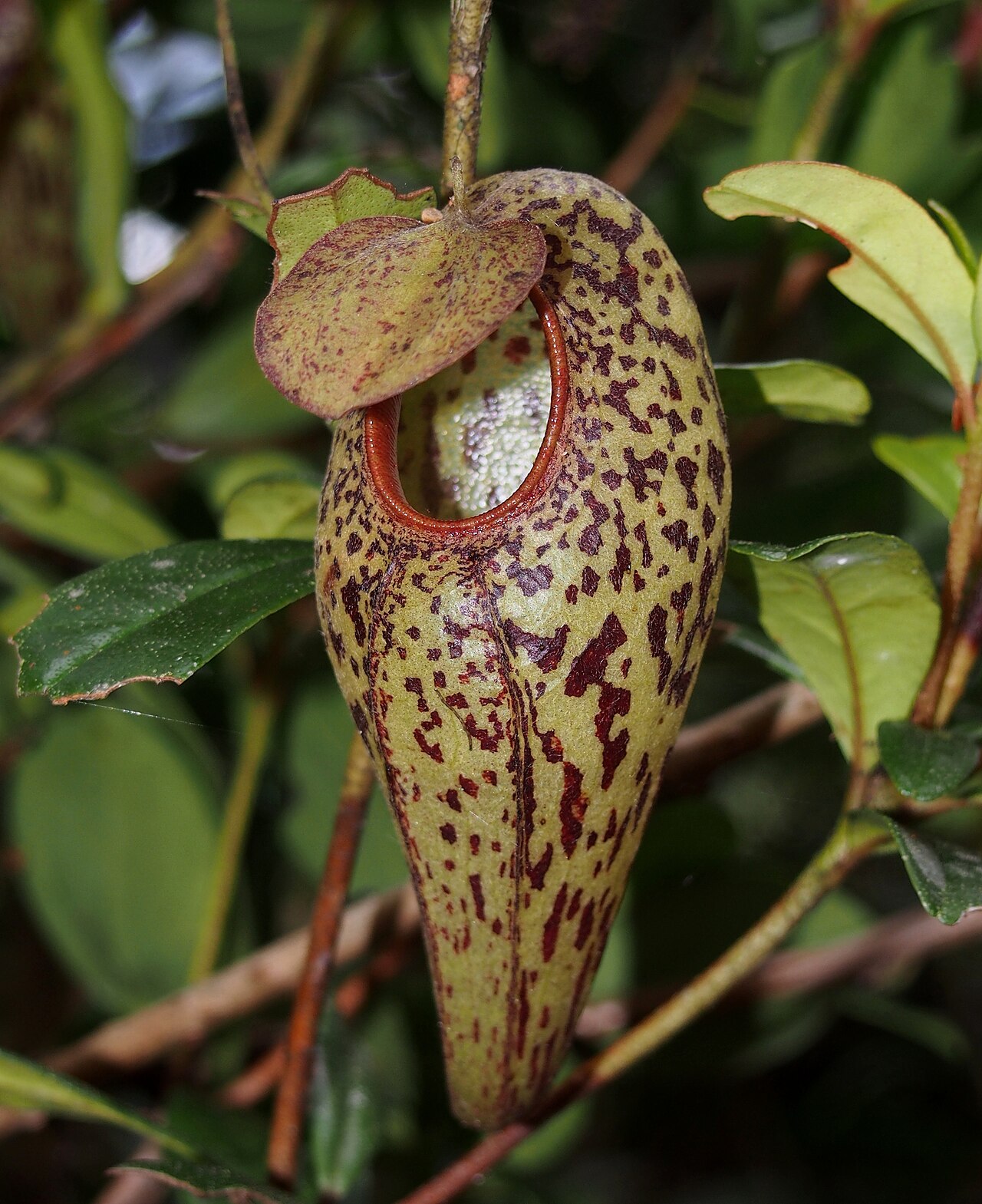
A pitcher plant that looks like a pipevine flower. The pitchers of Nepenthes aristolochioides are shaped like an inflated globe with a mouth set almost vertically on the front rather than on top, recalling the flowers of Aristolochia, after which the species is named. Willem Meijer collected the type material on 5 August 1956 in the mountains of Jambi; it lay unnoticed in the herbarium for more than thirty years until Joachim Nerz found it again in 1988. In June 1996 Nerz located the first living plants, and in 1997 Matthew Jebb and Martin Cheek formally described the species.

Identification
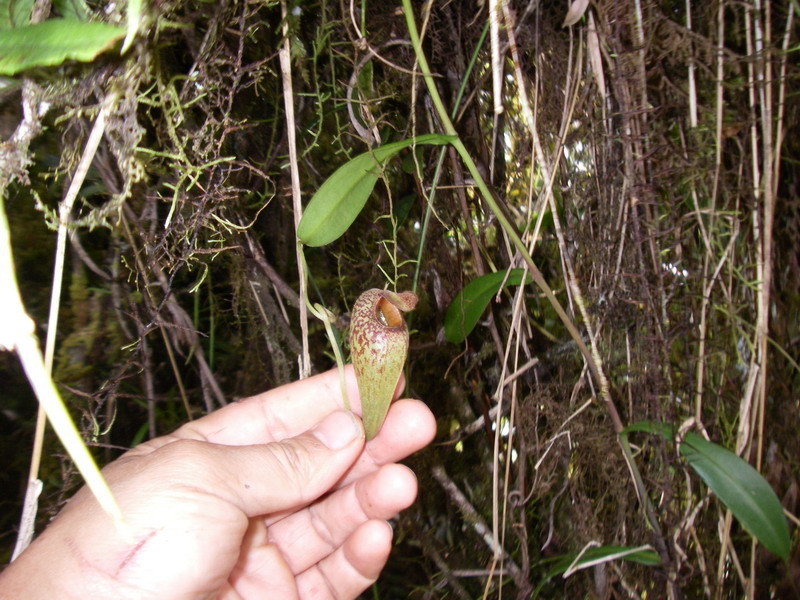
A climber with a round stem of 2 to 4 mm and internodes of 5.5 to 13 cm. The leaves are leathery, sessile, narrowly lanceolate to spathulate, 7.5 to 15 cm long and 1 to 3 cm wide, clasping one third to one half of the stem. The upper pitchers are the key feature: funnel-shaped below, swelling above into an obovoid globe, to 9 cm tall and 3.5 cm wide. The mouth sits almost vertically on the front of that globe, ovate and up to 2 cm wide. The peristome is rounded and narrow on the outside (1.5 mm), flattened and up to 8 mm wide on the inside, forming a kind of entrance corridor. The lid is round, about 2.7 by 2.1 cm; the spur is undivided, about 9 mm, with two to four points. Pitchers are white to reddish with numerous red-brown to purple speckles that become denser towards the mouth; the peristome is dark red-brown to purple. Lower and upper pitchers differ little in this species.
Similar species
No other Sumatran species has such a vertical, sideways mouth. The closest relative is Nepenthes talangensis, with a similarly inflated pitcher but a horizontal mouth and a short neck. N. klossii from New Guinea also has a forward-facing mouth, but is not closely related; the likeness is regarded as convergent evolution. The hybrid with N. singalana has smaller pitchers, rarely over 5 cm, with an oblique rather than vertical mouth.
The trap and how it works
A trap that combines several principles. The upper part of the globe is translucent, so light falls through the wall: flying insects that crawl in orient towards that light rather than towards the exit, as in some North American pitcher plants. The broad, inrolled peristome forms an entrance like that of a lobster pot. At the bottom stands an extremely thick, mucilaginous fluid that also works as flypaper. The prey consists mainly of small flies. No infauna has been found in the pitchers, whereas it is abundant in those of the neighbouring N. singalana.
Habitat and ecology
Mossy montane cloud forest rich in Sphagnum, just below the tops of steep ridges (B1), between about 1800 and 2500 m. The species mostly grows on the ground in the thick moss layer, sometimes epiphytically on mossy trunks. It grows together with N. gymnamphora and N. singalana. The climate is cool and cloud cover almost permanent.
Distribution and elevation
Endemic to Sumatra, in the Barisan Mountains of Jambi province, in the area of Gunung Kerinci and Gunung Tujuh. Around 2009 three subpopulations were known within Kerinci Seblat National Park; the type locality itself may have been lost to poaching. Because the species is critically endangered, this guide gives no more precise localities. The world checklist gives Sumatra as its only area.
- Recorded (one-degree cells)
Forms and variation
No varieties or forms have been described from the wild; colour varies from almost white with fine speckles to predominantly reddish. One natural hybrid is known, with N. singalana, on the same mountain; it has smaller pitchers with an oblique mouth and is intermediate in shape. Such hybrids may be mistaken in the field for young plants of the species.
Where and when to see it
This species is critically endangered and suffers precisely from visits by collectors; it does not belong on a wish list. Anyone visiting Kerinci Seblat National Park does so with the required permit and a recognised guide, and keeps to established trails. Should you nonetheless come across the species, photograph without trampling, do not touch the plants or the moss layer, and share no location data: the type locality was probably stripped because of just such information.
Conservation status
Assessed on the Red List as Critically Endangered (2013 assessment). The main threat is over-collection: the unusual pitcher shape makes the species highly sought after, and the type locality has probably been lost to poaching. The remaining subpopulations lie within a national park, which gives protection on paper but no guarantee against illegal collecting. As a member of the genus it is listed in CITES Appendix II. Since 2010 there has been a programme for ex-situ conservation of this and several other threatened species.
Scientific name
Nepenthes aristolochioides | Jebb & Cheek, 1997
Nepenthes aristolochioides was described in 1997 by Matthew Jebb and Martin Cheek in their revision "A skeletal revision of Nepenthes (Nepenthaceae)" (Blumea), based on a holotype (Meijer 6542) that Willem Meijer had already collected on 5 August 1956 on Mount Tujuh in Jambi (2,000 m), Sumatra; the specimen is held, in poor condition, at the National Herbarium of the Netherlands (Leiden). Mount Tujuh (Tudjuh) in Jambi, Sumatra, at 2,000 m elevation. The specific epithet derives from the plant genus Aristolochia combined with the Latin suffix "-oides" ("resembling"), referring to the pitcher's striking resemblance, in both shape and colouring, to the flowers of Aristolochia.
World Checklist of Vascular Plants (WCVP), via Plants of the World Online (POWO), Royal Botanic Gardens, Kew.