All species › Caryophyllales › Tropical pitcher plant family › Nepenthes jacquelineae
Nepenthes jacquelineae
A discovery from recent Nepenthes history. In July 2000 Charles Clarke and Troy Davis found, in the Barisan Mountains north of Bukittinggi, West Sumatra, a plant whose upper pitchers carry a peristome lying like a broad, smooth collar around the mouth, up to 3.5 cm wide. Clarke described the species in 2001 in his monograph Nepenthes of Sumatra and Peninsular Malaysia and named it after his wife Jacqueline. The type material was collected by Clarke, Davis and Rusjdi Tamin and is kept in the herbarium of Universitas Andalas in Padang.
Identification
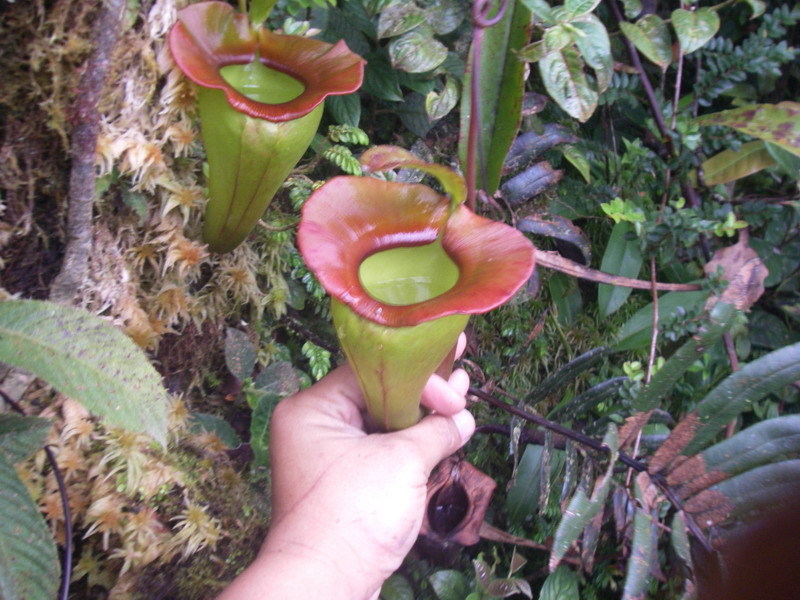
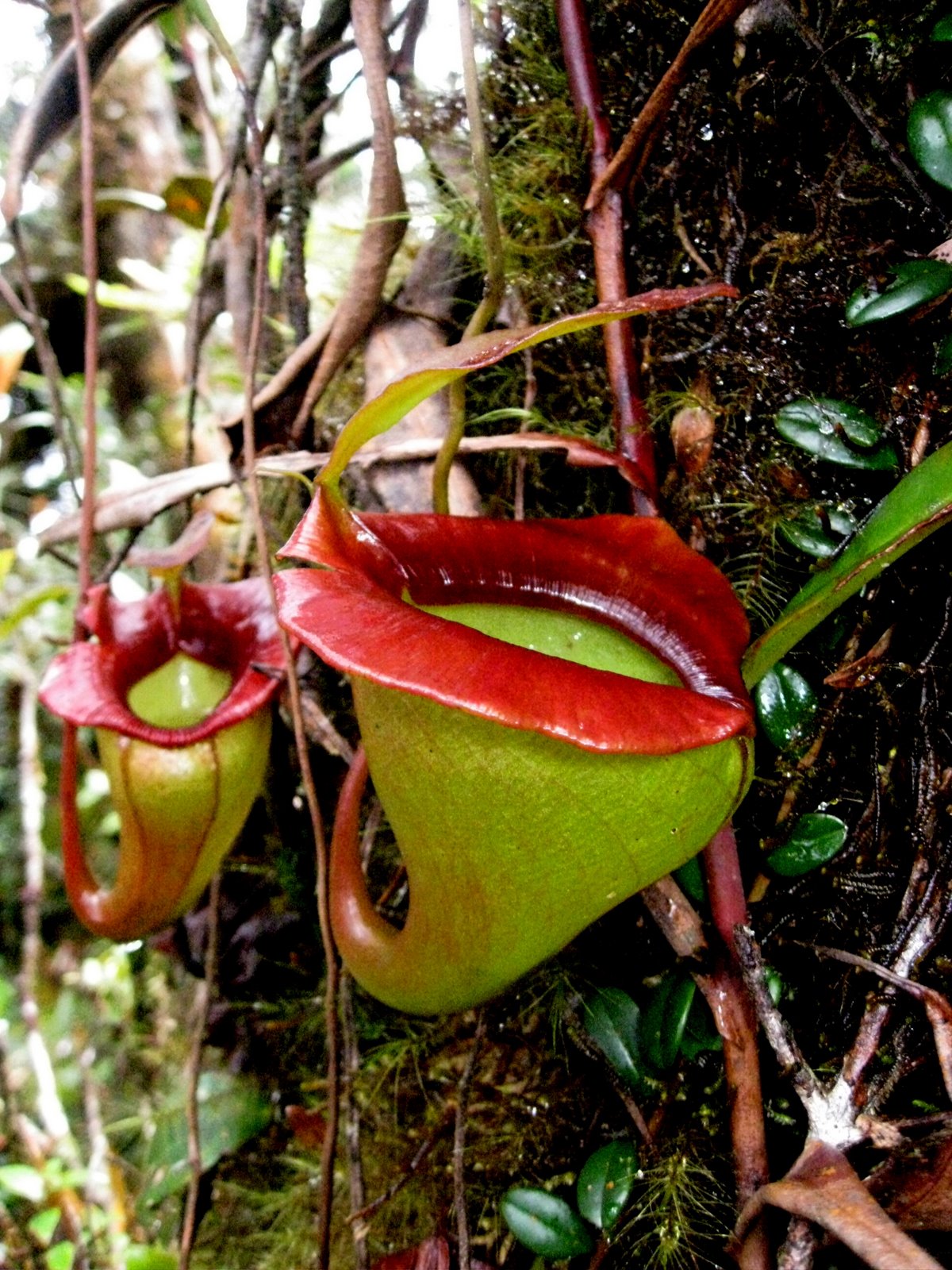
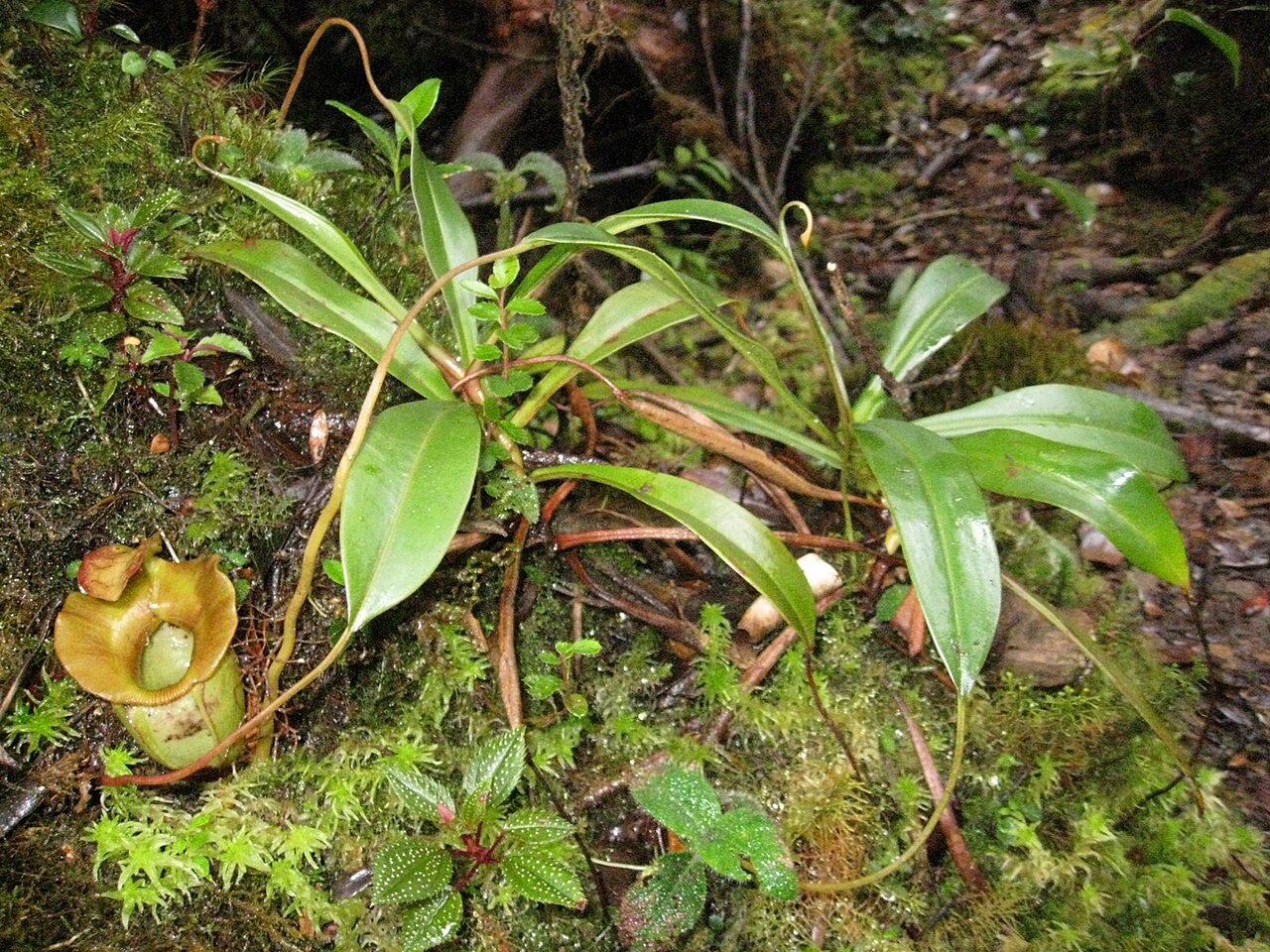
A climber with a stem to 5 m long and at most 5 mm thick, round to angular, with internodes to 10 cm. Rosette leaves are leathery, ovate-spathulate, to 7 cm long and 3.5 cm wide; leaves of the climbing stem are larger, to 20 cm long and 6 cm wide, with tendrils to 30 cm that carry a curl in the middle. Lower pitchers are small: to 6 cm tall and 4 cm wide, funnel-shaped throughout, with a horizontal mouth, sometimes with narrow wings, and a flattened peristome to 1 cm. Upper pitchers are much larger and unmistakable: to 15 cm tall and 10 cm wide, broadly funnel-shaped, with a smooth, greatly expanded peristome up to 3.5 cm wide and a lid to 5 by 2 cm. The underside of the lid bears strikingly large, crater-like glands up to 1.5 mm, unique among Sumatran species. Stem and leaf are glabrous; the outside of the pitchers carries short white stellate hairs. The commonest colouring is a green pitcher with a red peristome.
Similar species
Related to Nepenthes flava, N. inermis, N. jamban, N. talangensis and N. tenuis, but impossible to confuse with any of them once the upper pitchers are visible. N. flava from North Sumatra also has a broad, undulate peristome, but wholly yellow pitchers and a narrowly ovate lid without the large crater glands. N. inermis, which occurs in the same region, has virtually no peristome. N. izumiae from the same highlands has longer, more cylindrical pitchers. The small lower pitchers are harder; look at the peristome and the stellate hairs.
The trap and how it works
The broad peristome works as a slide: when wet, insects landing on it lose their grip, and the ridges lead them inwards. In addition the pitcher holds an extremely viscous fluid that works as both pitfall and flypaper. The combination is effective against large flying insects: cockroaches, bees and moths are regularly found in the pitchers. The large crater glands under the lid secrete nectar and lure prey over the mouth. The lower pitchers, sunk in Sphagnum, catch small ground-dwelling animals, including snails.
Habitat and ecology
Dense, mossy montane cloud forest (B1) between 1700 and 2200 m, where rain falls daily, mist hangs almost permanently between the trees, and it is cool and dim. The species grows epiphytically on mossy trunks and branches or on the ground in the thick moss layer, often among Sphagnum. The upper pitchers hang free in the air from the tendrils of climbing stems.
Distribution and elevation
Endemic to Sumatra, in the Barisan Mountains of West Sumatra province, north of Bukittinggi, between 1700 and 2200 m. The species is known from only a small number of mountains in that area. The world checklist gives Sumatra as its only area.
- Recorded (one-degree cells)
Forms and variation
No formal varieties have been described. Colour varies: besides the usual green pitchers with a red peristome other colour forms are reported, but they are not described further in the sources used. Natural hybrids are reported with N. izumiae, which grows on the same mountains and produces reddish pitchers in which the features of N. jacquelineae dominate, and with N. dubia, from a single plant.
Where and when to see it
The highlands north of Bukittinggi can be reached from the town, but the sites lie in steep, densely mossy forest without trails; go only with a local guide. Look up: the large upper pitchers with their broad red collar often hang several metres up in the trees. The small lower pitchers lie in the moss and are easily trodden on. Its striking appearance makes the species sought after by collectors; share no precise locations.
Conservation status
The species has not been evaluated by the IUCN (NE). Clarke himself assessed it in 2001 as Data Deficient. Its range is small and lies outside national parks, and the conspicuous pitchers make it vulnerable to over-collection; forest fires and clearance also threaten the mountain forest in this region. As a member of the genus it is listed in CITES Appendix II.
Scientific name
Nepenthes jacquelineae | Clarke, Davis & Tamin, 2001
Nepenthes jacquelineae was discovered in July 2000 by Charles Clarke and Troy Davis, and formally described in Clarke's 2001 monograph Nepenthes of Sumatra and Peninsular Malaysia. The holotype (Clarke, Davis & Tamin 1307) was collected on 13 July 2000 and is held at the Herbarium Universitas Andalas (ANDA). North of Bukittinggi, West Sumatra, at approximately 1,700 m elevation. The species is named after Jacqueline Clarke, the wife of Charles Clarke.
World Checklist of Vascular Plants (WCVP), via Plants of the World Online (POWO), Royal Botanic Gardens, Kew.