All species › Caryophyllales › Tropical pitcher plant family › Nepenthes eymae
Nepenthes eymae
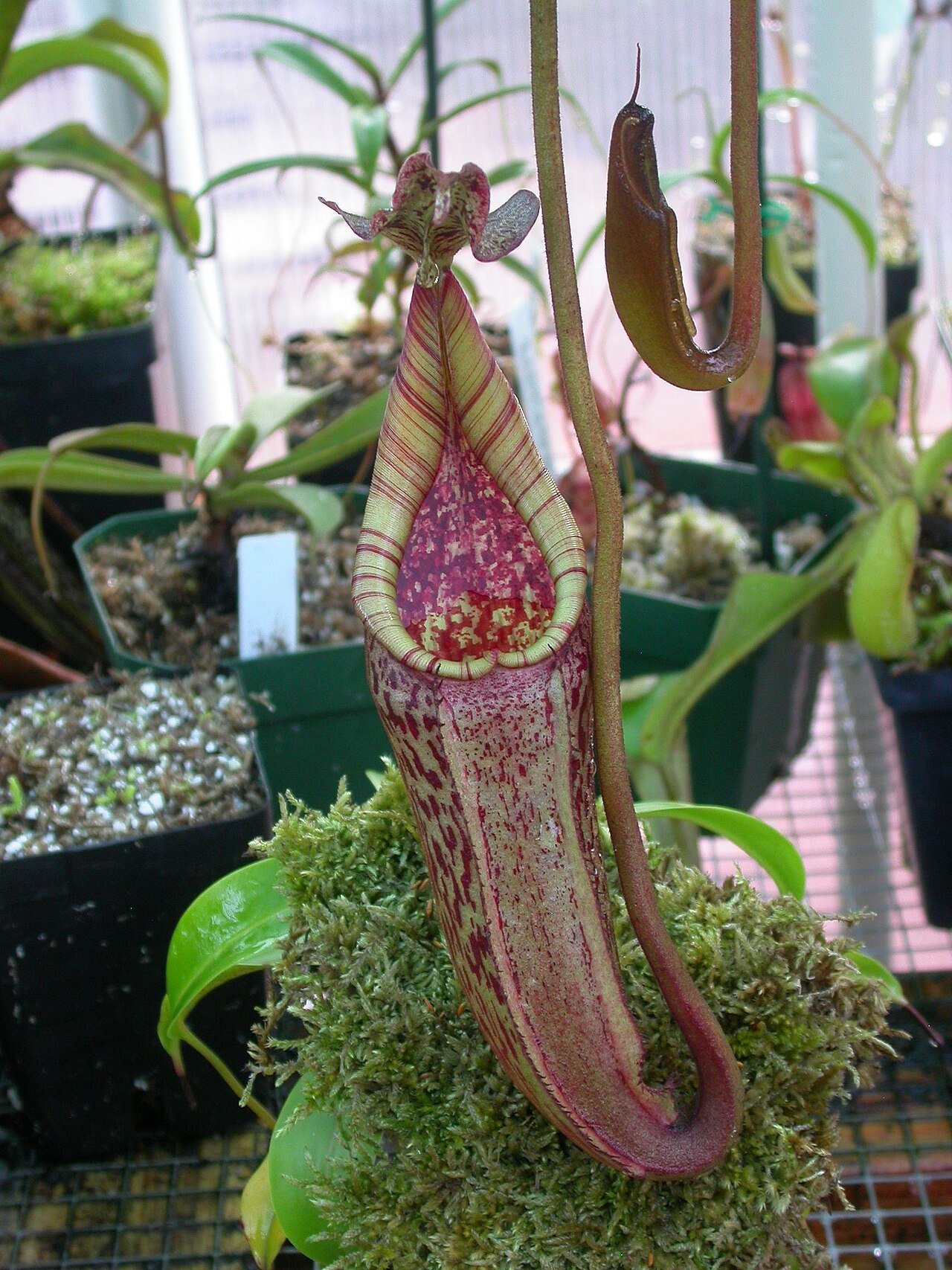
A pitcher plant with upper pitchers shaped like a wine glass: a long, narrow stem that suddenly flares into a broad bowl at the top. Nepenthes eymae was described in 1984 by the Japanese pitcher plant specialist Shigeo Kurata, from material from Mount Lumut in Central Sulawesi, and named after the Dutch botanist Pieter Johannes Eyma, who collected in the mountains of Sulawesi in the 1930s. Four days later Turnbull and Middleton described the same plant as N. infundibuliformis; Kurata's name has priority. It is one of the most widespread mountain species of the island.
Identification
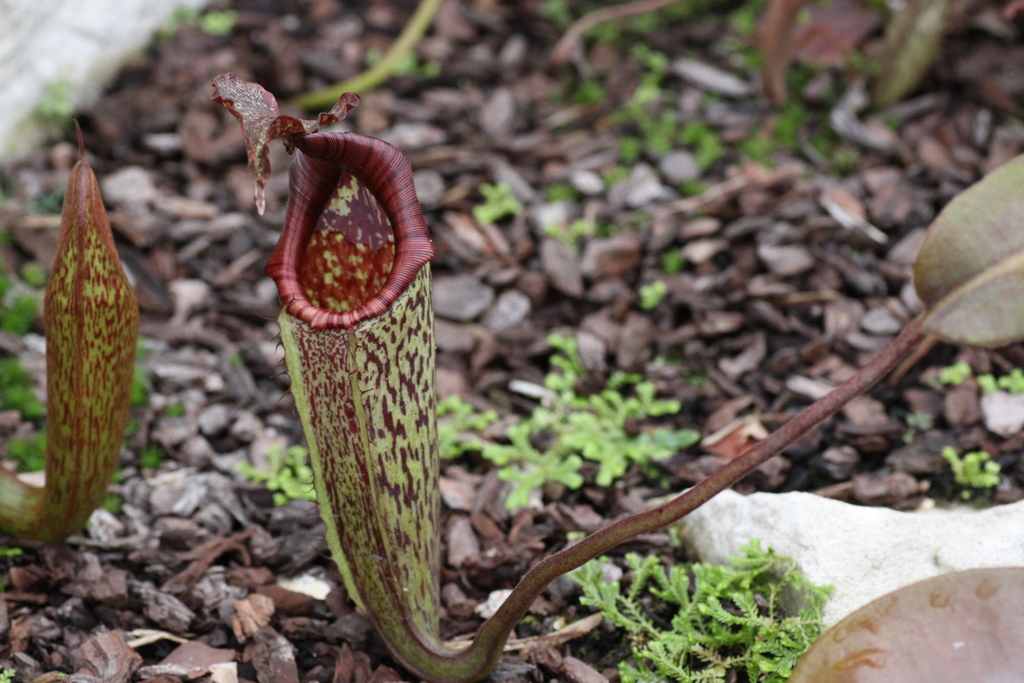
A vigorous climber to eight metres, with a two-ridged stem 5 to 8 mm thick. On rosettes the leaves can reach 35 cm long and 12 cm wide; on climbing stems they are smaller, oblong-elliptic, usually 8 to 13 cm. The lower pitchers are cylindrical, slightly constricted just below the mouth, 10 to 18 cm tall, with fringed wings. The upper pitchers are the eye-catcher: a narrow, curved tube below that rapidly widens from half to three-quarters of its height into a broad bowl, to about 15 cm tall and 8 cm wide. The peristome is narrow at the front and widens and becomes wavy towards the lid. The lid is narrow and almost triangular, with a pointed tip.
Similar species
The species belongs to the N. maxima complex and can be confused on Sulawesi with Nepenthes maxima itself. The difference lies in the upper pitchers: those of N. eymae are wingless, funnel- to wine-glass-shaped and relatively small, with a narrow, triangular to hastate lid; those of N. maxima are longer, narrowly funnel-shaped, often winged, with an ovate lid. Where both species grow together, intermediate forms may occur, making identification difficult.
The trap and how it works
A pitfall whose upper pitchers form almost literally a funnel. The broad bowl at the top catches flying insects, and the peristome, widened and wavy towards the back, enlarges the area on which they land and slip. Nectar glands on the peristome and under the lid lure the prey; the narrow tube below holds the digestive fluid, from which a fallen insect has difficulty escaping. The lower pitchers, with wings as a walkway, stand on the ground and catch mainly walking animals. No prey study has been published. Work on other species of the genus has shown that the peristome works by 'aquaplaning': a thin film of water on the finely ribbed surface makes it so slippery that the adhesive pads of insect feet can no longer grip. The trap therefore works best when it is damp, which in cloud forest is almost always the case.
Habitat and ecology
Mountain forest and open mountain sites between about 1000 and 2000 m, mostly above 1400 m (B1, B5). Flora Malesiana mentions ridges in moss forest; other sources also mention heath forest, river banks, cliffs, landslides and disturbed secondary forest. The species is thus less choosy than many relatives and benefits from open, bright places.
Distribution and elevation
Endemic to Sulawesi, where it is widespread in the mountains of Central Sulawesi, including the eastern peninsula, and also known from West Sulawesi. This agrees with 'Sulawesi' in the guide's own species list. Some populations lie in Morowali Nature Reserve. Sulawesi lies east of Wallace's Line, in the transition zone between the Asian and Australian floras and faunas, and holds far fewer pitcher plants than Borneo; all the more striking, then, that a large share of the island's species is endemic.
- Recorded (one-degree cells)
Forms and variation
No varieties or wild forms have been formally described. The pitchers vary from green to heavily red-blotched, and the degree to which the upper pitcher flares differs between plants. There are no confirmed natural hybrids, but where the species grows with N. maxima, gene exchange is suspected. Like all pitcher plants the species is dioecious: there are male and female plants, and both must be in flower for seed to set. The small, inconspicuous flowers are borne in racemes or panicles and are pollinated by insects; the seeds are light and dispersed by wind.
Where and when to see it
Because the species is widespread and also grows in disturbed places, it is one of the easier mountain species of Sulawesi to find. In the uplands of Central Sulawesi, look along clearings, forest edges and landslides above about 1400 m for the characteristic wine-glass-shaped upper pitchers, which often hang free in the scrub. In the mountains expect daily rain, cold nights and leeches on the trails, and allow plenty of time: most pitchers are found only by walking slowly and searching the vegetation systematically.
Conservation status
The IUCN Red List assesses the species as Least Concern (assessed 2018): it is widespread and locally abundant, most populations are remote and not seriously threatened, and some lie in protected areas. As a member of Nepenthes it is listed in CITES Appendix II, so international trade in wild plants requires a permit.
Scientific name
Nepenthes eymae | Kurata, 1984
Nepenthes eymae was described on 6 February 1984 by Shigeo Kurata, in The Journal of Insectivorous Plant Society 35(2): 41-44 — four days ahead of a concurrent, independent description by Turnbull and Middleton (which turned out to describe a different species, N. glabrata). The holotype (Kurata, Atsumi & Komatsu 102a) was collected on 5 November 1983 on the northern spur of Mount Lumut, Central Sulawesi, at 1,850 m elevation. The northern spur of Mount Lumut, Central Sulawesi, Indonesia, at 1,850 m elevation. The specific epithet honours Pierre Joseph Eyma, a Dutch botanist who worked extensively in the Dutch East Indies and originally discovered the species. Kurata initially used the spelling "eymai", but later authors amended it to "eymae" because, although Eyma was male, the name form is grammatically feminine.
World Checklist of Vascular Plants (WCVP), via Plants of the World Online (POWO), Royal Botanic Gardens, Kew.