All species › Caryophyllales › Tropical pitcher plant family › Nepenthes flava
Nepenthes flava
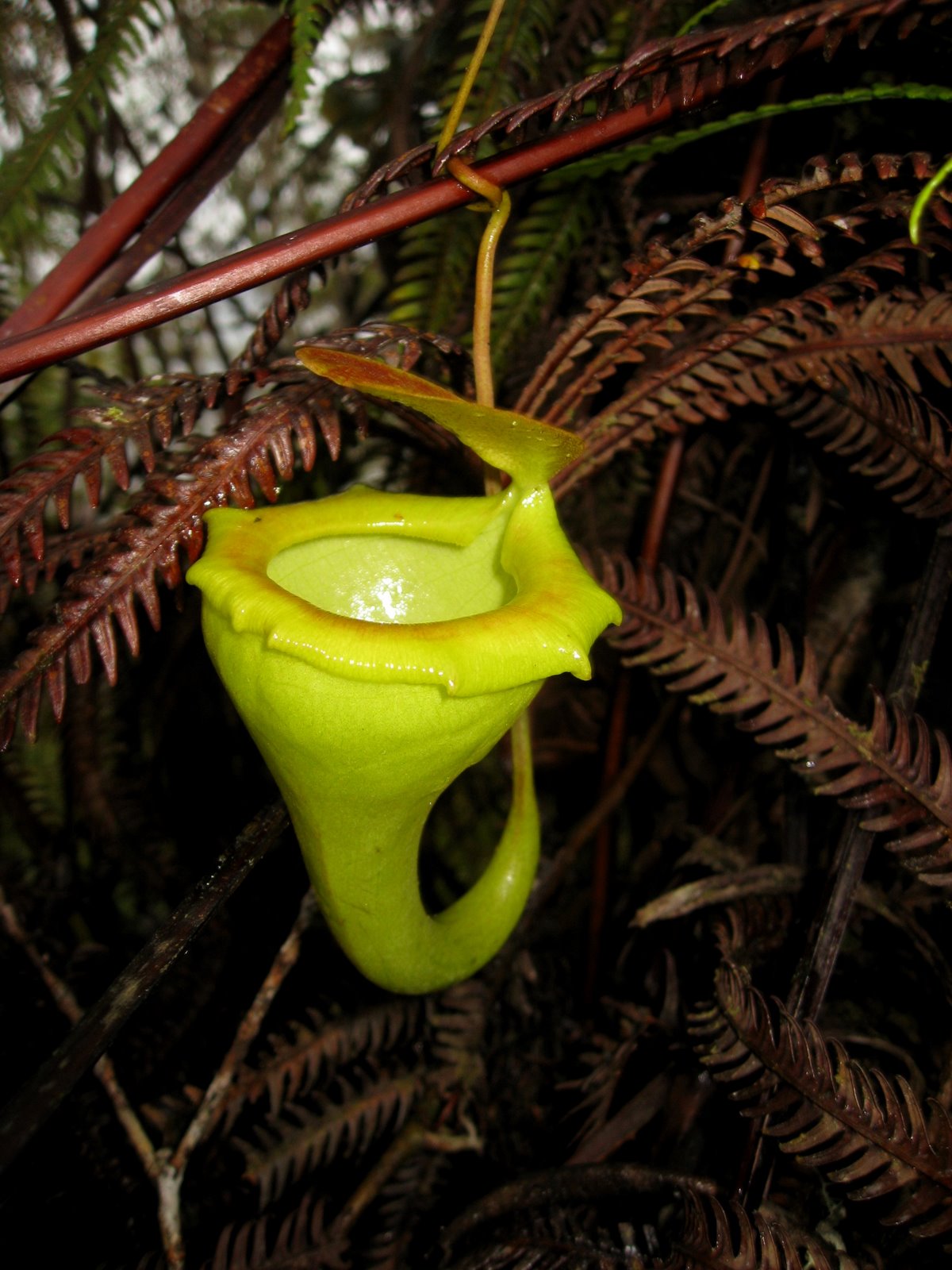
The yellow pitcher plant of North Sumatra. Nepenthes flava, Latin for 'yellow', has pitchers that are wholly yellow to yellowish green, never spotted, with a broad, wavy cream rim. Andreas Wistuba, Joachim Nerz and Andreas Fleischmann described the species in 2007 in Blumea; the holotype, collected at 1800 m, is kept at the National Herbarium in Leiden. The plant had been known for some years before under a provisional designation. The authors deliberately do not name the locality, and this guide follows that.

Identification
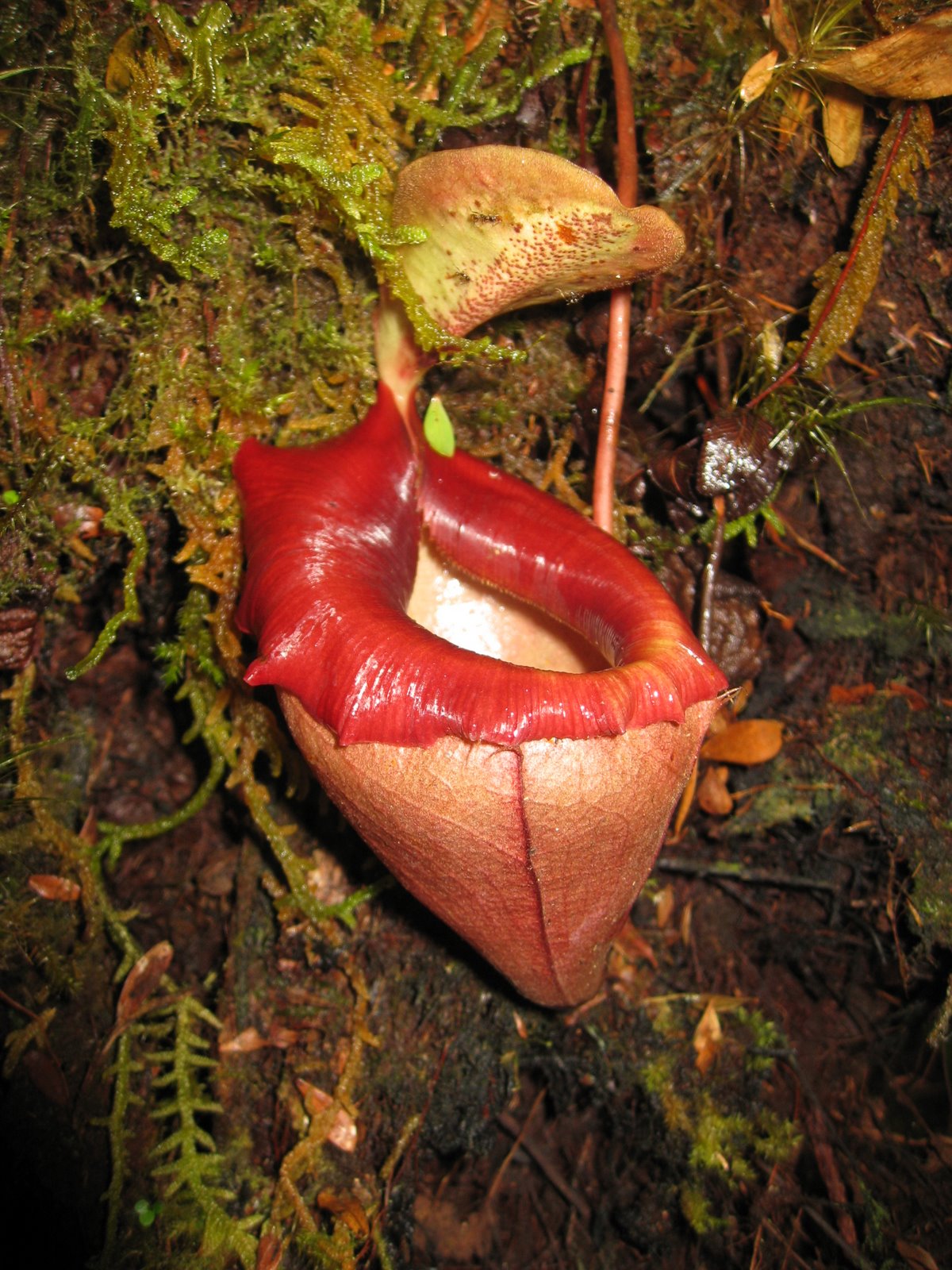
A small climber with an almost round stem about 3 mm thick, green to dark red, with internodes of 2 to 14 cm. The leaves are oblong to narrowly obovate, 7 to 9 cm long and 1.5 to 2.5 cm wide, yellowish green, with three distinct longitudinal veins. Lower pitchers are ovate-funnel-shaped, 4 to 7 cm tall and 3 to 4 cm wide, with wings of 2 to 3 mm bearing thread-like fringes of about 5 mm, a rounded peristome of 8 to 10 mm with fine ribs, and a lid of 2.5 to 3.5 by 1.5 to 2 cm. Upper pitchers arise abruptly at the end of the tendril; they are tubular below and funnel-shaped above, with a peristome 5 to 15 mm wide whose outer edge is distinctly crumpled or wavy, with very small teeth. The lid is narrowly ovate, without appendages. The colour is characteristic: yellow to yellowish green, rarely reddish, never spotted, with a cream to pale yellow peristome. The male inflorescence is short, 6 to 7 cm, with 15 to 40 flowers.
Similar species
Most similar is Nepenthes jacquelineae from West Sumatra, which also has a very broad peristome on its upper pitchers, but has green pitchers with a red peristome and large crater-like glands under the lid. N. inermis has comparable funnel-shaped upper pitchers but virtually no peristome. N. eymae from Sulawesi also has a broad peristome but is a more robust plant. From the species it grows alongside, such as N. mikei and N. spectabilis, N. flava differs at once by its plain yellow colour.
The trap and how it works
A combination of pitfall and flypaper. The pitcher fluid is very viscous and also coats the inner wall above the fluid surface as a sticky layer, so that small flying insects stick before they even reach the fluid. The broad, wavy peristome of the upper pitchers lures with nectar and turns slippery when wet. The lower pitchers, small and round, catch mainly walking animals among the moss. The plain yellow colour may itself attract certain insects, but this has not been studied.
Habitat and ecology
Upper montane mossy forest (B1) between 1800 and 2200 m, dominated by Rhododendron and Leptospermum, open and low: the vegetation rarely exceeds 4 to 5 m. The species mostly grows on the ground in the open parts of the forest, and climbs through the low scrub (R5). It shares its mountain with several other species.
Distribution and elevation
Endemic to Sumatra, and known from a single mountain in the Barisan range of North Sumatra province, between 1800 and 2200 m. The exact locality is deliberately withheld in the scientific literature, and this guide follows that. The world checklist gives Sumatra as its only area.
- Recorded (one-degree cells)
Forms and variation
No varieties or colour forms have been described; rarely plants are reddish rather than yellow. Natural hybrids are reported with N. ovata and N. rhombicaulis. No hybrids are known with N. mikei and N. spectabilis, which grow on the same mountain.
Where and when to see it
Because the locality is deliberately kept secret and the species is already threatened by collectors, this is not a species to search for purposefully. Anyone who comes across a pitcher plant with plain yellow funnel pitchers and a broad, wavy cream rim in the high mountains of North Sumatra almost certainly has N. flava in front of them. Photograph, note the altitude, but publish no coordinates.
Conservation status
The species has not been evaluated by the IUCN (NE). What is known: it occurs on one mountain, outside the boundaries of national parks, and it is regarded as being at significant risk from poaching and over-collection, because the yellow pitchers make it desirable to enthusiasts. Its habitat is also small. As a member of the genus it is listed in CITES Appendix II.
Scientific name
Nepenthes flava | Wistuba, Nerz & Fleischmann, 2007
Nepenthes flava was described on 4 July 2007 by Andreas Wistuba, Joachim Nerz and Andreas Fleischmann, in Blumea 52(1): 159-163. The holotype (Wistuba cult. Wistuba 100201) was collected at 1,800 m elevation on a single mountain in the Barisan Mountains, North Sumatra, Indonesia; the precise location has not been publicly disclosed for conservation reasons. The material is held at the National Herbarium of the Netherlands (Leiden). A single mountain in the Barisan Mountains, North Sumatra, Indonesia, at 1,800 m elevation; the precise location has not been made public. The specific epithet is Latin for "yellow", referring to the bright yellow colour of the upper pitchers and most of the lower pitchers.
World Checklist of Vascular Plants (WCVP), via Plants of the World Online (POWO), Royal Botanic Gardens, Kew.