All species › Caryophyllales › Tropical pitcher plant family › Nepenthes spectabilis
Nepenthes spectabilis
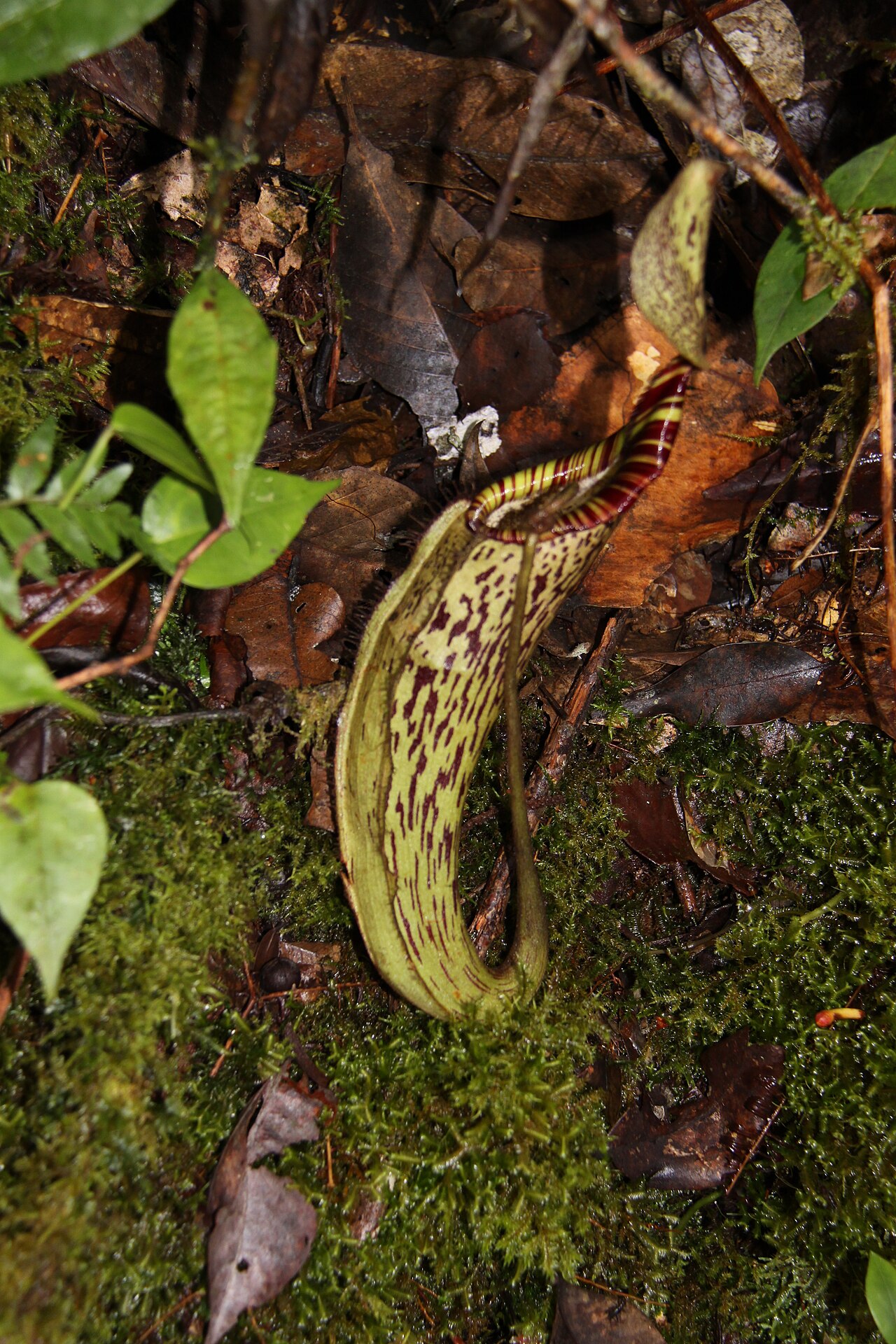
A pitcher plant of North Sumatra with a telling name: spectabilis means 'remarkable' or 'worth seeing'. The slender upper pitchers, up to nearly 30 cm long, are densely speckled and hang from long tendrils in the mossy mountain forest. The German forester Julius August Lörzing collected the first plants on 5 June 1920 on Gunung Sibayak, between 1800 and 1900 m; B.H. Danser described the species in 1928, and Jebb & Cheek designated Lörzing's specimen as lectotype in 1997.

Identification
A climber of 2 to 3 m, by Clarke's (2001) account to 6 m long, with a round, sometimes rounded-square stem 5 to 7 mm thick and internodes of 3.5 to 10 cm. Young parts are densely covered in dull coppery-red felted hairs of 0.3 to 0.7 mm. The leaves are leathery, narrowly oblong, 15 to 24 cm long (to 30 cm) and 3.4 to 5.4 cm wide, narrowing into a winged petiole of 2 to 7 cm. Lower pitchers are 11 to 15 cm tall and 3 to 6 cm wide, with two fringed wings of 2 to 5 mm, an oblique mouth and a flattened peristome widening from 4 mm at the front to 12 mm at the back. The spur is strikingly long: 10 to 16 mm on the lower and 11 to 22 mm on the upper pitchers, and undivided. Upper pitchers are narrowly funnel-shaped to narrowly cylindrical, 17 to 28 cm long and 3 to 4.5 cm wide, with at most narrow wings in the upper part and a lid of 3.5 to 5.5 cm with a keel beneath. The stem is purple; pitchers are pale green to purplish brown with numerous dark speckles or cream blotches, the peristome often yellowish green with brown stripes.
Similar species
The closest relative is Nepenthes lavicola from the Geureudong massif in Aceh. That species has a narrower peristome, a short spur under 6 mm, less hair, rounded, almost globular lower pitchers instead of ovoid-cylindrical ones, and is dark brownish purple to almost black rather than pale green with speckles; it also has strikingly large bracts in the inflorescence. N. rigidifolia has thicker, stiffer leaves, ovoid upper pitchers and a branched spur. N. ovata has much more inflated lower pitchers and a hooked appendage under the lid.
The trap and how it works
A pitfall with two kinds of pitcher. Lower pitchers stand in moss and catch walking animals; the long upper pitchers hang free in the vegetation. A study on Gunung Bandahara in 1996 found beetles to be the main prey in both pitcher types, with mosquito larvae living in the fluid. Nectar glands on the peristome and under the lid lure the prey; the broader rear part of the peristome, under the lid, is where insects following the nectar most often slip.
Habitat and ecology
Mossy montane cloud forest and low, stunted upper montane scrub (B1, R5), between about 1400 and 2200 m. The species mostly grows on the ground and climbs through the shrub layer, sometimes epiphytically. It prefers open forest and scrub on ridges to dense, closed forest.
Distribution and elevation
Endemic to Sumatra, in the provinces of North Sumatra and Aceh: from the Lake Toba area north to Gunung Kemiri in Aceh. The type locality is Gunung Sibayak, a volcano north of Lake Toba. Other known mountains are Gunung Pangulubao and Gunung Bandahara. The world checklist gives Sumatra as its only area.
- Recorded (one-degree cells)
Forms and variation
There are no formal varieties, but variation between populations is great. Plants on Gunung Pangulubao have narrower pitchers; a gracile form grows on the west side of Lake Toba; on Gunung Siluatan the pitchers are wholly green. Hairiness also varies strongly. Natural hybrids are known with N. gymnamphora, N. mikei, N. ovata, N. rhombicaulis, N. rigidifolia and N. tobaica; the cross with N. ovata has pitchers roughly intermediate between the parents.
Where and when to see it
Gunung Sibayak north of Lake Toba is a much-visited volcano with a good trail to the summit, and the classic locality. Pangulubao, with its wealth of pitcher plants, is another good choice. Look for the long, speckled upper pitchers in the scrub along the ridge; the lower pitchers lie in the moss. The long, undivided spur behind the lid is a handy feature for telling the species from its relatives.
Conservation status
Assessed on the Red List as Vulnerable. Its range is confined to northern Sumatra, and collectors have left their mark on accessible mountains: as early as 1995 Clarke noted on Pangulubao that few young plants were to be seen, and attributed this to collecting. Fire on much-visited volcanoes and clearance of lower slopes also play a part. As a member of the genus it is listed in CITES Appendix II.
Scientific name
Nepenthes spectabilis | Danser, 1928
Nepenthes spectabilis was described in 1928 by Benedictus Hubertus Danser, in his monograph "The Nepenthaceae of the Netherlands Indies" (Bulletin du Jardin Botanique de Buitenzorg). The type material (Lörzing 7308) was collected on 5 June 1920 on Mount Sibajak, at 1,800-1,900 m elevation, and is held at the Bogor Botanical Gardens; isotypes are held at the National Herbarium of the Netherlands (Leiden). Mount Sibajak, Sumatra, Indonesia, at 1,800-1,900 m elevation. The specific epithet derives from the Latin "spectabilis" ("notable, visible"), referring to the plant's distinctive appearance.
World Checklist of Vascular Plants (WCVP), via Plants of the World Online (POWO), Royal Botanic Gardens, Kew.