All species › Caryophyllales › Tropical pitcher plant family › Nepenthes tobaica
Nepenthes tobaica
The common pitcher plant of the uplands around Lake Toba, the great crater lake of North Sumatra. The Dutch horticulturist Johannes Elias Teijsmann collected it as early as 8 February 1856 in the Batak lands, but only in 1928 did B.H. Danser describe it as Nepenthes tobaica, in his great survey of the Nepenthaceae of the Netherlands Indies. It is an inconspicuous, slender species with small, pale green to red-marked pitchers that thrives where the original forest has been disturbed: along forest edges, in scrub on old clearings, and locally in large numbers around the lake.


Identification
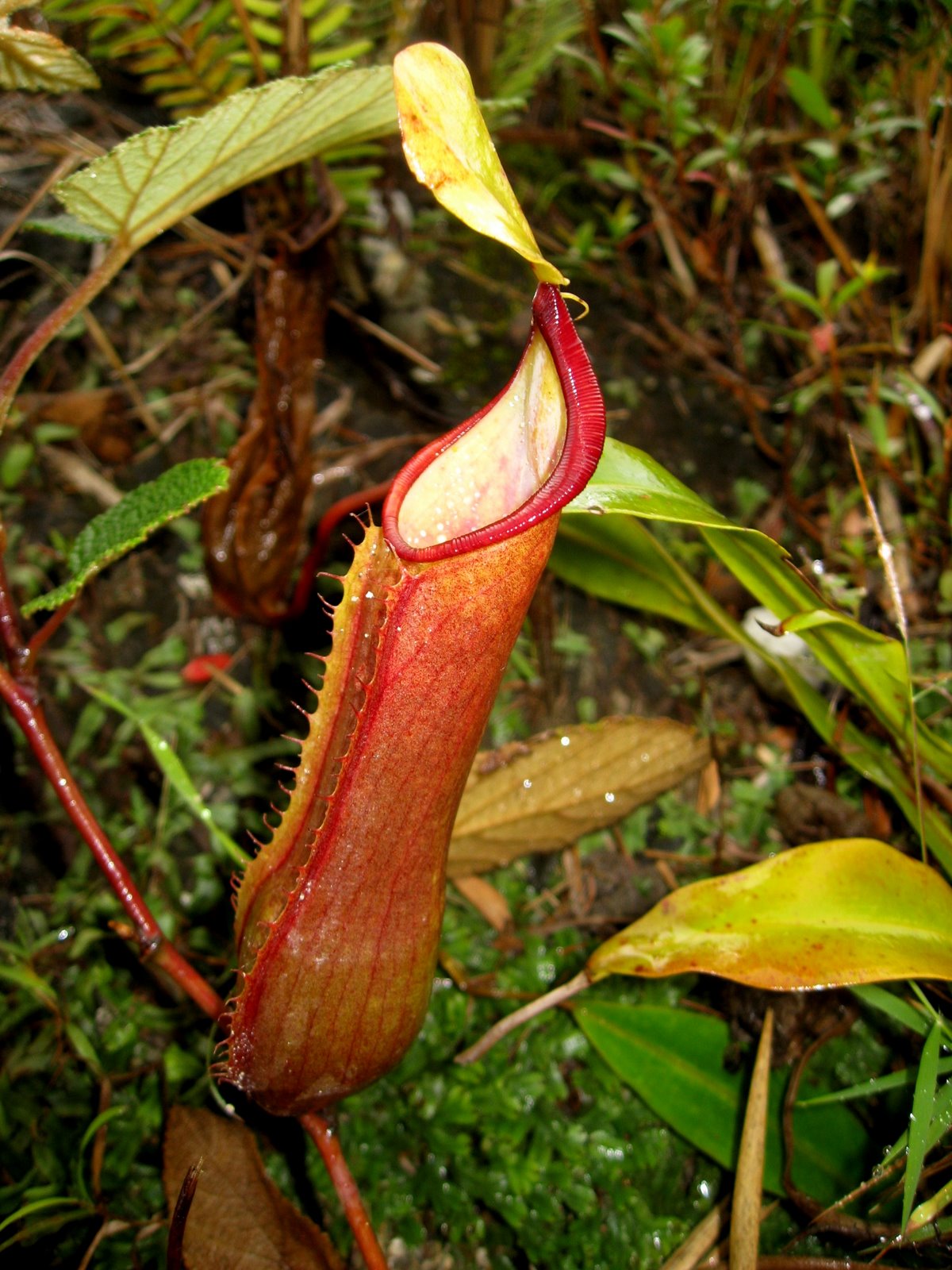
A slender climber to about 5 m, with a thin, usually slightly zigzag stem of 1.5 to 4 mm and distinct axillary buds. The stem is glabrous apart from conspicuous tufts of white hair in the leaf axils. Leaves are leathery, sessile, often reflexed, narrowly elliptic to oblanceolate, 5.5 to 14 cm long and to 2 cm wide. Lower pitchers are ellipsoid below and cylindrical above, around 8.5 cm tall and 2.7 cm wide, with two fringed wings to 5 mm and a thin, rounded peristome of 0.5 to 1.2 mm. Upper pitchers are 6 to 10 cm long (to 13 cm), 1.3 to 2.2 cm wide at the base, slightly constricted at the middle and widening again to the mouth. The spur is undivided, or two- or three-pointed. Colour is light green or yellowish green with red parts, rarely wholly red or wholly green; some plants have a bright red lid underside.
Similar species
Nepenthes mikei is darker, almost black, has narrower blades, a short inflorescence with one-flowered pedicels and a spur split into several threads. N. angasanensis forms underground runners. N. gracilis and N. reinwardtiana from the lowlands have other pitcher shapes, and N. reinwardtiana has the characteristic eye-spots in its upper pitchers. N. adnata from West Sumatra resembles N. tobaica but differs in stem and blade. N. gymnamphora has a broad, ribbed peristome with distinct teeth.
The trap and how it works
A small tubular trap with a narrow peristome. Lower pitchers in the litter mainly catch ants and other walking animals; upper pitchers, hanging in the sun at the forest edge, also take flying insects. Nectar glands on the rim and under the lid lure the prey; the bright red lid underside of some plants makes those glands extra conspicuous. The pitcher fluid harbours a rich infauna of small aquatic animals; a mite, Creutzeria tobaica, is named after this species and was described from its pitchers.
Habitat and ecology
Forest edges, open mountain forest and scrub (B5, B1), often among Leptospermum and Rhodomyrtus and in the shrub layer of old clearings; also in high-altitude peat-swamp forest (B4). According to Cheek & Jebb (2001) between 950 and 2750 m; Clarke (2001) records sites from 380 m. The species grows on the ground and is one of the few in this group that clearly benefits from disturbance: where forest has been cut or burnt and scrub returns, it can become abundant.
Distribution and elevation
Endemic to Sumatra. The core area lies in the north, from the Gayo lands in Aceh to around Tarutung south of Lake Toba; Cheek & Jebb (2001) give the range as Lake Toba to Gunung Leuser. Populations have since been found around Gunung Sorik Marapi and near Lake Kerinci in Jambi, far south of the main area. The world checklist gives Sumatra as its only area.
- Recorded (one-degree cells)
Forms and variation
No varieties have been described, but colour varies greatly: from wholly green to almost wholly red pitchers, and plants with a red lid alongside others with a green one. The spur also varies from undivided to three-toothed. Natural hybrids are known with N. ampullaria, N. reinwardtiana, N. rhombicaulis, N. spathulata and N. spectabilis. Thanks to its wide altitudinal range the species comes into contact with both lowland and highland species.
Where and when to see it
The shores and slopes around Lake Toba are the easiest place: look along road verges and in the scrub of old clearings, where the species often stands in numbers. The pitchers are small and hang among the low scrub; the white hair tufts in the leaf axils and the zigzag stem help with recognition. Anyone wanting to see the mite Creutzeria tobaica needs a hand lens: the animals live in the pitcher fluid.
Conservation status
Assessed on the Red List as Least Concern (2018 assessment): the species is widespread, very numerous around Lake Toba, and benefits from disturbed vegetation. As a member of the genus it is listed in CITES Appendix II. Where scrub is converted to farmland or plantations, populations disappear, but as long as there are forest edges and fallow slopes the species is not threatened.
Scientific name
Nepenthes tobaica | Danser, 1928
Described by B.H. Danser in 1928, in "The Nepenthaceae of the Netherlands Indies" (Bulletin du Jardin Botanique de Buitenzorg, series III, volume 9, no. 3-4, p. 249-438). Lectotype collected by Johannes Elias Teijsmann on 8 February 1856, probably in the Batak regions of Sumatra (specimen H.L.B. 908,155-1106); the lectotype was only formally designated in 1997, by Jebb & Cheek. No precise coordinates are known. The species occurs from the Gayo lands (Aceh) to Tarutung, at 380-1800 m elevation. Named after Lake Toba, Sumatra, where the plant is particularly abundant.
World Checklist of Vascular Plants (WCVP), via Plants of the World Online (POWO), Royal Botanic Gardens, Kew.